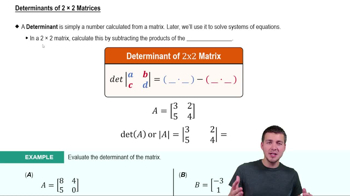
Identify the matrix from which the determinant needs to be calculated. If the matrix is a 2x2 matrix, represented as \( \begin{bmatrix} a & b \\ c & d \end{bmatrix} \), then the determinant is calculated using the formula \( ad - bc \).
If the matrix is a 3x3 matrix, represented as \( \begin{bmatrix} a & b & c \\ d & e & f \\ g & h & i \end{bmatrix} \), use the formula \( a(ei − fh) − b(di − fg) + c(dh − eg) \) to find the determinant.
For matrices larger than 3x3, use the method of cofactor expansion, which involves expanding the determinant along a row or column and calculating the determinants of the smaller matrices (minors) recursively.
Check for any rows or columns containing zeros, as these can simplify the calculation of the determinant. Expanding along a row or column with zeros reduces the number of terms you need to calculate.
After calculating the determinant using the appropriate method, interpret the result in the context of the problem. A determinant can provide information about the properties of the matrix, such as whether it is invertible (a non-zero determinant) or singular (a zero determinant).
Verified video answer for a similar problem:
This video solution was recommended by our tutors as helpful for the problem above
Video duration:
1m
Play a video:
Was this helpful?
Key Concepts
Here are the essential concepts you must grasp in order to answer the question correctly.
Determinants
A determinant is a scalar value that can be computed from the elements of a square matrix. It provides important information about the matrix, such as whether it is invertible and the volume scaling factor of the linear transformation represented by the matrix. The determinant can be calculated using various methods, including row reduction, cofactor expansion, or leveraging properties of determinants.
Matrix operations, including addition, subtraction, and multiplication, are fundamental in linear algebra. Understanding how to manipulate matrices is essential for evaluating determinants, as the properties of these operations can simplify calculations. For instance, the determinant of a product of matrices equals the product of their determinants, which can be useful in complex evaluations.
Cofactor expansion is a method used to calculate the determinant of a matrix by breaking it down into smaller matrices. This technique involves selecting a row or column, multiplying each element by its corresponding cofactor (which is the determinant of the submatrix formed by removing the row and column of that element), and summing these products. It is particularly useful for larger matrices where direct computation is cumbersome.