Evaluate each determinant in Exercises 1–10. 1/2 1/21/8 - 3/4
Verified step by step guidance
1
Identify the elements of the 2x2 matrix: a = \frac{1}{2}, b = \frac{1}{2}, c = \frac{1}{8}, d = -\frac{3}{4}.
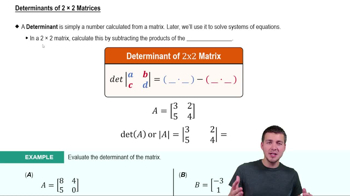
Recall the formula for the determinant of a 2x2 matrix: det(A) = ad - bc.
Substitute the values into the formula: det(A) = \left(\frac{1}{2}\right)\left(-\frac{3}{4}\right) - \left(\frac{1}{2}\right)\left(\frac{1}{8}\right).
Calculate the product of a and d: \frac{1}{2} \times -\frac{3}{4}.
Calculate the product of b and c: \frac{1}{2} \times \frac{1}{8}.
Verified video answer for a similar problem:
This video solution was recommended by our tutors as helpful for the problem above
Video duration:
1m
Play a video:
Was this helpful?
Key Concepts
Here are the essential concepts you must grasp in order to answer the question correctly.
Determinants
A determinant is a scalar value that can be computed from the elements of a square matrix. It provides important information about the matrix, such as whether it is invertible and the volume scaling factor of the linear transformation represented by the matrix. For a 2x2 matrix, the determinant can be calculated using the formula ad - bc, where a, b, c, and d are the elements of the matrix.
Matrices are rectangular arrays of numbers arranged in rows and columns. In the context of determinants, a 2x2 matrix is represented as [[a, b], [c, d]]. Understanding how to read and interpret matrix notation is essential for evaluating determinants and performing operations such as addition, multiplication, and finding inverses.
Determinants have several key properties that simplify calculations. For instance, the determinant of a matrix is zero if the rows (or columns) are linearly dependent. Additionally, swapping two rows of a matrix changes the sign of the determinant, while multiplying a row by a scalar multiplies the determinant by that scalar. These properties are crucial for efficiently evaluating determinants and understanding their implications in linear algebra.