Evaluate each expression. See Example 7. (-64/27)1/3
Verified step by step guidance
1
Recognize that the expression \(\left(-\frac{64}{27}\right)^{\frac{1}{3}}\) represents the cube root of the fraction \(-\frac{64}{27}\).
Recall the property of exponents that allows you to take the cube root of a fraction by taking the cube root of the numerator and the denominator separately: \(\left(\frac{a}{b}\right)^{\frac{1}{3}} = \frac{a^{\frac{1}{3}}}{b^{\frac{1}{3}}}\).
Apply this property to rewrite the expression as \(\frac{(-64)^{\frac{1}{3}}}{27^{\frac{1}{3}}}\).
Find the cube root of the numerator \(-64\). Since \$64 = 4^3\(, the cube root of \)-64\( is \)-4$ because the cube root of a negative number is negative.
Find the cube root of the denominator \$27\(. Since \)27 = 3^3\(, the cube root of \)27\( is \)3\(. Combine these results to express the simplified form as \)\frac{-4}{3}$.
Verified video answer for a similar problem:
This video solution was recommended by our tutors as helpful for the problem above
Video duration:
2m
Play a video:
Was this helpful?
Key Concepts
Here are the essential concepts you must grasp in order to answer the question correctly.
Rational Exponents
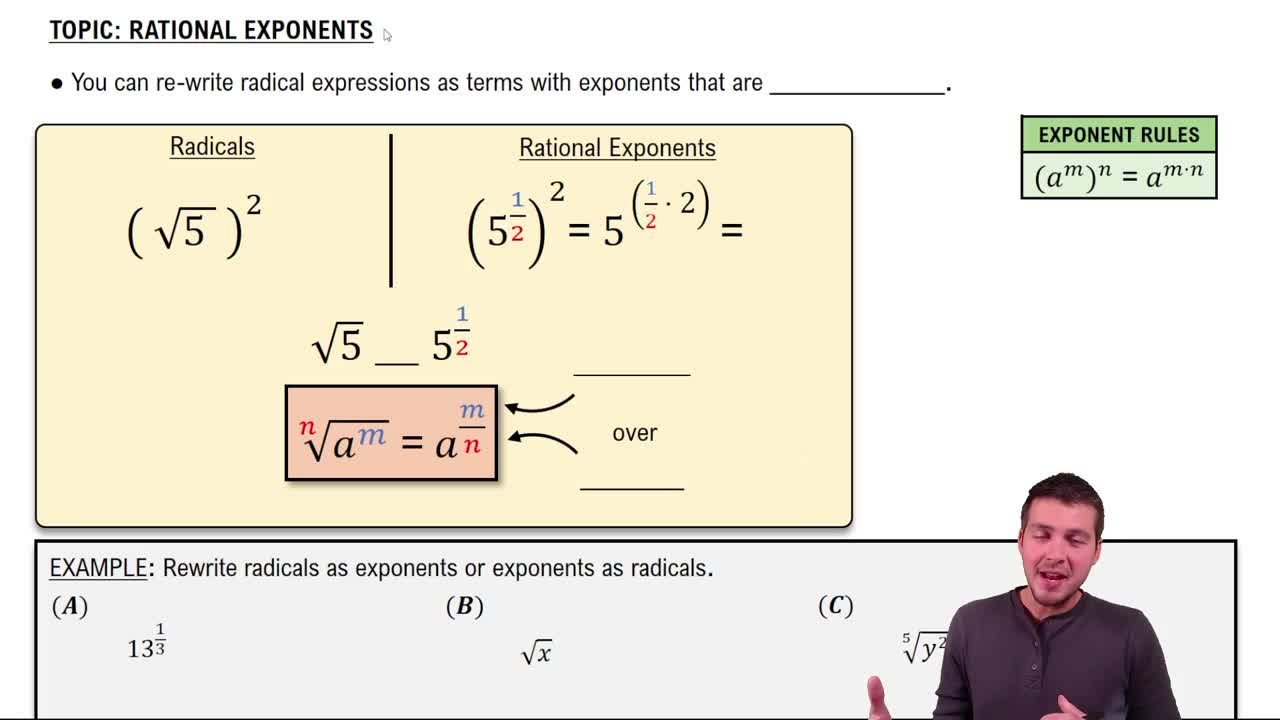
Rational exponents represent roots and powers combined. An expression like a^(m/n) means the nth root of a raised to the mth power. For example, a^(1/3) is the cube root of a, and a^(2/3) is the cube root of a squared.
The cube root of a negative number is also negative because cubing a negative number results in a negative number. For instance, the cube root of -64 is -4 since (-4)^3 = -64. This differs from even roots, which are not real for negative numbers.
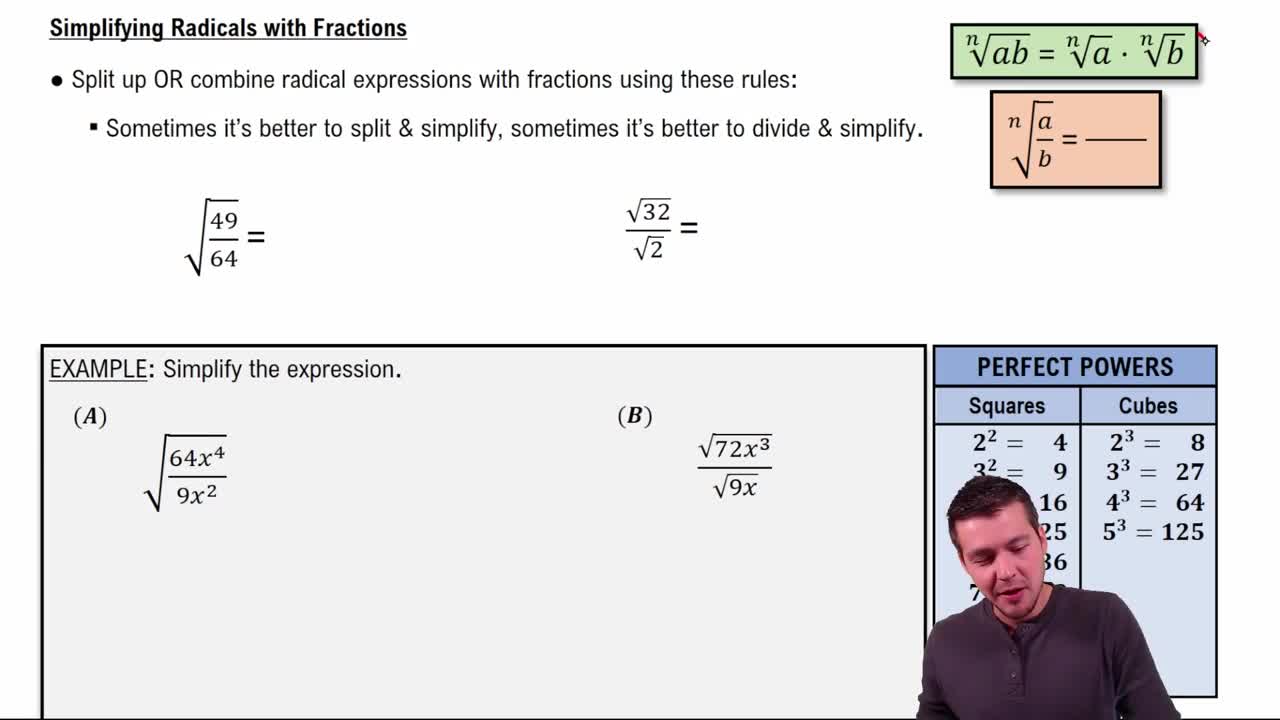
When dealing with fractional bases raised to powers, apply the exponent to both numerator and denominator separately. For example, (a/b)^(m/n) = (a^(m/n)) / (b^(m/n)). This helps simplify expressions like (-64/27)^(1/3) by taking cube roots of numerator and denominator individually.