Identify the expression given: \((-4)^{\frac{1}{2}}\). This means we are looking for the square root of -4 because an exponent of \(\frac{1}{2}\) corresponds to the square root.
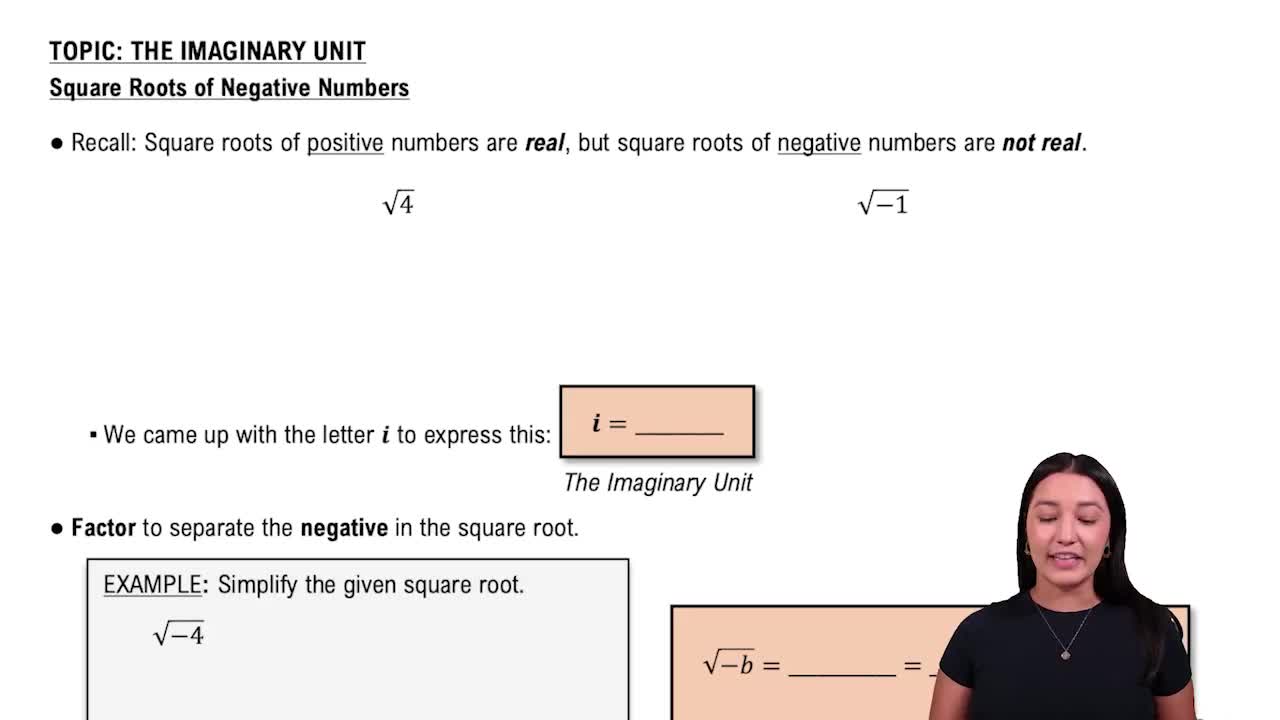
Recall that the square root of a negative number is not a real number, but an imaginary number. Specifically, \(\sqrt{-a} = i\sqrt{a}\) where \(i\) is the imaginary unit with the property \(i^2 = -1\).
Rewrite the expression using the imaginary unit: \((-4)^{\frac{1}{2}} = \sqrt{-4} = \sqrt{4 \times -1} = \sqrt{4} \times \sqrt{-1}\).
Calculate the square root of 4, which is 2, and recognize that \(\sqrt{-1} = i\). So the expression becomes \$2i$.
Therefore, the value of \((-4)^{\frac{1}{2}}\) is expressed in terms of the imaginary unit as \$2i$.
Verified video answer for a similar problem:
This video solution was recommended by our tutors as helpful for the problem above
Video duration:
1m
Play a video:
Was this helpful?
Key Concepts
Here are the essential concepts you must grasp in order to answer the question correctly.
Exponents and Powers
Exponents indicate how many times a base number is multiplied by itself. For example, a^n means multiplying 'a' by itself 'n' times. Understanding how to interpret and manipulate exponents is essential for evaluating expressions like (-4)^(1/2).
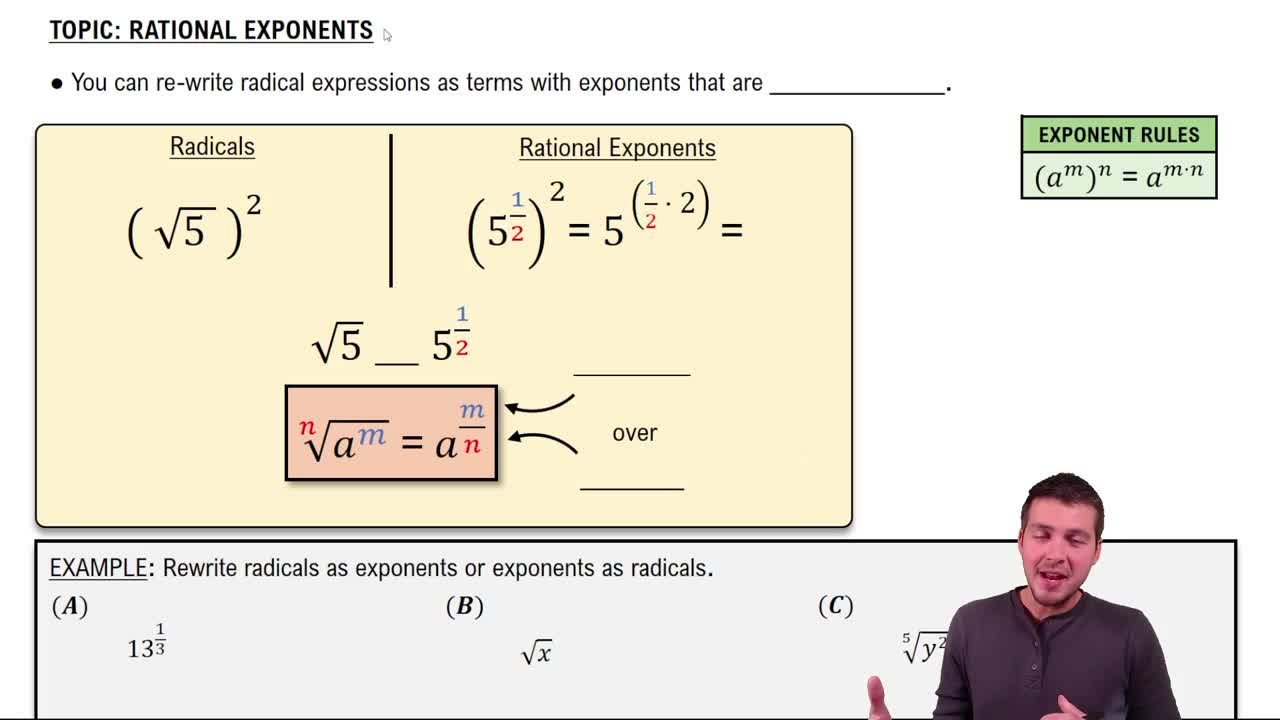
A fractional exponent such as 1/2 represents a root; specifically, a^(1/2) is the square root of 'a'. This means evaluating (-4)^(1/2) involves finding the square root of -4, which requires understanding roots of negative numbers.
Since the square root of a negative number is not real, it involves complex numbers. The imaginary unit 'i' is defined as √(-1), allowing expressions like √(-4) to be written as 2i. Recognizing when to use complex numbers is crucial for evaluating roots of negative bases.