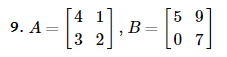
In Exercises 9 - 16, find the following matrices: a. A + B
Verified step by step guidance
1
Step 1: Understand that matrix addition involves adding corresponding elements from each matrix. Both matrices A and B must have the same dimensions, which they do here (2 rows and 2 columns).
Step 2: Write down the matrices clearly:
A = \( \begin{bmatrix} 4 & 1 \\ 3 & 2 \end{bmatrix} \),
B = \( \begin{bmatrix} 5 & 9 \\ 0 & 7 \end{bmatrix} \).
Step 3: Add the elements in the first row and first column: 4 (from A) + 5 (from B) = 4 + 5.
Step 4: Add the elements in the first row and second column: 1 (from A) + 9 (from B) = 1 + 9.
Step 5: Repeat the process for the second row: 3 + 0 for the first column, and 2 + 7 for the second column.
Verified video answer for a similar problem:
This video solution was recommended by our tutors as helpful for the problem above
Video duration:
2m
Play a video:
Was this helpful?
Key Concepts
Here are the essential concepts you must grasp in order to answer the question correctly.
Matrix Addition
Matrix addition involves adding corresponding elements from two matrices of the same dimensions. Each element in the resulting matrix is the sum of elements in the same position from the original matrices. This operation is only defined when both matrices have the same number of rows and columns.
The dimension of a matrix is given by the number of rows and columns it contains, expressed as 'rows × columns'. For matrix addition, both matrices must have identical dimensions to ensure each element corresponds correctly for addition.
Element-wise operations on matrices, such as addition, require performing the operation on each pair of corresponding elements individually. Understanding this helps in correctly computing the sum of matrices by focusing on each element's position.