Table of contents
- 0. Review of Algebra4h 18m
- 1. Equations & Inequalities3h 18m
- 2. Graphs of Equations1h 43m
- 3. Functions2h 17m
- 4. Polynomial Functions1h 44m
- 5. Rational Functions1h 23m
- 6. Exponential & Logarithmic Functions2h 28m
- 7. Systems of Equations & Matrices4h 5m
- 8. Conic Sections2h 23m
- 9. Sequences, Series, & Induction1h 22m
- 10. Combinatorics & Probability1h 45m
3. Functions
Transformations
Problem 82
Textbook Question
Begin by graphing the absolute value function, f(x) = |x|. Then use transformations of this graph to graph the given function. g(x) = |x|+3
Verified step by step guidance1
Start by graphing the parent function f(x) = |x|. This is the absolute value function, which forms a V-shaped graph with its vertex at the origin (0, 0). The graph opens upwards, with the left side having a slope of -1 and the right side having a slope of 1.
Understand the transformation applied to the parent function. The given function g(x) = |x| + 3 adds a constant value of 3 to the output of the absolute value function. This is a vertical shift.
Apply the vertical shift to the graph of f(x) = |x|. To do this, move every point on the graph of f(x) = |x| upward by 3 units. For example, the vertex (0, 0) of f(x) = |x| will move to (0, 3).
Adjust the slopes of the graph accordingly. The left side of the graph will still have a slope of -1, and the right side will still have a slope of 1, but the entire graph is now shifted upward.
Sketch the transformed graph of g(x) = |x| + 3. Label the vertex at (0, 3) and ensure the V-shape is preserved, with the left and right sides extending as described.
Verified video answer for a similar problem:This video solution was recommended by our tutors as helpful for the problem above
Video duration:
1mPlay a video:
Was this helpful?
Key Concepts
Here are the essential concepts you must grasp in order to answer the question correctly.
Absolute Value Function
The absolute value function, denoted as f(x) = |x|, outputs the non-negative value of x. This function has a V-shaped graph that opens upwards, with its vertex at the origin (0,0). Understanding this function is crucial as it serves as the foundation for graphing transformations.
Recommended video:
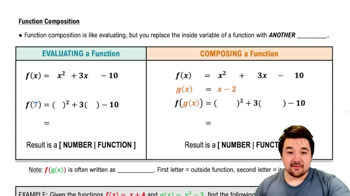
Function Composition
Graph Transformations
Graph transformations involve shifting, reflecting, stretching, or compressing the graph of a function. In this case, adding a constant (like +3) to the absolute value function translates the graph vertically upwards by 3 units. Recognizing how these transformations affect the graph is essential for accurately sketching the new function.
Recommended video:
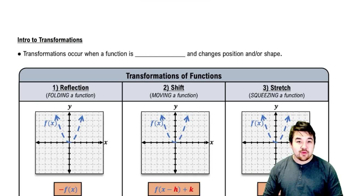
Intro to Transformations
Vertical Shift
A vertical shift occurs when a constant is added to or subtracted from a function's output. For g(x) = |x| + 3, the entire graph of f(x) = |x| is moved up by 3 units. This concept is important for understanding how the position of the graph changes without altering its shape.
Recommended video:
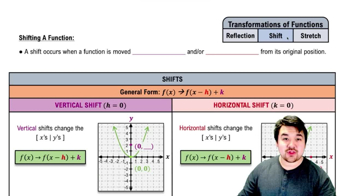
Shifts of Functions
Watch next
Master Intro to Transformations with a bite sized video explanation from Patrick
Start learningRelated Videos
Related Practice
Textbook Question
Graph each function. See Examples 6–8 and the Summary of Graphing Techniques box following Example 9. h(x)=-(x+1)^3
539
views