Show that each polynomial function has a real zero as described in parts (a) and (b). In Exercises 31 and 32, also work part (c). ƒ(x)=3x^3-8x^2+x+2 between -1 and 0
Table of contents
- 0. Review of Algebra4h 18m
- 1. Equations & Inequalities3h 18m
- 2. Graphs of Equations1h 43m
- 3. Functions2h 17m
- 4. Polynomial Functions1h 44m
- 5. Rational Functions1h 23m
- 6. Exponential & Logarithmic Functions2h 28m
- 7. Systems of Equations & Matrices4h 5m
- 8. Conic Sections2h 23m
- 9. Sequences, Series, & Induction1h 22m
- 10. Combinatorics & Probability1h 45m
4. Polynomial Functions
Zeros of Polynomial Functions
Problem 32a
Textbook Question
Show that each polynomial function has a real zero as described in parts (a) and (b). In Exercises 31 and 32, also work part (c). ƒ(x)=4x3-37x2+50x+60 between 2 and 3
Verified step by step guidance1
First, identify the polynomial function given: \(f(x) = 4x^3 - 37x^2 + 50x + 60\).
Evaluate the function at the endpoints of the interval given, which are \(x=2\) and \(x=3\). Calculate \(f(2)\) and \(f(3)\) by substituting these values into the polynomial.
Check the signs of \(f(2)\) and \(f(3)\). If \(f(2)\) and \(f(3)\) have opposite signs (one positive and one negative), then by the Intermediate Value Theorem, there must be at least one real zero between 2 and 3.
Explain the Intermediate Value Theorem: it states that if a continuous function changes sign over an interval, it must cross zero at some point within that interval.
Conclude that since polynomial functions are continuous everywhere, and if the sign change is confirmed, the function \(f(x)\) has at least one real zero between 2 and 3.
Verified video answer for a similar problem:This video solution was recommended by our tutors as helpful for the problem above
Video duration:
4mPlay a video:
Was this helpful?
Key Concepts
Here are the essential concepts you must grasp in order to answer the question correctly.
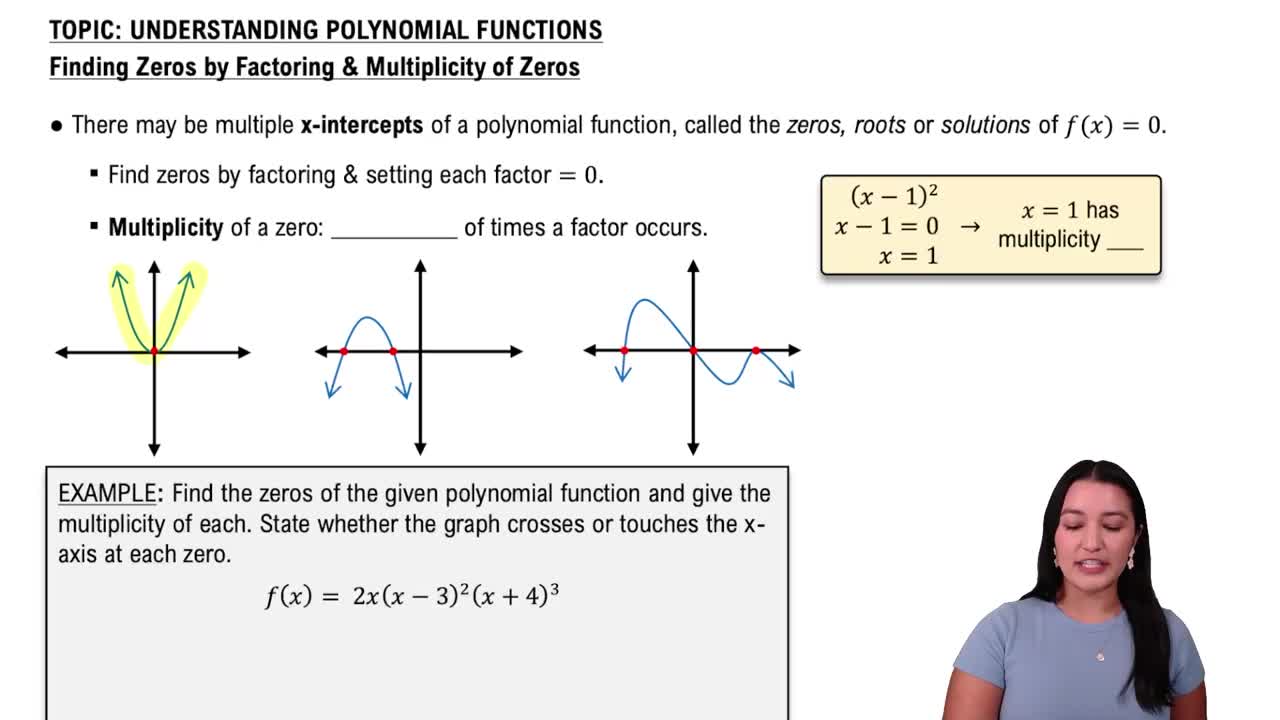
Polynomial Functions and Their Zeros
A polynomial function is an expression involving variables raised to whole-number exponents with coefficients. The zeros of a polynomial are the values of x for which the function equals zero. Understanding how to find or estimate these zeros is essential for analyzing the behavior of the function.
Recommended video:
Finding Zeros & Their Multiplicity
Intermediate Value Theorem
The Intermediate Value Theorem states that if a continuous function changes sign over an interval [a, b], then it must have at least one root in that interval. This theorem is useful for proving the existence of a zero between two points by evaluating the function's values at those points.
Recommended video:
Introduction to Hyperbolas
Evaluating Polynomial Functions at Specific Points
To apply the Intermediate Value Theorem, you need to calculate the polynomial's value at given points. By substituting x-values into the polynomial and finding the sign of the output, you can determine if a zero lies between those points based on a sign change.
Recommended video:
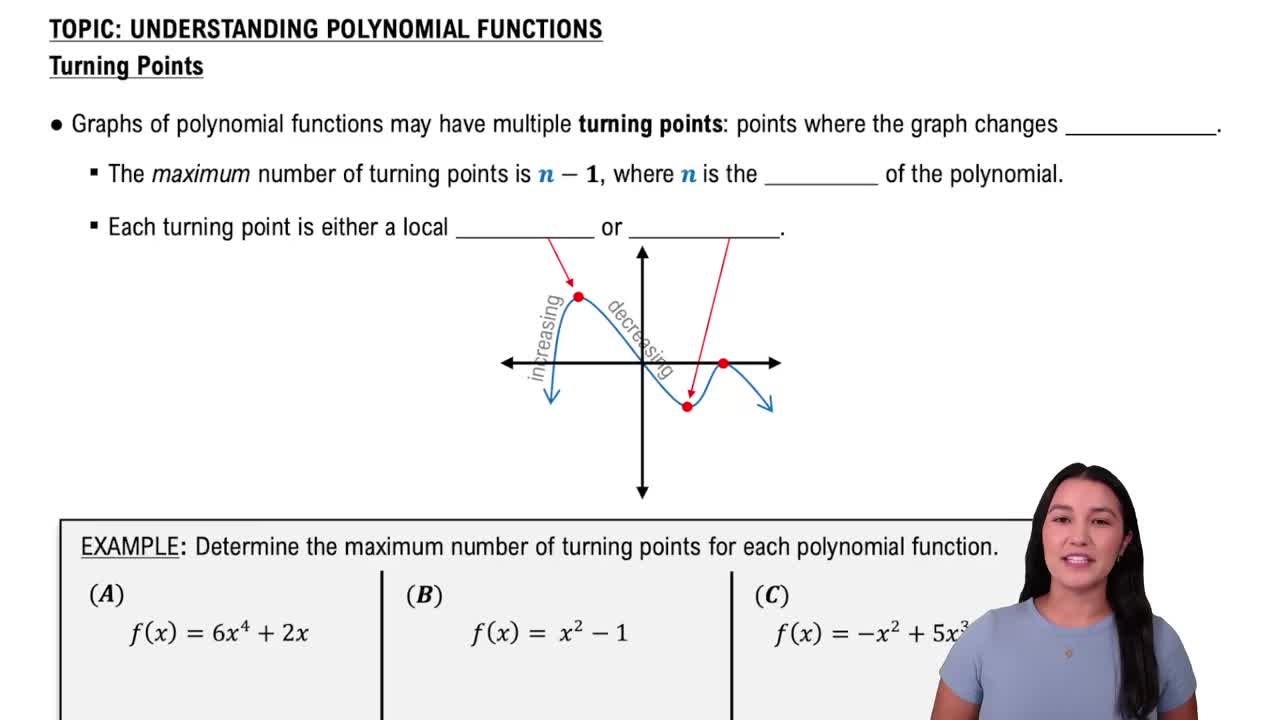
Maximum Turning Points of a Polynomial Function
Related Videos
Related Practice
Textbook Question
219
views