Table of contents
- 0. Review of Algebra4h 18m
- 1. Equations & Inequalities3h 18m
- 2. Graphs of Equations1h 43m
- 3. Functions2h 17m
- 4. Polynomial Functions1h 44m
- 5. Rational Functions1h 23m
- 6. Exponential & Logarithmic Functions2h 28m
- 7. Systems of Equations & Matrices4h 5m
- 8. Conic Sections2h 23m
- 9. Sequences, Series, & Induction1h 22m
- 10. Combinatorics & Probability1h 45m
6. Exponential & Logarithmic Functions
Properties of Logarithms
Problem 95
Textbook Question
In Exercises 89–102, determine whether each equation is true or false. Where possible, show work to support your conclusion. If the statement is false, make the necessary change(s) to produce a true statement. ln(5x) + ln 1 = ln(5x)
Verified step by step guidance1
Recall the logarithmic property that states: . This means the sum of two natural logarithms is the natural logarithm of the product of their arguments.
Apply this property to the left side of the equation: .
Recognize that because the natural logarithm of 1 is always zero.
Since the left side simplifies to , and the right side is also , the equation is true as written.
Therefore, no changes are necessary to make the statement true.
Verified video answer for a similar problem:This video solution was recommended by our tutors as helpful for the problem above
Video duration:
1mPlay a video:
Was this helpful?
Key Concepts
Here are the essential concepts you must grasp in order to answer the question correctly.
Properties of Logarithms
Logarithms have specific properties that simplify expressions, such as the product rule: ln(a) + ln(b) = ln(ab). Understanding these rules helps in combining or breaking down logarithmic expressions correctly.
Recommended video:
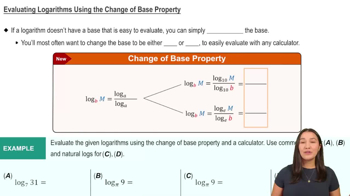
Change of Base Property
Logarithm of One
The natural logarithm of 1, ln(1), is always 0 because e^0 = 1. Recognizing this fact is essential when simplifying logarithmic expressions involving ln(1).
Recommended video:
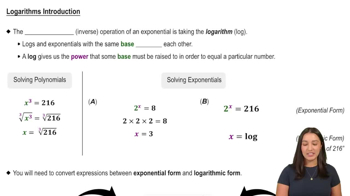
Logarithms Introduction
Equation Verification and Simplification
To determine if an equation involving logarithms is true, simplify both sides using logarithmic properties and evaluate constants. This process helps verify the equality or identify necessary corrections.
Recommended video:
Categorizing Linear Equations
Watch next
Master Product, Quotient, and Power Rules of Logs with a bite sized video explanation from Patrick
Start learningRelated Videos
Related Practice
Textbook Question
Let u = ln a and v = ln b. Write each expression in terms of u and v without using the ln function. ln √(a^3/b^5)
623
views