In Exercises 37–52, perform the indicated operations and write the result in standard form. (3√-5)(- 4√-12)
Table of contents
- 0. Review of Algebra4h 18m
- 1. Equations & Inequalities3h 18m
- 2. Graphs of Equations1h 43m
- 3. Functions2h 17m
- 4. Polynomial Functions1h 44m
- 5. Rational Functions1h 23m
- 6. Exponential & Logarithmic Functions2h 28m
- 7. Systems of Equations & Matrices4h 5m
- 8. Conic Sections2h 23m
- 9. Sequences, Series, & Induction1h 22m
- 10. Combinatorics & Probability1h 45m
1. Equations & Inequalities
The Imaginary Unit
Problem 67
Textbook Question
In Exercises 65–70, perform the indicated operation(s) and write the result in standard form. (2 + i)2 - (3 - i)2
Verified step by step guidance1
Step 1: Recall the formula for squaring a binomial: \((a + b)^2 = a^2 + 2ab + b^2\). Apply this formula to \((2 + i)^2\), where \(a = 2\) and \(b = i\). Expand it as \(2^2 + 2(2)(i) + i^2\).
Step 2: Simplify \((2 + i)^2\) by calculating each term: \(2^2 = 4\), \(2(2)(i) = 4i\), and \(i^2 = -1\) (since \(i^2 = -1\) by definition of the imaginary unit). Combine these to get \(4 + 4i - 1\).
Step 3: Simplify \(4 + 4i - 1\) to \(3 + 4i\). This is the result of \((2 + i)^2\).
Step 4: Similarly, apply the formula for squaring a binomial to \((3 - i)^2\), where \(a = 3\) and \(b = -i\). Expand it as \(3^2 + 2(3)(-i) + (-i)^2\).
Step 5: Simplify \((3 - i)^2\) by calculating each term: \(3^2 = 9\), \(2(3)(-i) = -6i\), and \((-i)^2 = -1\). Combine these to get \(9 - 6i - 1\), which simplifies to \(8 - 6i\). Subtract \((3 - i)^2\) from \((2 + i)^2\) to get \((3 + 4i) - (8 - 6i)\), and simplify the real and imaginary parts separately.
Verified video answer for a similar problem:This video solution was recommended by our tutors as helpful for the problem above
Video duration:
4mPlay a video:
Was this helpful?
Key Concepts
Here are the essential concepts you must grasp in order to answer the question correctly.
Complex Numbers
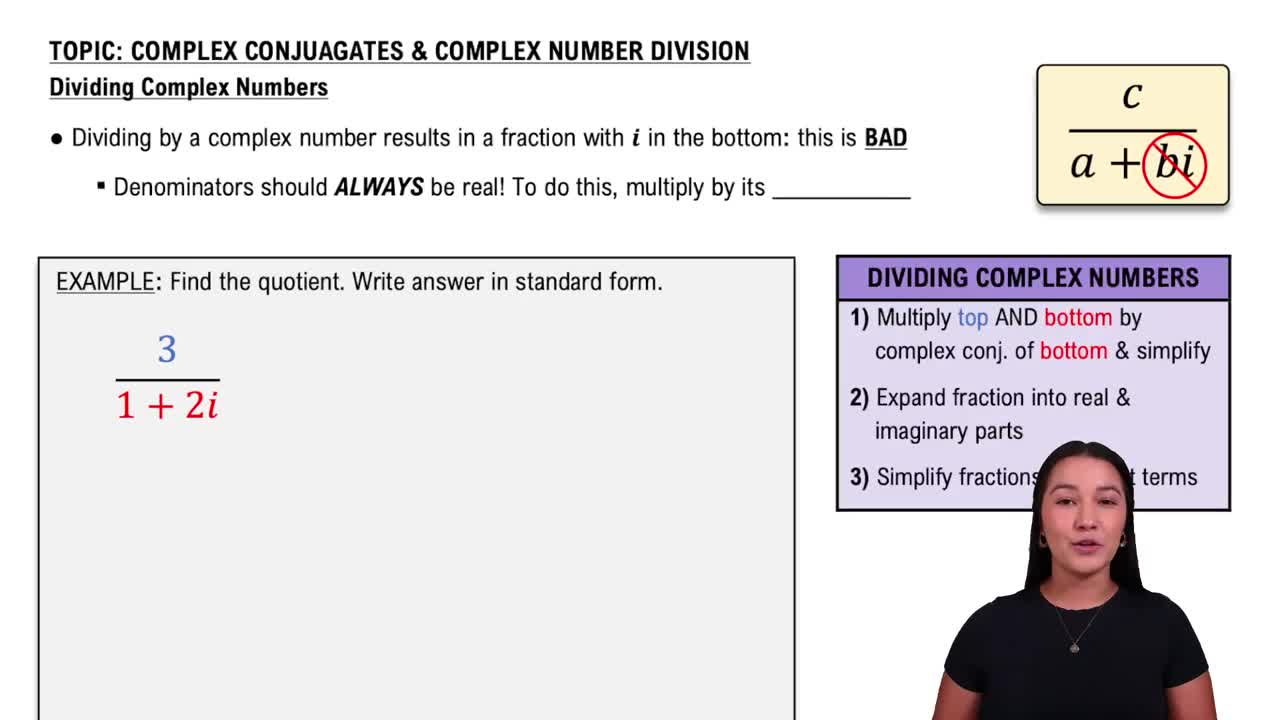
Complex numbers are numbers that have a real part and an imaginary part, expressed in the form a + bi, where a is the real part, b is the imaginary part, and i is the imaginary unit defined as the square root of -1. Understanding how to manipulate complex numbers is essential for performing operations such as addition, subtraction, multiplication, and division.
Recommended video:
Dividing Complex Numbers
Standard Form of Complex Numbers
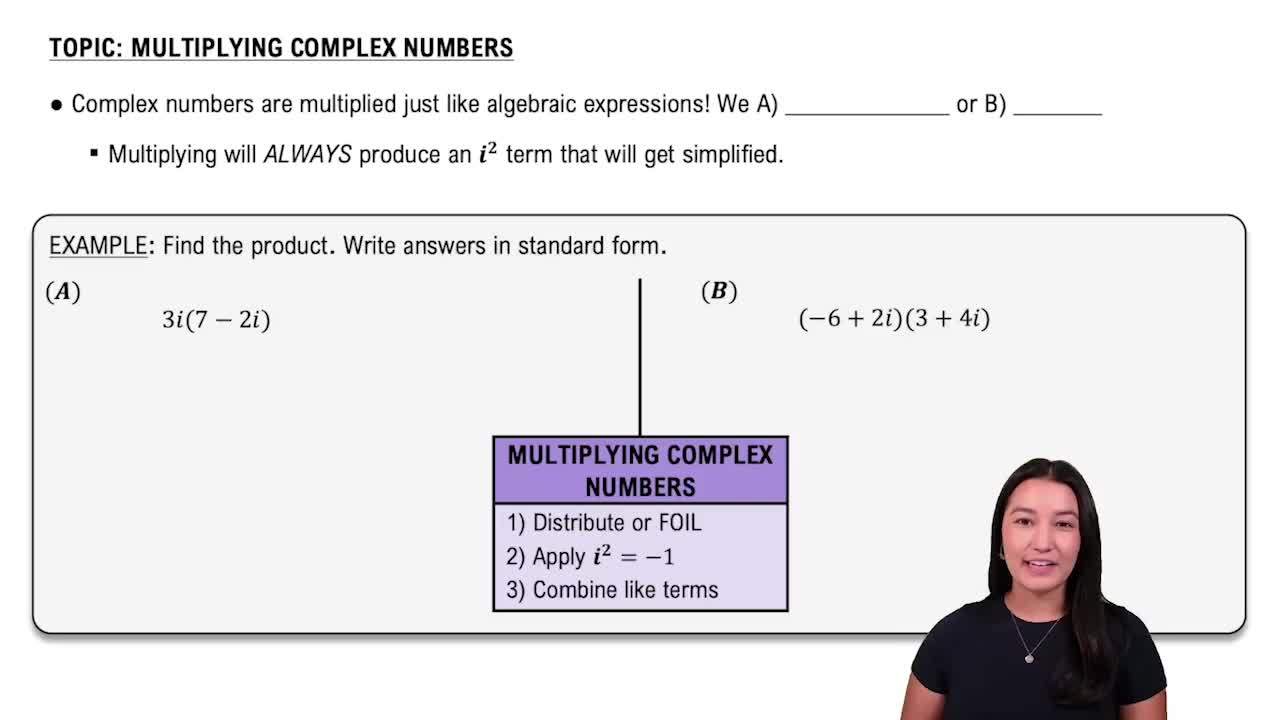
The standard form of a complex number is a + bi, where a and b are real numbers. When performing operations on complex numbers, it is important to express the final result in this form to clearly identify the real and imaginary components. This helps in further calculations and interpretations in complex number theory.
Recommended video:
Multiplying Complex Numbers
Binomial Expansion
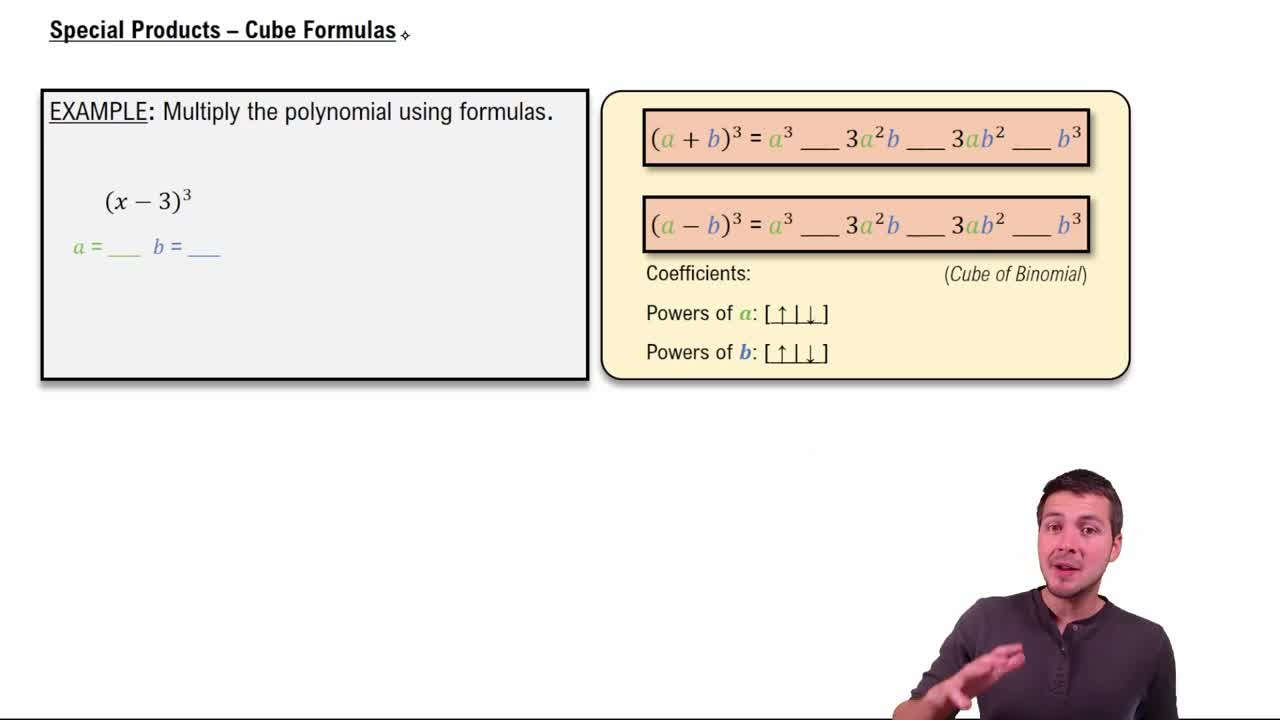
Binomial expansion refers to the process of expanding expressions that are raised to a power, such as (a + b)^n. In the context of complex numbers, this involves applying the formula (x + y)^2 = x^2 + 2xy + y^2 to simplify expressions like (2 + i)^2 and (3 - i)^2. Mastery of this concept is crucial for accurately calculating the squares of binomials.
Recommended video:
Guided course
Special Products - Cube Formulas
Watch next
Master Square Roots of Negative Numbers with a bite sized video explanation from Patrick
Start learningRelated Videos
Related Practice
Textbook Question
137
views