For the pair of functions defined, find (ƒ/g)(x). Give the domain of each. See Example 2. ƒ(x)=2x^2-3x, g(x)=x^2-x+3
Verified step by step guidance
1
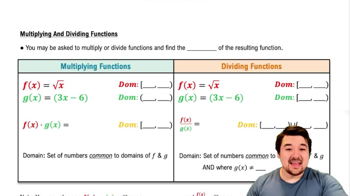
First, recall that the operation (ƒ/g)(x) means the quotient of the two functions, which is given by the formula: \[(\frac{ƒ}{g})(x) = \frac{ƒ(x)}{g(x)}\]
Substitute the given functions into the quotient: \[(\frac{ƒ}{g})(x) = \frac{2x^2 - 3x}{x^2 - x + 3}\]
Next, simplify the expression if possible by factoring the numerator and denominator and canceling any common factors. For the numerator, factor out the common term: \[2x^2 - 3x = x(2x - 3)\]. Check if the denominator can be factored as well.
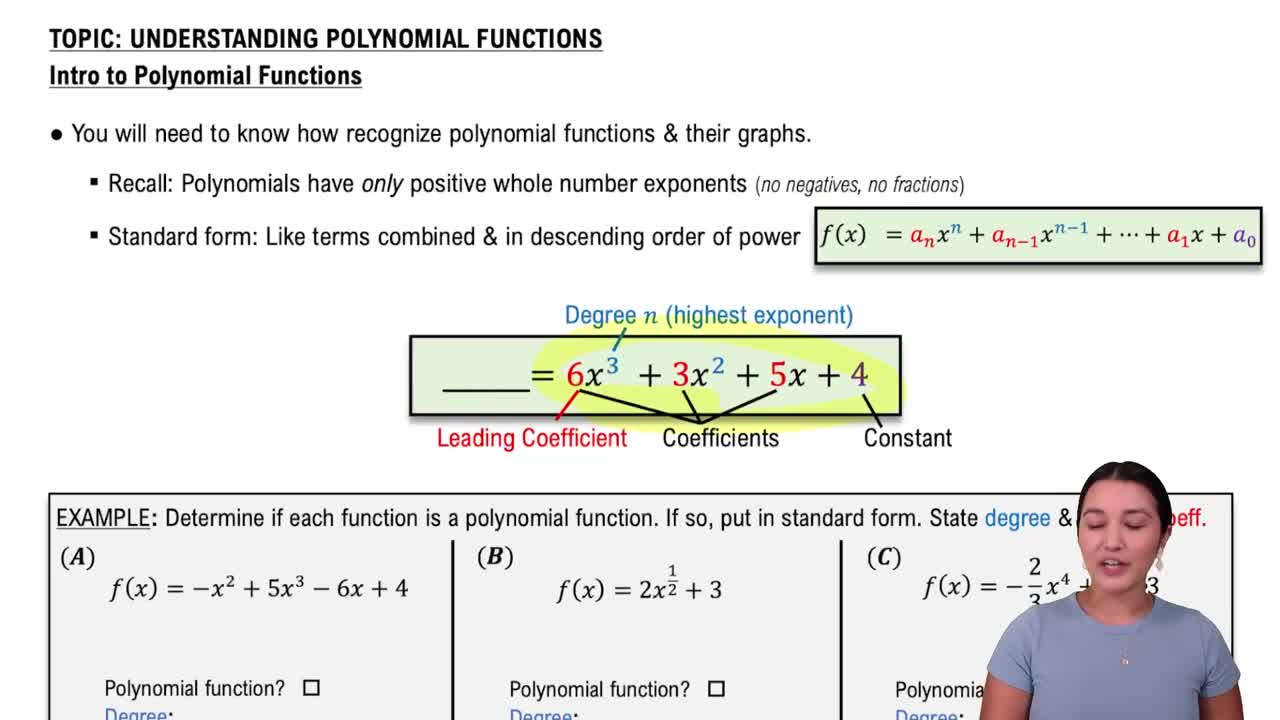
Determine the domain of each function separately. For \(ƒ(x) = 2x^2 - 3x\), since it is a polynomial, its domain is all real numbers: \[(-\infty, \infty)\].
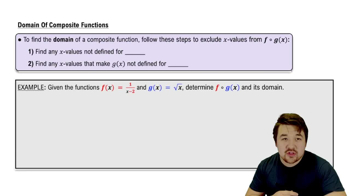
For \(g(x) = x^2 - x + 3\), also a polynomial, the domain is all real numbers. However, for the quotient \((ƒ/g)(x)\), the domain excludes values where \(g(x) = 0\) because division by zero is undefined. Solve the equation \[x^2 - x + 3 = 0\] to find any such values and exclude them from the domain.
Verified video answer for a similar problem:
This video solution was recommended by our tutors as helpful for the problem above
Video duration:
4m
Play a video:
Was this helpful?
Key Concepts
Here are the essential concepts you must grasp in order to answer the question correctly.
Function Operations (Division of Functions)
Dividing two functions ƒ and g, denoted (ƒ/g)(x), means creating a new function by dividing the output of ƒ(x) by g(x). This operation is defined as (ƒ/g)(x) = ƒ(x) / g(x), where g(x) ≠ 0 to avoid division by zero.
The domain of a function is the set of all input values (x) for which the function is defined. For (ƒ/g)(x), the domain includes all x-values in the domains of ƒ and g, except where g(x) = 0, since division by zero is undefined.
Both ƒ(x) = 2x² - 3x and g(x) = x² - x + 3 are polynomial functions, which are defined for all real numbers. However, when dividing, the domain excludes values that make the denominator zero, so identifying zeros of g(x) is essential.