Determine whether each relation defines a function, and give the domain and range.
Verified step by step guidance
1
Step 1: Identify if the relation is a function by using the vertical line test. A relation is a function if every vertical line intersects the graph at most once.
Step 2: Observe the graph of the red line. Since it is a straight line with a positive slope and no vertical segments, any vertical line will intersect it exactly once.
Step 3: Conclude that the relation defines a function because it passes the vertical line test.
Step 4: Determine the domain by looking at the x-values covered by the graph. Since the line extends indefinitely in both directions along the x-axis, the domain is all real numbers, expressed as \((-\infty, \infty)\).
Step 5: Determine the range by looking at the y-values covered by the graph. Similarly, since the line extends indefinitely in both directions along the y-axis, the range is all real numbers, expressed as \((-\infty, \infty)\).
Verified video answer for a similar problem:
This video solution was recommended by our tutors as helpful for the problem above
Video duration:
1m
Play a video:
0 Comments
Key Concepts
Here are the essential concepts you must grasp in order to answer the question correctly.
Definition of a Function
A function is a relation where each input (x-value) corresponds to exactly one output (y-value). This means no x-value can be paired with more than one y-value. The vertical line test is a common method to determine if a graph represents a function.
The domain is the set of all possible input values (x-values) for which the function is defined. For a line extending infinitely in both directions, the domain is typically all real numbers, unless restricted by the context or graph.
The range is the set of all possible output values (y-values) that the function can produce. For a line with positive slope extending infinitely, the range is also all real numbers, as y-values increase and decrease without bound.

 1:53 minutes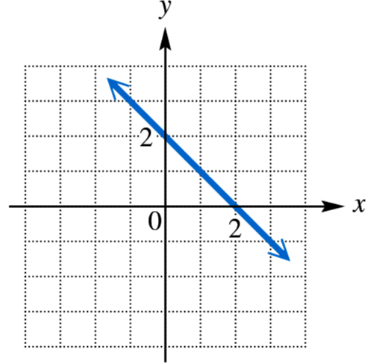
 Verified step by step guidance
 5:57
5:57