Graph each function. Give the domain and range. ƒ(x) = (1/3)x+2
Verified step by step guidance
1
Identify the function given: \(f(x) = \left(\frac{1}{3}\right)^{x+2}\). This is an exponential function with base \(\frac{1}{3}\), which is between 0 and 1, indicating exponential decay.
Determine the domain of the function. Since exponential functions are defined for all real numbers, the domain is all real numbers, expressed as \((-\infty, \infty)\).
Analyze the range of the function. Because \(\left(\frac{1}{3}\right)^{x+2}\) is always positive (a positive base raised to any real power), the function's values are always greater than 0. Therefore, the range is \((0, \infty)\).
To graph the function, start by plotting key points. For example, calculate \(f(x)\) at \(x = -2\) to find the y-intercept: \(f(-2) = \left(\frac{1}{3}\right)^0 = 1\). Then choose other values like \(x = 0\) and \(x = -4\) to see how the function behaves.
Sketch the curve showing exponential decay: as \(x\) increases, \(f(x)\) approaches 0 but never touches the x-axis (horizontal asymptote at \(y=0\)), and as \(x\) decreases, \(f(x)\) grows larger. Label the domain and range on your graph accordingly.
Verified video answer for a similar problem:
This video solution was recommended by our tutors as helpful for the problem above
Video duration:
6m
Play a video:
0 Comments
Key Concepts
Here are the essential concepts you must grasp in order to answer the question correctly.
Exponential Functions
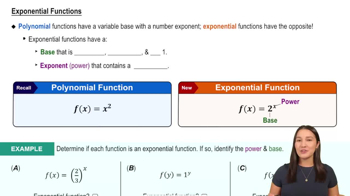
An exponential function has the form f(x) = a^x, where the base a is a positive constant not equal to 1. In this problem, the function is f(x) = (1/3)^(x+2), which means the output changes exponentially as x changes. Understanding how the base affects growth or decay is essential for graphing.
The domain of a function is the set of all possible input values (x-values), and the range is the set of all possible output values (f(x)-values). For exponential functions like this one, the domain is all real numbers, while the range is typically positive real numbers, reflecting the function's behavior.
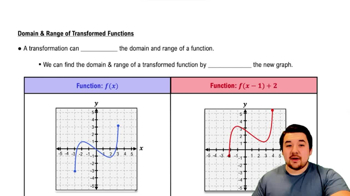
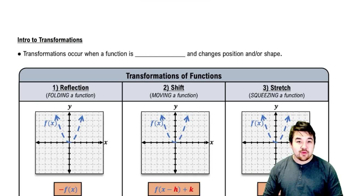
Graphing transformations involve shifts, stretches, or reflections of the basic function graph. The term (x+2) inside the exponent shifts the graph horizontally to the left by 2 units. Recognizing this helps in accurately plotting the function and understanding its behavior.

 6:08 minutes
 Verified step by step guidance
 6:13
6:13