In Exercises 59–76, find the indicated root, or state that the expression is not a real number.
___
⁴√−16
Verified step by step guidance
1
Identify the expression: \( \sqrt[4]{-16} \).
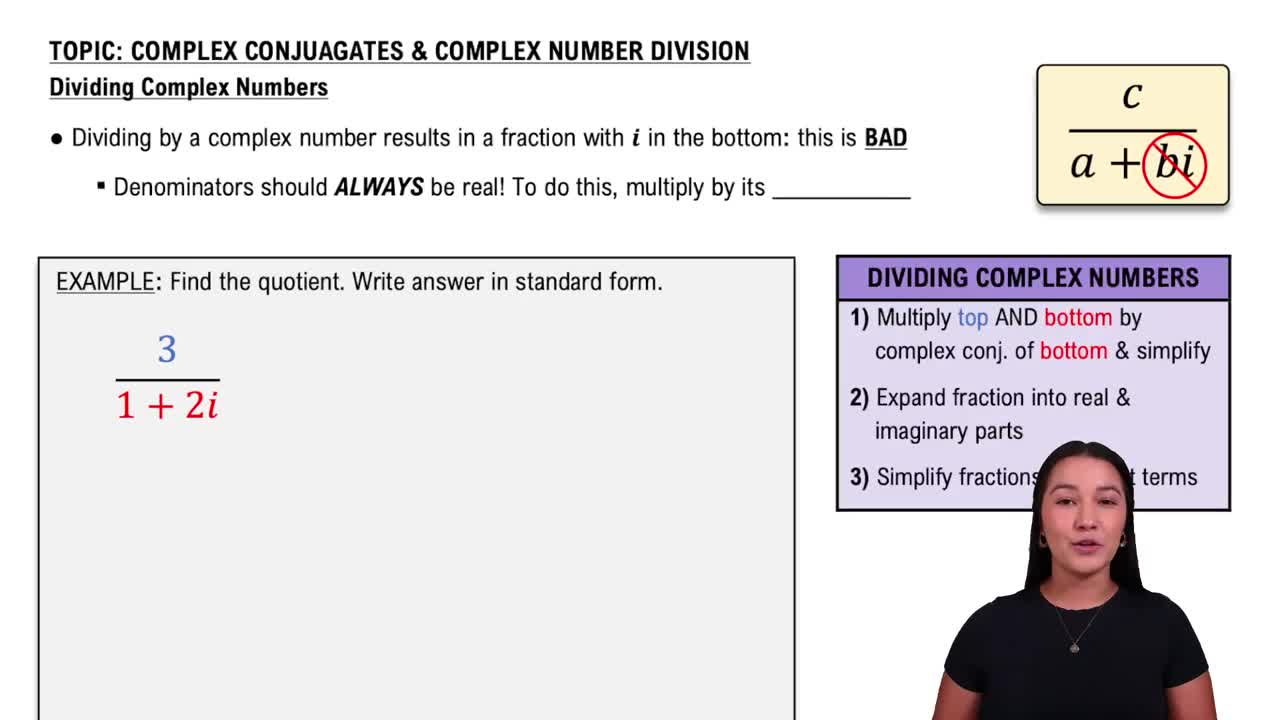
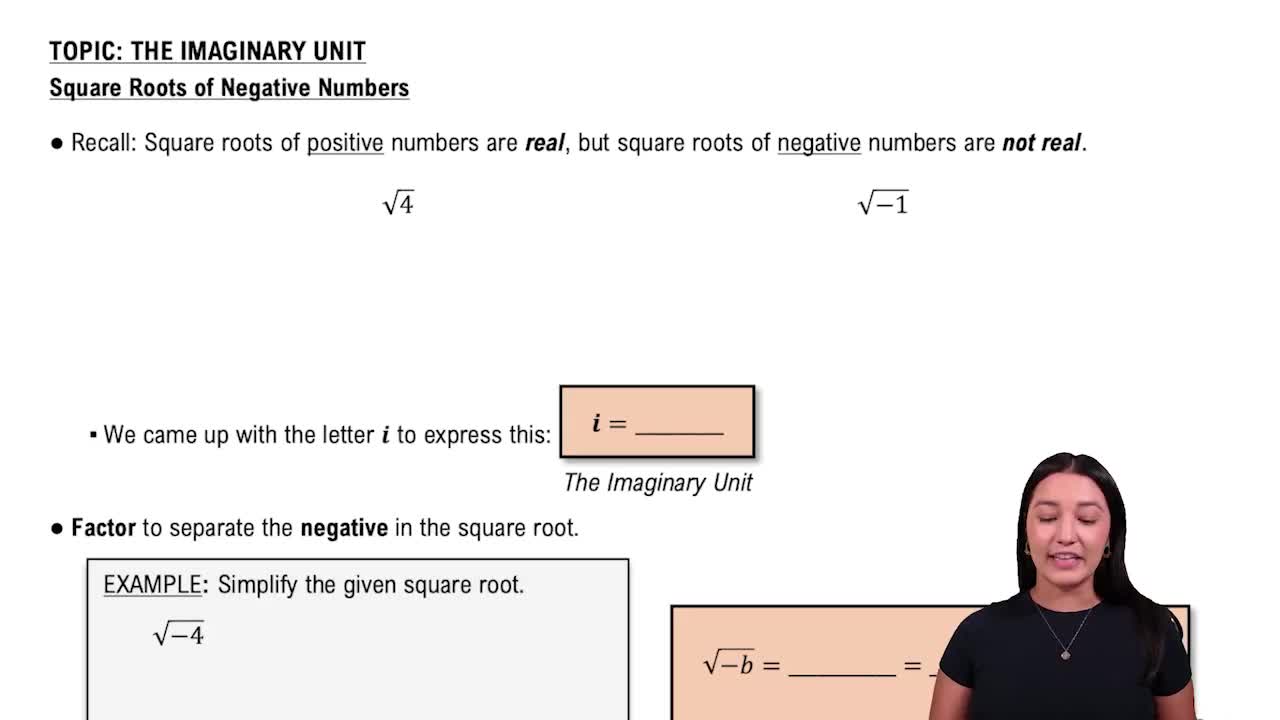
Recognize that finding the fourth root of a negative number involves complex numbers, as even roots of negative numbers are not real.
Recall that the fourth root of a number \( x \) is a number \( y \) such that \( y^4 = x \).
Since \( -16 \) is negative, and we are looking for an even root, the result is not a real number.
Conclude that \( \sqrt[4]{-16} \) is not a real number, as it involves complex numbers.
Verified video answer for a similar problem:
This video solution was recommended by our tutors as helpful for the problem above.
Video duration:
4m
Play a video:
0 Comments
Key Concepts
Here are the essential concepts you must grasp in order to answer the question correctly.
Even Roots of Negative Numbers
In mathematics, even roots (like square roots or fourth roots) of negative numbers are not defined within the set of real numbers. This is because no real number, when raised to an even power, can yield a negative result. Therefore, expressions like the fourth root of -16 do not produce a real number.
Complex numbers extend the concept of one-dimensional number lines to two dimensions by introducing the imaginary unit 'i', where i² = -1. When dealing with even roots of negative numbers, we can express the result in terms of complex numbers. For example, the fourth root of -16 can be expressed as 2i, indicating that it has both a real and an imaginary component.
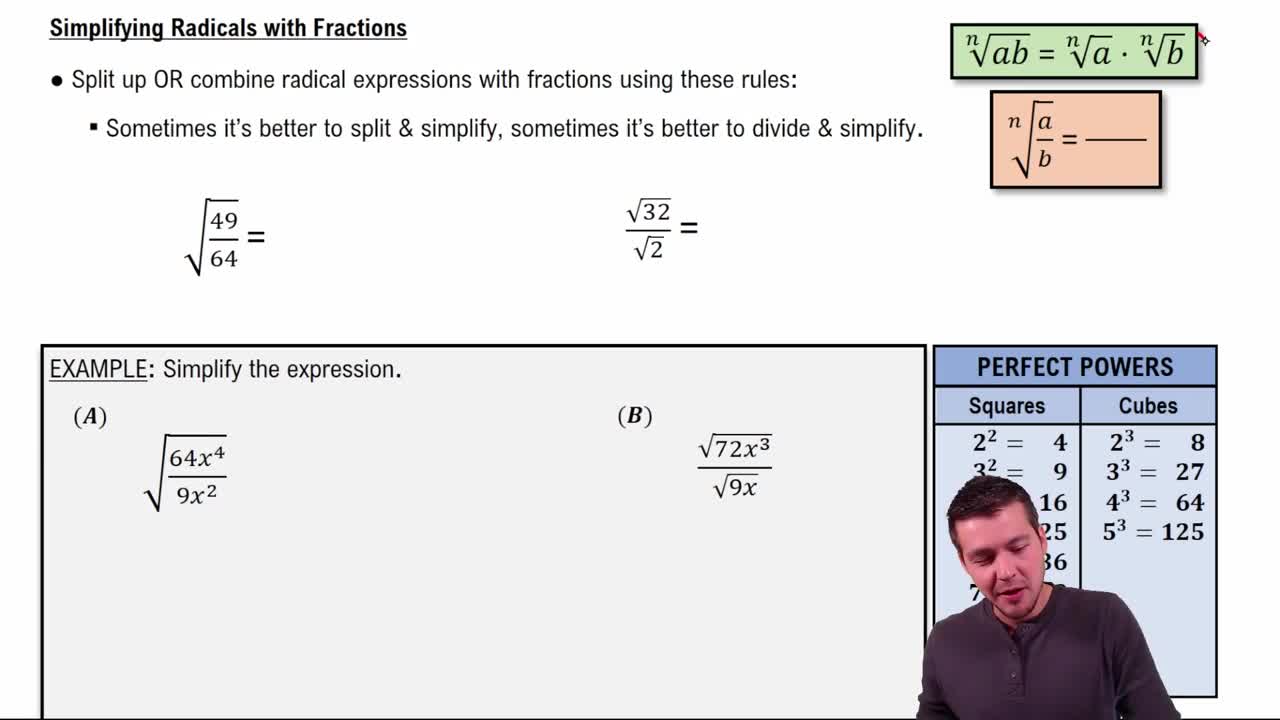
Radical expressions involve roots, such as square roots or cube roots, and can be simplified or manipulated according to specific rules. Understanding how to simplify radical expressions is crucial when determining whether a root is a real number or a complex number. In this case, recognizing that the fourth root of a negative number leads to a complex result is essential for solving the problem.

 4:30 minutes
 Verified step by step guidance
 05:02
05:02