Solve each logarithmic equation in Exercises 49–92. Be sure to reject any value of x that is not in the domain of the original logarithmic expressions. Give the exact answer. Then, where necessary, use a calculator to obtain a decimal approximation, correct to two decimal places, for the solution. log(3x−3)=log(x+1)+log 4
Table of contents
- 0. Review of Algebra4h 18m
- 1. Equations & Inequalities3h 18m
- 2. Graphs of Equations1h 43m
- 3. Functions2h 17m
- 4. Polynomial Functions1h 44m
- 5. Rational Functions1h 23m
- 6. Exponential & Logarithmic Functions2h 28m
- 7. Systems of Equations & Matrices4h 5m
- 8. Conic Sections2h 23m
- 9. Sequences, Series, & Induction1h 22m
- 10. Combinatorics & Probability1h 45m
6. Exponential & Logarithmic Functions
Solving Exponential and Logarithmic Equations
Problem 83
Textbook Question
Solve each equation. Give solutions in exact form. log x2 = (log x)2
Verified step by step guidance1
Rewrite the given equation \(\log x^2 = (\log x)^2\) using logarithm properties. Recall that \(\log x^2\) can be rewritten as \$2 \log x\(, so the equation becomes \)2 \log x = (\log x)^2$.
Introduce a substitution to simplify the equation. Let \(y = \log x\). Then the equation becomes \$2y = y^2$.
Rewrite the equation in standard quadratic form: \(y^2 - 2y = 0\).
Factor the quadratic equation: \(y(y - 2) = 0\). This gives two possible solutions for \(y\): \(y = 0\) or \(y = 2\).
Recall the substitution \(y = \log x\). Solve for \(x\) by rewriting each solution: For \(y = 0\), \(\log x = 0\) implies \(x = 10^0\); for \(y = 2\), \(\log x = 2\) implies \(x = 10^2\). Remember to check that these values satisfy the original equation and the domain restrictions of the logarithm.
Verified video answer for a similar problem:This video solution was recommended by our tutors as helpful for the problem above
Video duration:
6mPlay a video:
Was this helpful?
Key Concepts
Here are the essential concepts you must grasp in order to answer the question correctly.
Properties of Logarithms
Understanding the properties of logarithms is essential, including how to simplify expressions like log(x^2) = 2 log(x). These properties allow manipulation of logarithmic equations to isolate variables or rewrite terms for easier solving.
Recommended video:
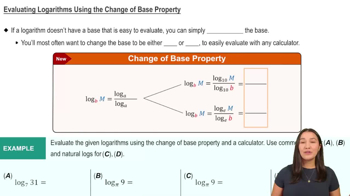
Change of Base Property
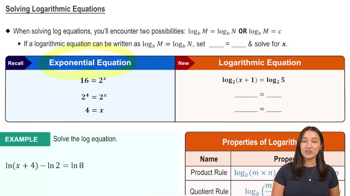
Solving Logarithmic Equations
Solving logarithmic equations involves rewriting the equation using log properties, then converting to exponential form if needed. It also requires checking for extraneous solutions since the domain of logarithms is restricted to positive arguments.
Recommended video:
Solving Logarithmic Equations
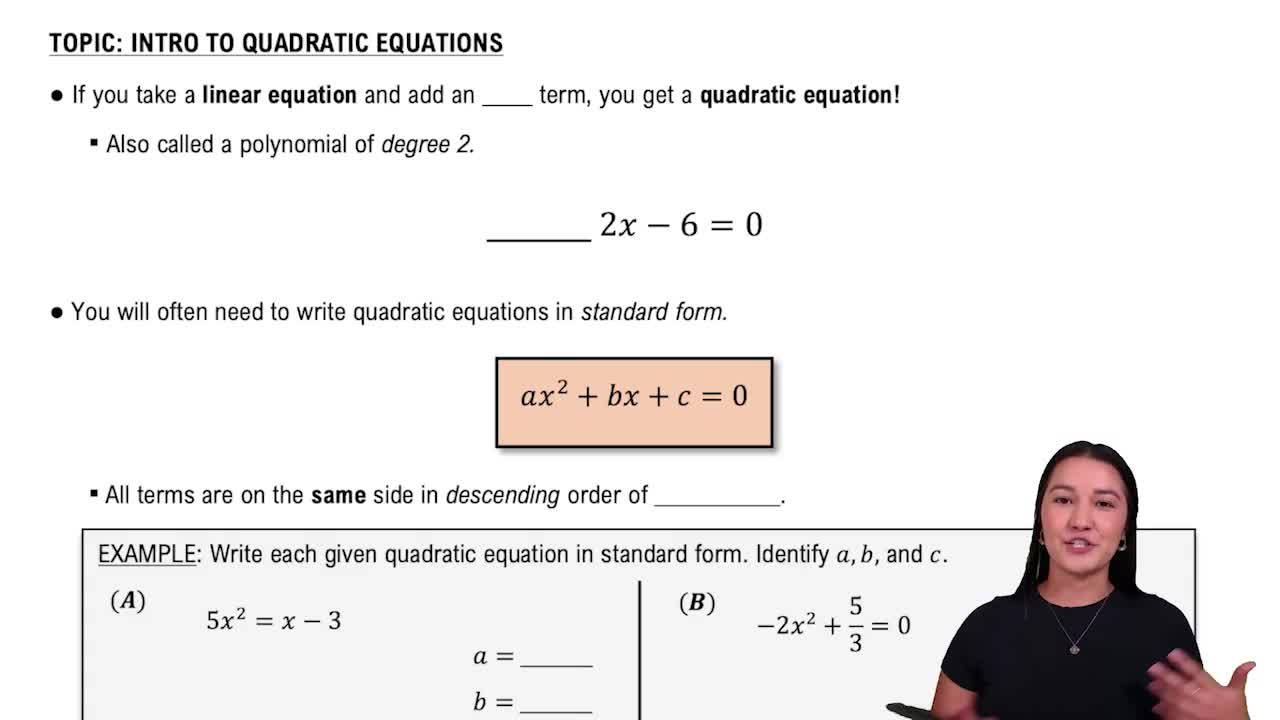
Quadratic Equations
When logarithmic expressions are squared or rearranged, the resulting equation may be quadratic in form. Recognizing and solving quadratic equations using factoring, completing the square, or the quadratic formula is crucial to find all possible solutions.
Recommended video:
Introduction to Quadratic Equations
Watch next
Master Solving Exponential Equations Using Like Bases with a bite sized video explanation from Patrick
Start learningRelated Videos
Related Practice
Textbook Question
620
views