Solve each quadratic inequality. Give the solution set in interval notation. x2 + x - 30 ≤ 0
Verified step by step guidance
1
Start by rewriting the inequality: \(x^{2} + x - 30 \leq 0\).
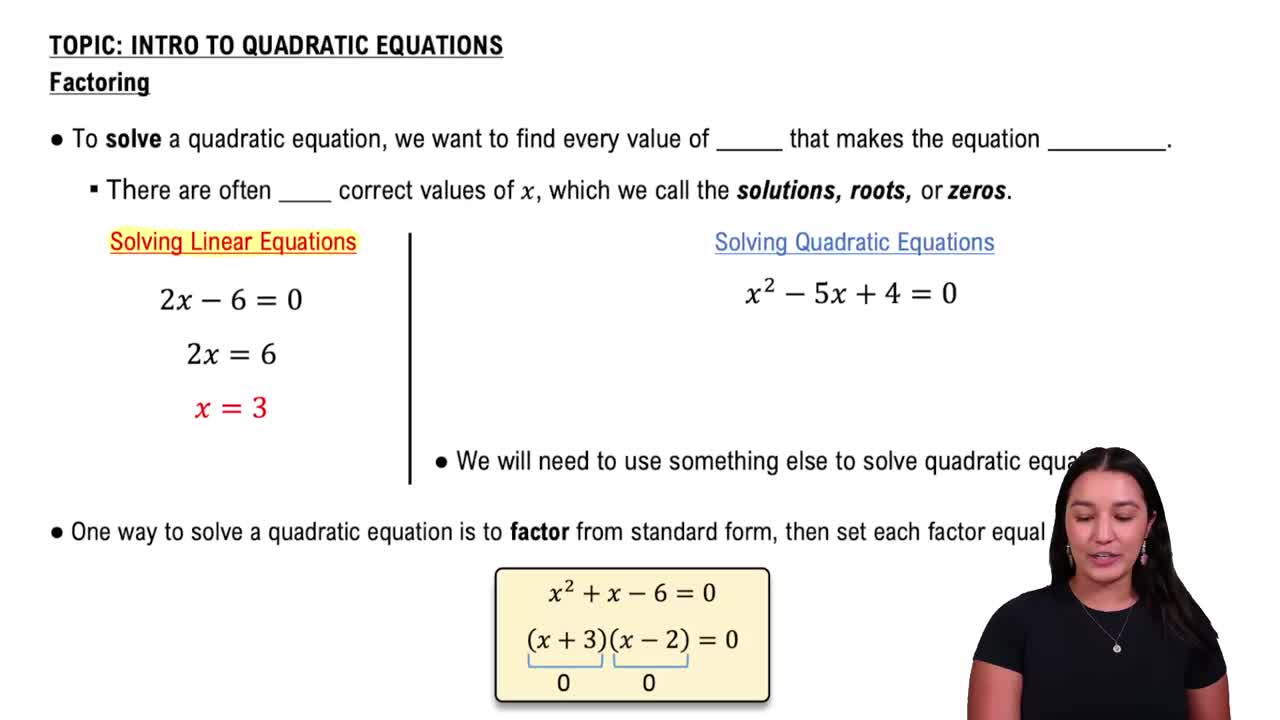
Factor the quadratic expression on the left side. Find two numbers that multiply to \(-30\) and add to \(1\). This will give you the factored form: \((x + a)(x + b) \leq 0\).
Set each factor equal to zero to find the critical points: \(x + a = 0\) and \(x + b = 0\). Solve these to find the roots of the quadratic.
Use the critical points to divide the number line into intervals. Test a value from each interval in the original inequality to determine where the inequality holds true.
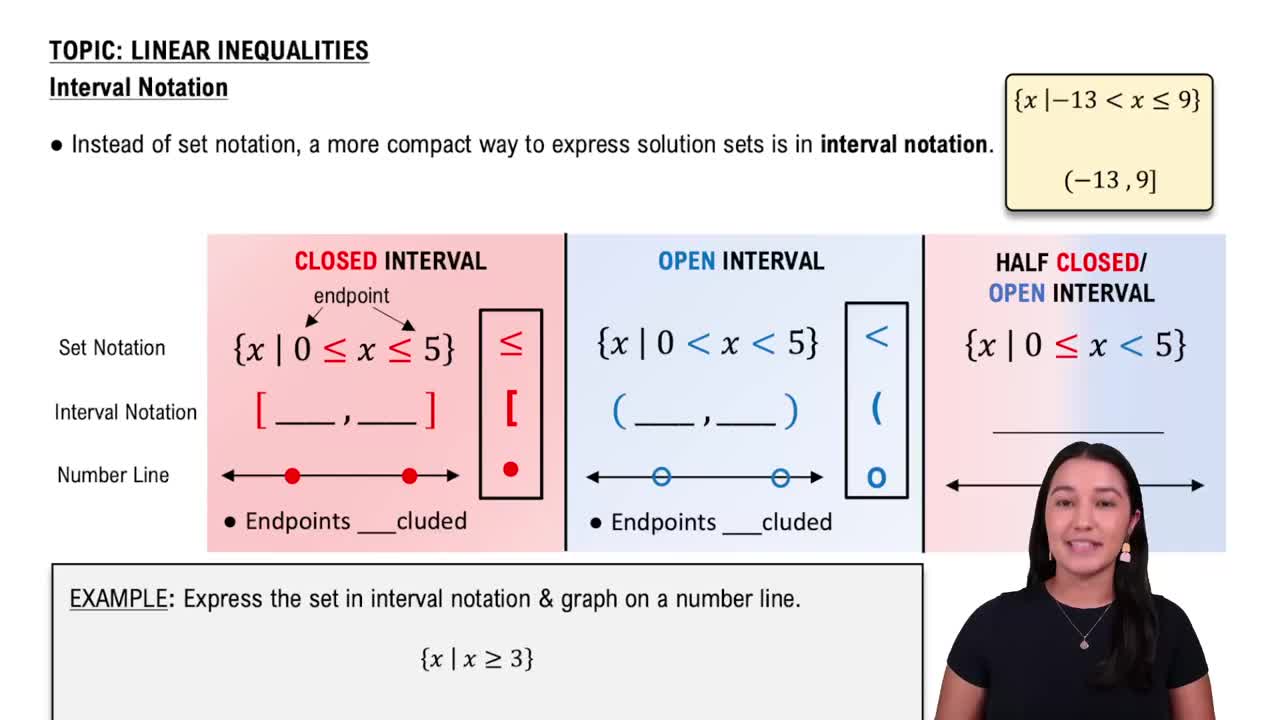
Write the solution set in interval notation, including endpoints where the inequality is less than or equal to zero.
Verified video answer for a similar problem:
This video solution was recommended by our tutors as helpful for the problem above
Video duration:
4m
Play a video:
0 Comments
Key Concepts
Here are the essential concepts you must grasp in order to answer the question correctly.
Quadratic Inequalities
A quadratic inequality involves a quadratic expression set less than, greater than, or equal to a value, such as zero. Solving it means finding all x-values that satisfy the inequality, often by analyzing the sign of the quadratic expression over intervals.
Factoring rewrites a quadratic expression as a product of two binomials, making it easier to find the roots. For example, x² + x - 30 factors to (x + 6)(x - 5), which helps identify critical points where the expression changes sign.
After finding roots, the number line is divided into intervals to test the sign of the quadratic expression in each. Interval notation expresses the solution set compactly, indicating where the inequality holds true, including endpoints if the inequality is non-strict.

 4:58 minutes
 Verified step by step guidance
 3:21
3:21