In Exercises 29 - 32, write each linear system as a matrix equation in the form AX = B, where A is the coefficient matrix and B is the constant matrix. 6x + 5y = 13 5x + 4y = 10
Table of contents
- 0. Review of Algebra4h 18m
- 1. Equations & Inequalities3h 18m
- 2. Graphs of Equations1h 43m
- 3. Functions2h 17m
- 4. Polynomial Functions1h 44m
- 5. Rational Functions1h 23m
- 6. Exponential & Logarithmic Functions2h 28m
- 7. Systems of Equations & Matrices4h 5m
- 8. Conic Sections2h 23m
- 9. Sequences, Series, & Induction1h 22m
- 10. Combinatorics & Probability1h 45m
7. Systems of Equations & Matrices
Determinants and Cramer's Rule
Problem 44
Textbook Question
In Exercises 43–44, (a) Write each linear system as a matrix equation in the form AX = B (b) Solve the system using the inverse that is given for the coefficient matrix.
Verified step by step guidance1
Step 1: Identify the linear system of equations provided in the problem. A linear system typically consists of two or more equations with variables (e.g., x and y). Write the system in standard form, where each equation is written as Ax + By = C.
Step 2: Write the system of equations as a matrix equation in the form AX = B. Here, A is the coefficient matrix (a matrix containing the coefficients of the variables), X is the column matrix of variables (e.g., [x, y]^T), and B is the column matrix of constants (e.g., [C1, C2]^T).
Step 3: Use the given inverse of the coefficient matrix (A^(-1)) to solve the system. Recall that if AX = B, then X = A^(-1)B. Multiply the inverse matrix A^(-1) by the constant matrix B to find the solution matrix X.
Step 4: Perform the matrix multiplication A^(-1)B. Ensure that you follow the rules of matrix multiplication: multiply corresponding elements and sum them to compute each entry in the resulting matrix.
Step 5: Interpret the resulting solution matrix X. The entries in X correspond to the values of the variables in the original system of equations. Write the solution in the form of ordered pairs or as individual variable values.
Verified video answer for a similar problem:This video solution was recommended by our tutors as helpful for the problem above
Video duration:
6mPlay a video:
Was this helpful?
Key Concepts
Here are the essential concepts you must grasp in order to answer the question correctly.
Matrix Representation of Linear Systems
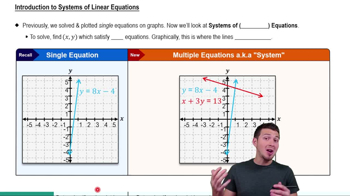
A linear system can be expressed in matrix form as AX = B, where A is the coefficient matrix containing the coefficients of the variables, X is the column matrix of the variables, and B is the column matrix of constants. This representation simplifies the process of solving systems of equations, allowing for the use of matrix operations.
Recommended video:
Guided course
Introduction to Systems of Linear Equations
Matrix Inverse
The inverse of a matrix A, denoted as A⁻¹, is a matrix that, when multiplied by A, yields the identity matrix. For a system of equations represented as AX = B, if A is invertible, the solution can be found using X = A⁻¹B. This concept is crucial for solving linear systems efficiently.
Recommended video:
Graphing Logarithmic Functions
Solving Linear Systems
To solve a linear system, one can use various methods, including substitution, elimination, and matrix operations. When using the matrix approach, the solution involves finding the inverse of the coefficient matrix and multiplying it by the constants matrix. Understanding these methods is essential for effectively solving linear equations.
Recommended video:
Guided course
Introduction to Systems of Linear Equations
Watch next
Master Determinants of 2×2 Matrices with a bite sized video explanation from Patrick
Start learningRelated Videos
Related Practice
Textbook Question
457
views