Solve each equation. Round answers to the nearest hundredth as needed. (1/4)x=64
Table of contents
- 0. Review of Algebra4h 18m
- 1. Equations & Inequalities3h 18m
- 2. Graphs of Equations1h 43m
- 3. Functions2h 17m
- 4. Polynomial Functions1h 44m
- 5. Rational Functions1h 23m
- 6. Exponential & Logarithmic Functions2h 28m
- 7. Systems of Equations & Matrices4h 5m
- 8. Conic Sections2h 23m
- 9. Sequences, Series, & Induction1h 22m
- 10. Combinatorics & Probability1h 45m
6. Exponential & Logarithmic Functions
Introduction to Exponential Functions
Problem 18
Textbook Question
For ƒ(x) = 3x and g(x)= (1/4)x find each of the following. Round answers to the nearest thousandth as needed. See Example 1. g(-3)
Verified step by step guidance1
Identify the function g(x) given as \(g(x) = \left( \frac{1}{4} \right)^x\).
To find \(g(-3)\), substitute \(x = -3\) into the function: \(g(-3) = \left( \frac{1}{4} \right)^{-3}\).
Recall the property of exponents: \(a^{-n} = \frac{1}{a^n}\). Apply this to rewrite \(\left( \frac{1}{4} \right)^{-3}\) as \$4^3$.
Calculate \$4^3\( by multiplying 4 by itself three times: \)4 \times 4 \times 4$.
After finding the value, round the result to the nearest thousandth if necessary.
Verified video answer for a similar problem:This video solution was recommended by our tutors as helpful for the problem above
Video duration:
1mPlay a video:
Was this helpful?
Key Concepts
Here are the essential concepts you must grasp in order to answer the question correctly.
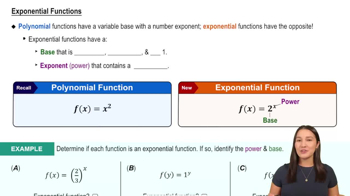
Exponential Functions
Exponential functions have the form f(x) = a^x, where the base a is a positive constant. They model growth or decay processes and are evaluated by raising the base to the power of the input x. Understanding how to compute values for given x is essential.
Recommended video:
Exponential Functions
Negative Exponents
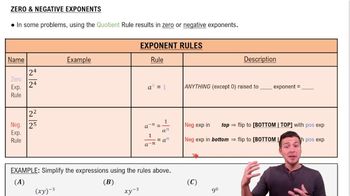
A negative exponent indicates the reciprocal of the base raised to the positive exponent, i.e., a^(-x) = 1/(a^x). This concept is crucial when evaluating functions like g(x) = (1/4)^x at negative values of x.
Recommended video:
Guided course
Zero and Negative Rules
Rounding to a Specified Decimal Place
Rounding involves approximating a number to a certain number of decimal places, here to the nearest thousandth (three decimal places). This ensures answers are presented clearly and consistently, especially when dealing with irrational or long decimal values.
Recommended video:
The Number e
Watch next
Master Exponential Functions with a bite sized video explanation from Patrick
Start learningRelated Videos
Related Practice
Textbook Question
703
views