Step 1: Understand the equation. The equation 'x = -5' is a vertical line equation. In this type of equation, x always equals a constant, which means all points on the line will have an x-coordinate of -5.
Step 2: Identify the points. Since x is always -5, the points on the line can be (-5, y) for any value of y. For example, some points on the line could be (-5, -2), (-5, 0), (-5, 2), etc.
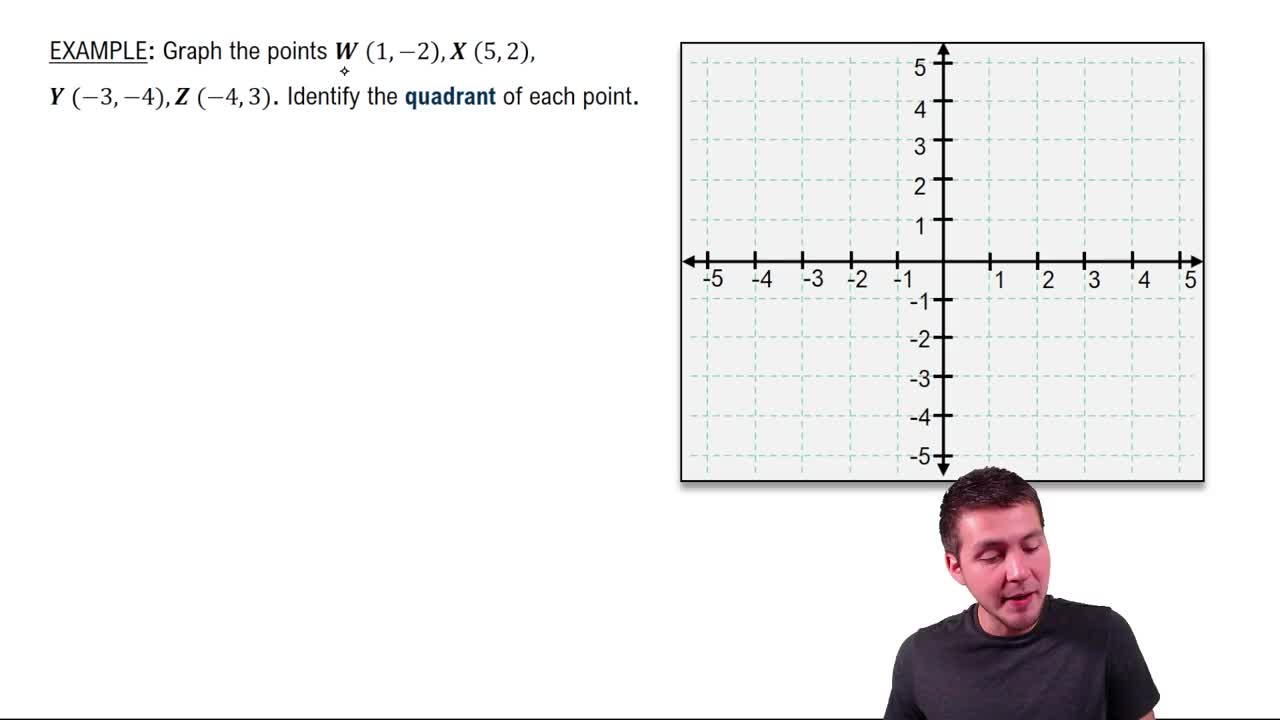
Step 3: Plot the points on the graph. Start by plotting the point (-5, 0) on the graph. This is the point where the line crosses the y-axis.
Step 4: Draw the line. Once you have plotted a few points, you can draw a straight line through them. This line represents all the possible points where x = -5.
Step 5: Check your work. Make sure your line is vertical and passes through the correct points. Any point on this line should have an x-coordinate of -5.
Verified video answer for a similar problem:
This video solution was recommended by our tutors as helpful for the problem above.
Video duration:
39s
Play a video:
0 Comments
Key Concepts
Here are the essential concepts you must grasp in order to answer the question correctly.
Vertical Lines
The equation x = -5 represents a vertical line on the Cartesian plane. Vertical lines have the same x-coordinate for all points, meaning that no matter the value of y, x will always be -5. This results in a line that runs parallel to the y-axis and intersects the x-axis at the point (-5, 0).
Graphing techniques involve plotting points and understanding the relationship between variables in an equation. For x = -5, one can simply mark points where x is -5 for various y values, such as (-5, -2), (-5, 0), and (-5, 3). Connecting these points visually illustrates the vertical line.
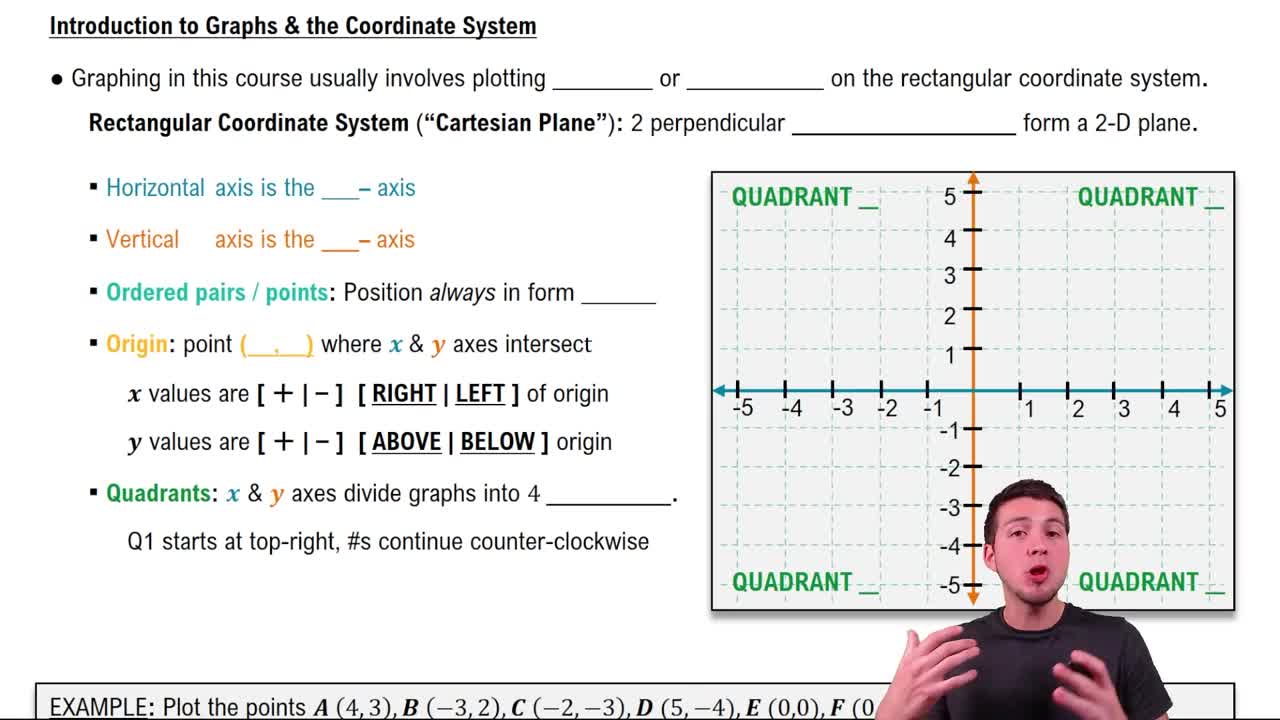
The coordinate system is a two-dimensional plane defined by the x-axis (horizontal) and y-axis (vertical). Each point on this plane is represented by an ordered pair (x, y). Understanding this system is crucial for accurately graphing equations and interpreting their geometric representations.

 0:39 minutes
 Verified step by step guidance
 06:49
06:49