Solve each problem. If y varies inversely as x, and y=10 when x=3, find y when x=20.
Ch. 3 - Polynomial and Rational Functions

Chapter 4, Problem 11a
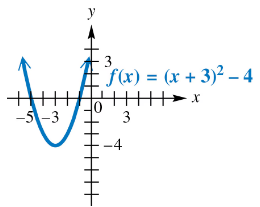
Consider the graph of each quadratic function.
a) Give the domain and range.

Verified step by step guidance1
Identify the domain of the quadratic function. Since it is a parabola that opens upwards and extends infinitely left and right, the domain includes all real numbers. In interval notation, this is expressed as \((-\infty, \infty)\).
Locate the vertex of the parabola on the graph. The vertex is given as \((-13, -15)\), which represents the minimum point of the parabola because it opens upwards.
Determine the range of the function. Since the parabola opens upwards, the function values (y-values) start at the vertex's y-coordinate and go to positive infinity. Therefore, the range is all real numbers greater than or equal to \(-15\).
Express the range in interval notation as \([-15, \infty)\), indicating that the function's output values start at \(-15\) and increase without bound.
Summarize the domain and range: Domain is all real numbers \((-\infty, \infty)\), and range is \([-15, \infty)\).

Verified video answer for a similar problem:
This video solution was recommended by our tutors as helpful for the problem above.
Video duration:
5mWas this helpful?
Key Concepts
Here are the essential concepts you must grasp in order to answer the question correctly.
Domain of a Quadratic Function
The domain of a quadratic function includes all possible input values (x-values) for which the function is defined. Since quadratic functions are polynomials, their domain is all real numbers, meaning any real number can be substituted for x.
Recommended video:
Domain Restrictions of Composed Functions
Range of a Quadratic Function
The range of a quadratic function is the set of all possible output values (y-values). For a parabola opening upwards, the range starts at the vertex's y-coordinate and extends to positive infinity. For the given function, the minimum value is -15, so the range is y ≥ -15.
Recommended video:
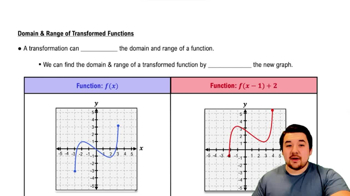
Domain & Range of Transformed Functions
Vertex Form of a Quadratic Function
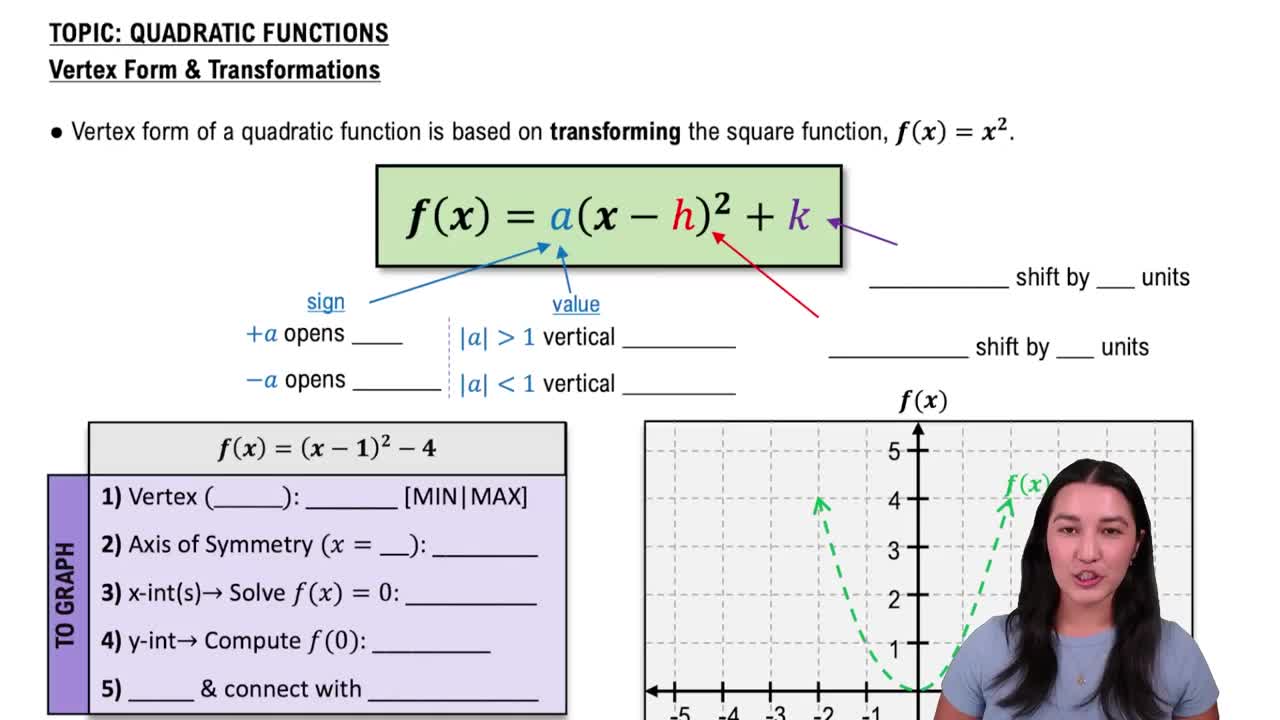
The vertex form of a quadratic function is f(x) = a(x-h)^2 + k, where (h, k) is the vertex. This form makes it easy to identify the vertex and determine the direction the parabola opens. Here, the vertex is (-13, -15), and since a = 1 > 0, the parabola opens upwards.
Recommended video:
Vertex Form
Related Practice
Textbook Question
664
views
Textbook Question
Solve each quadratic inequality. Give the solution set in interval notation.
(a) -(x + 1)(x + 2) ≥ 0
(b) -(x + 1)(x + 2) > 0
(c) -(x + 1)(x + 2) ≤ 0
(d) -(x + 1)(x + 2) < 0
523
views
Textbook Question
Solve each quadratic inequality. Give the solution set in interval notation.
(a) (x - 5)(x + 2) ≥ 0
(b) (x - 5)(x + 2) > 0
(c) (x - 5)(x + 2) ≤ 0
(d) (x - 5)(x + 2) < 0
581
views
Textbook Question
Use synthetic division to perform each division. (x4 + 4x3 + 2x2 + 9x+4) / x+4
393
views
Textbook Question
Use synthetic division to perform each division. (3x3+6x2-8x+3)/(x+3)
549
views
Textbook Question
Use the graphs of the rational functions in choices A–D to answer each question.
There may be more than one correct choice. If ƒ represents the function, only one choice has a single solution to the equation ƒ(x)=3. Which one is it?
27
views