In Exercises 31–50, find f−g and determine the domain for each function. f(x) = 2x + 3, g(x) = x − 1
Verified step by step guidance
1
Step 1: Understand the problem. We need to find the function (f - g)(x), which means we will subtract the function g(x) from f(x).
Step 2: Write down the expressions for f(x) and g(x). We have f(x) = 2x + 3 and g(x) = x - 1.
Step 3: Subtract g(x) from f(x). This means we calculate (f - g)(x) = f(x) - g(x) = (2x + 3) - (x - 1).
Step 4: Simplify the expression. Distribute the negative sign and combine like terms: (2x + 3) - (x - 1) = 2x + 3 - x + 1.
Step 5: Determine the domain of (f - g)(x). Since both f(x) and g(x) are linear functions, their domain is all real numbers. Therefore, the domain of (f - g)(x) is also all real numbers.
Verified video answer for a similar problem:
This video solution was recommended by our tutors as helpful for the problem above
Video duration:
1m
Play a video:
Was this helpful?
Key Concepts
Here are the essential concepts you must grasp in order to answer the question correctly.
Function Subtraction
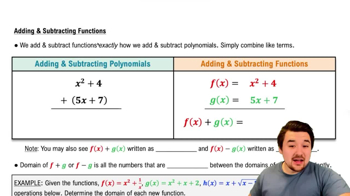
Function subtraction involves taking two functions, f(x) and g(x), and creating a new function, f-g, defined as (f-g)(x) = f(x) - g(x). In this case, you would subtract the output of g(x) from the output of f(x) for each x in the domain of both functions.
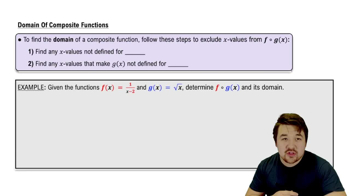
The domain of a function is the set of all possible input values (x-values) for which the function is defined. For linear functions like f(x) = 2x + 3 and g(x) = x - 1, the domain is typically all real numbers, unless specified otherwise by restrictions such as division by zero or square roots of negative numbers.
Combining functions, such as through addition, subtraction, or composition, requires understanding how the individual functions interact. When finding f-g, it is essential to ensure that the resulting function maintains the same domain as the original functions, which in this case remains all real numbers since both f and g are defined for all x.