Use properties of logarithms to expand each logarithmic expression as much as possible. Where possible, evaluate logarithmic expressions without using a calculator. log √(100x)
Table of contents
- 0. Review of Algebra4h 18m
- 1. Equations & Inequalities3h 18m
- 2. Graphs of Equations1h 43m
- 3. Functions2h 17m
- 4. Polynomial Functions1h 44m
- 5. Rational Functions1h 23m
- 6. Exponential & Logarithmic Functions2h 28m
- 7. Systems of Equations & Matrices4h 5m
- 8. Conic Sections2h 23m
- 9. Sequences, Series, & Induction1h 22m
- 10. Combinatorics & Probability1h 45m
6. Exponential & Logarithmic Functions
Properties of Logarithms
Problem 31
Textbook Question
Use properties of logarithms to expand each logarithmic expression as much as possible. Where possible, evaluate logarithmic expressions without using a calculator. log ∛(x/y)
Verified step by step guidance1
Recognize that the expression involves a logarithm of a cube root, which can be rewritten using fractional exponents. Recall that \( \sqrt[3]{a} = a^{1/3} \). So rewrite the expression as \( \log \left( \left( \frac{x}{y} \right)^{1/3} \right) \).
Use the logarithm power rule, which states \( \log(a^b) = b \log(a) \), to bring the fractional exponent \( \frac{1}{3} \) in front of the logarithm. This gives \( \frac{1}{3} \log \left( \frac{x}{y} \right) \).
Apply the logarithm quotient rule, which states \( \log \left( \frac{a}{b} \right) = \log a - \log b \), to expand \( \log \left( \frac{x}{y} \right) \) into \( \log x - \log y \).
Substitute this back into the expression to get \( \frac{1}{3} ( \log x - \log y ) \).
Distribute the \( \frac{1}{3} \) across the terms inside the parentheses to write the fully expanded form as \( \frac{1}{3} \log x - \frac{1}{3} \log y \).
Verified video answer for a similar problem:This video solution was recommended by our tutors as helpful for the problem above
Video duration:
3mPlay a video:
Was this helpful?
Key Concepts
Here are the essential concepts you must grasp in order to answer the question correctly.
Properties of Logarithms
Properties of logarithms include rules such as the product, quotient, and power rules. These allow us to rewrite logarithmic expressions by expanding or condensing them. For example, log(a/b) = log(a) - log(b) and log(a^n) = n·log(a). These properties are essential for simplifying and expanding logarithmic expressions.
Recommended video:
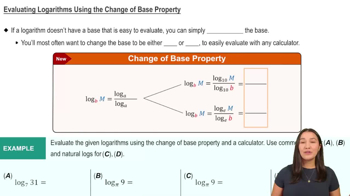
Change of Base Property
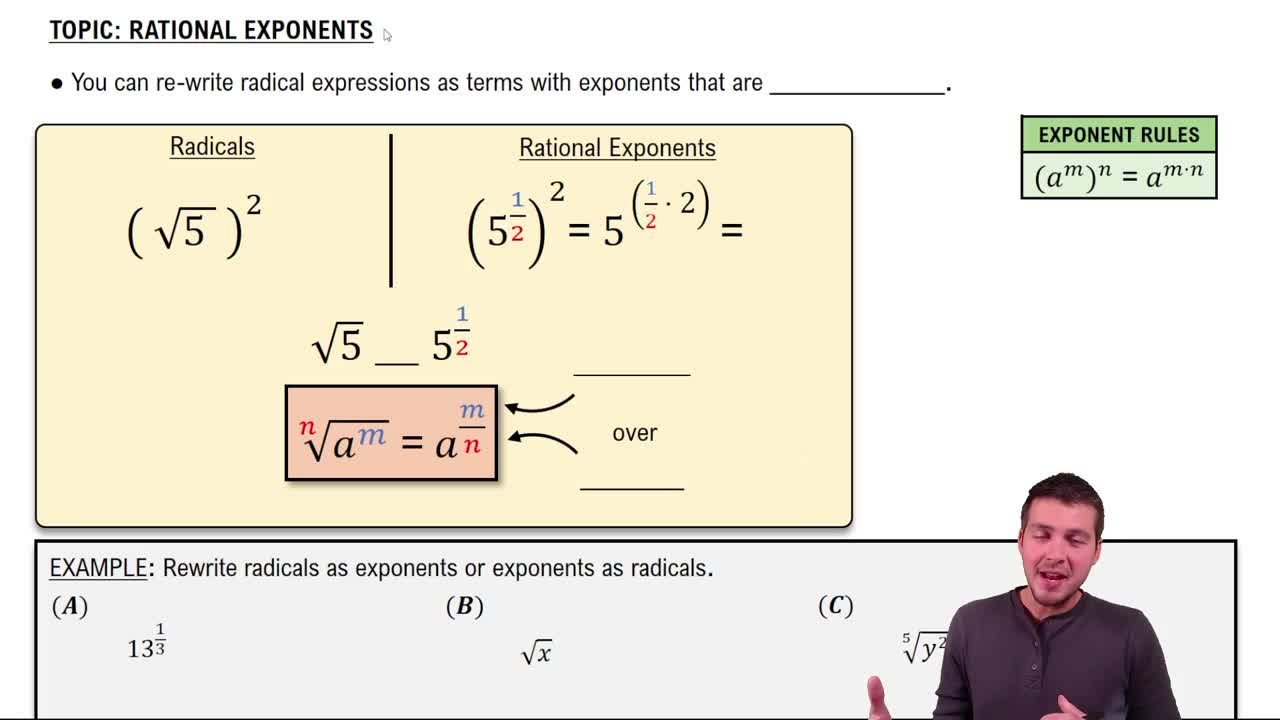
Radicals and Exponents
Radicals can be expressed as fractional exponents, where the nth root of a number is the same as raising it to the power of 1/n. For example, the cube root of x is x^(1/3). Converting radicals to exponents helps apply logarithm power rules effectively when expanding expressions.
Recommended video:
Guided course
Rational Exponents
Logarithmic Expression Expansion
Expanding logarithmic expressions involves breaking down complex logs into sums, differences, or multiples of simpler logs using the properties of logarithms. This process simplifies expressions and can sometimes allow evaluation without a calculator by recognizing standard log values or simplifying terms.
Recommended video:
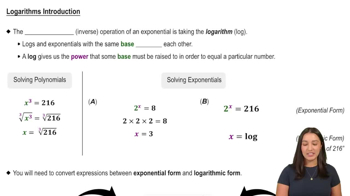
Logarithms Introduction
Watch next
Master Product, Quotient, and Power Rules of Logs with a bite sized video explanation from Patrick
Start learningRelated Videos
Related Practice
Textbook Question
