Is the algebraic expression a polynomial? If it is, write the polynomial in standard form. (2x+3)/x
Verified step by step guidance
1
Identify the given expression: \(\frac{2x + 3}{x}\).
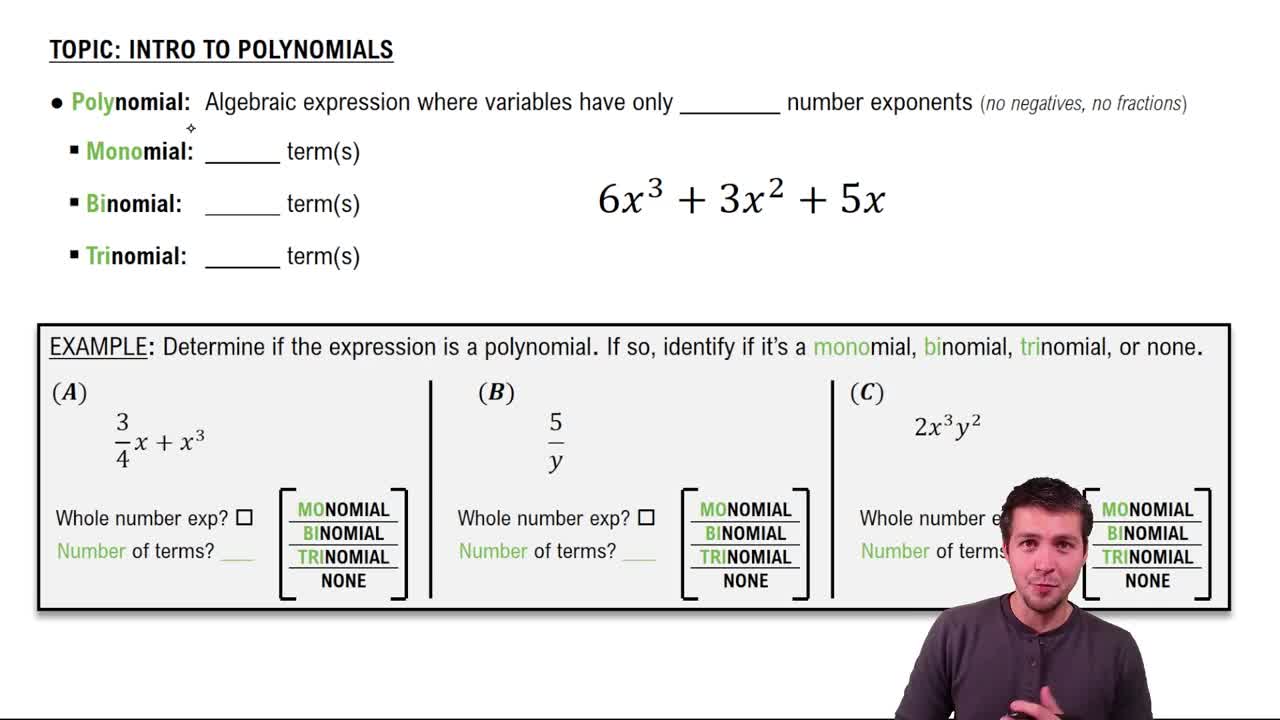
Recall that a polynomial is an expression consisting of variables raised to non-negative integer powers, combined using addition, subtraction, and multiplication only. Division by a variable (like \(x\)) is not allowed in polynomials.
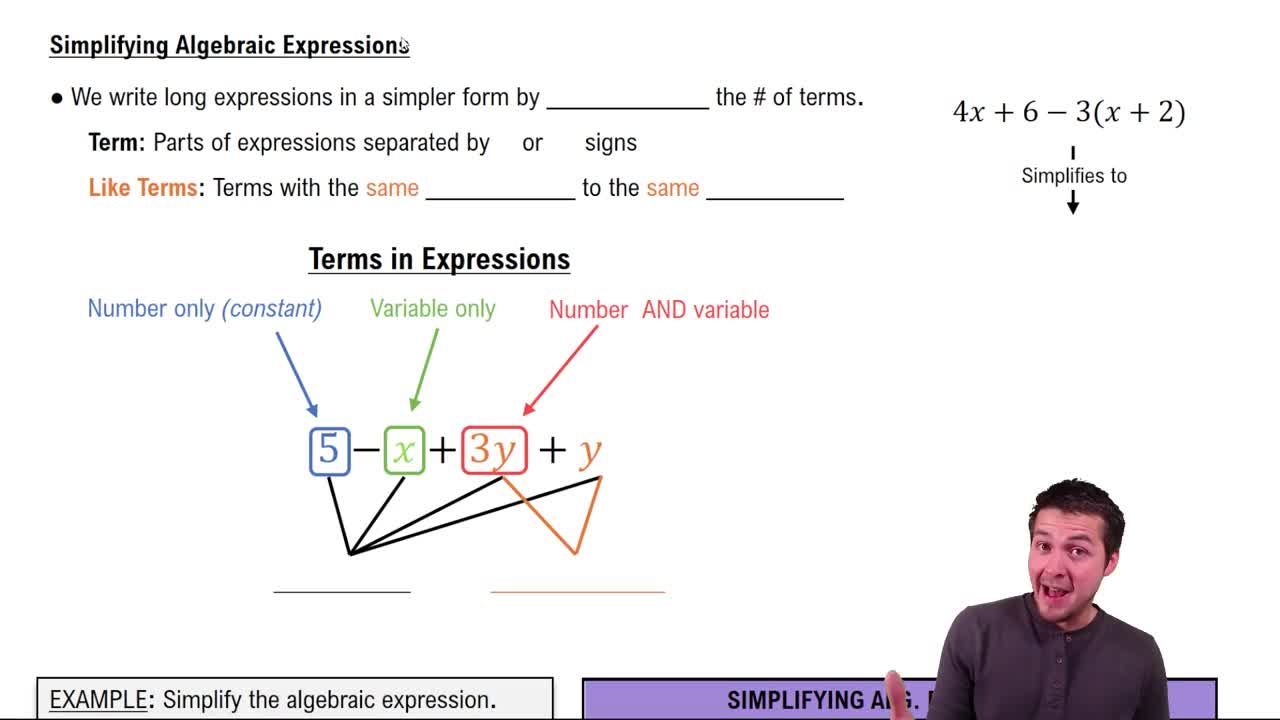
Rewrite the expression by dividing each term in the numerator by \(x\): \(\frac{2x}{x} + \frac{3}{x}\).
Simplify the terms: \(\frac{2x}{x} = 2\) and \(\frac{3}{x} = 3x^{-1}\).
Since \$3x^{-1}$ has a negative exponent, the expression is not a polynomial. Therefore, it cannot be written in standard polynomial form.
Verified video answer for a similar problem:
This video solution was recommended by our tutors as helpful for the problem above
Video duration:
2m
Play a video:
Was this helpful?
Key Concepts
Here are the essential concepts you must grasp in order to answer the question correctly.
Definition of a Polynomial
A polynomial is an algebraic expression consisting of variables and coefficients, involving only non-negative integer exponents of variables combined using addition, subtraction, and multiplication. Expressions with variables in denominators or with negative or fractional exponents are not polynomials.
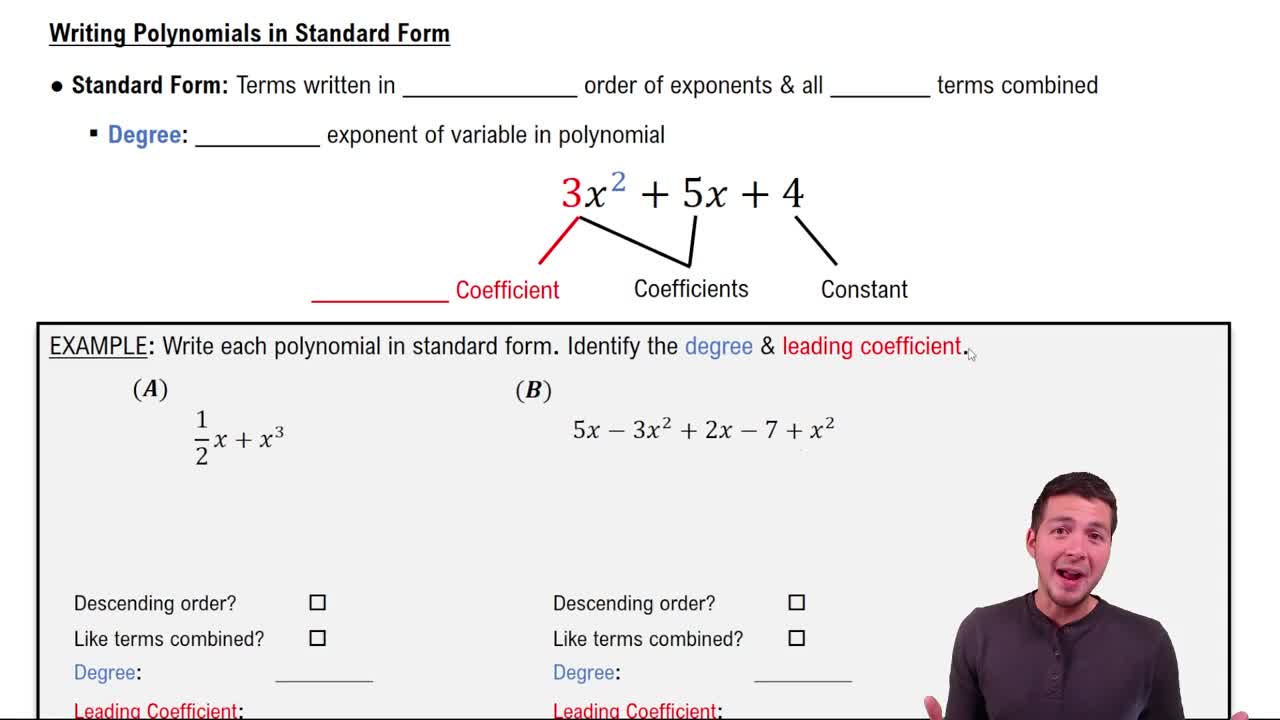
The standard form of a polynomial arranges terms in descending order of their exponents, starting with the highest degree term. This format helps in easily identifying the degree and leading coefficient of the polynomial.
A rational expression is a ratio of two polynomials. To determine if it is a polynomial, simplify the expression by performing division or factoring. If the variable remains in the denominator after simplification, the expression is not a polynomial.