Ch. 4 - Inverse, Exponential, and Logarithmic Functions
Lial - College Algebra 13th Edition
Lial13th EditionCollege AlgebraISBN: 9780136881063Not the one you use?Change textbook
Chapter 5, Problem 87

Solve each equation for the indicated variable. Use logarithms with the appropriate bases. p = a + (k/ln x), for x

Verified step by step guidance
1
Start with the given equation: \(p = a + \frac{k}{\ln x}\).
Isolate the term containing \(x\) by subtracting \(a\) from both sides: \(p - a = \frac{k}{\ln x}\).
Next, solve for \(\ln x\) by taking the reciprocal and multiplying both sides by \(k\): \(\ln x = \frac{k}{p - a}\).
Recall that \(\ln x\) means the natural logarithm of \(x\), so to solve for \(x\), rewrite the equation in exponential form: \(x = e^{\frac{k}{p - a}}\).
This expression gives \(x\) in terms of \(p\), \(a\), and \(k\), using the natural exponential function.

Verified video answer for a similar problem:

This video solution was recommended by our tutors as helpful for the problem above.
Video duration:
2m
Was this helpful?

Key Concepts

Here are the essential concepts you must grasp in order to answer the question correctly.

Solving Equations for a Specific Variable

This involves isolating the variable of interest on one side of the equation. It requires algebraic manipulation such as addition, subtraction, multiplication, division, and applying inverse operations to rewrite the equation in terms of the desired variable.
Recommended video:
Guided course
05:28
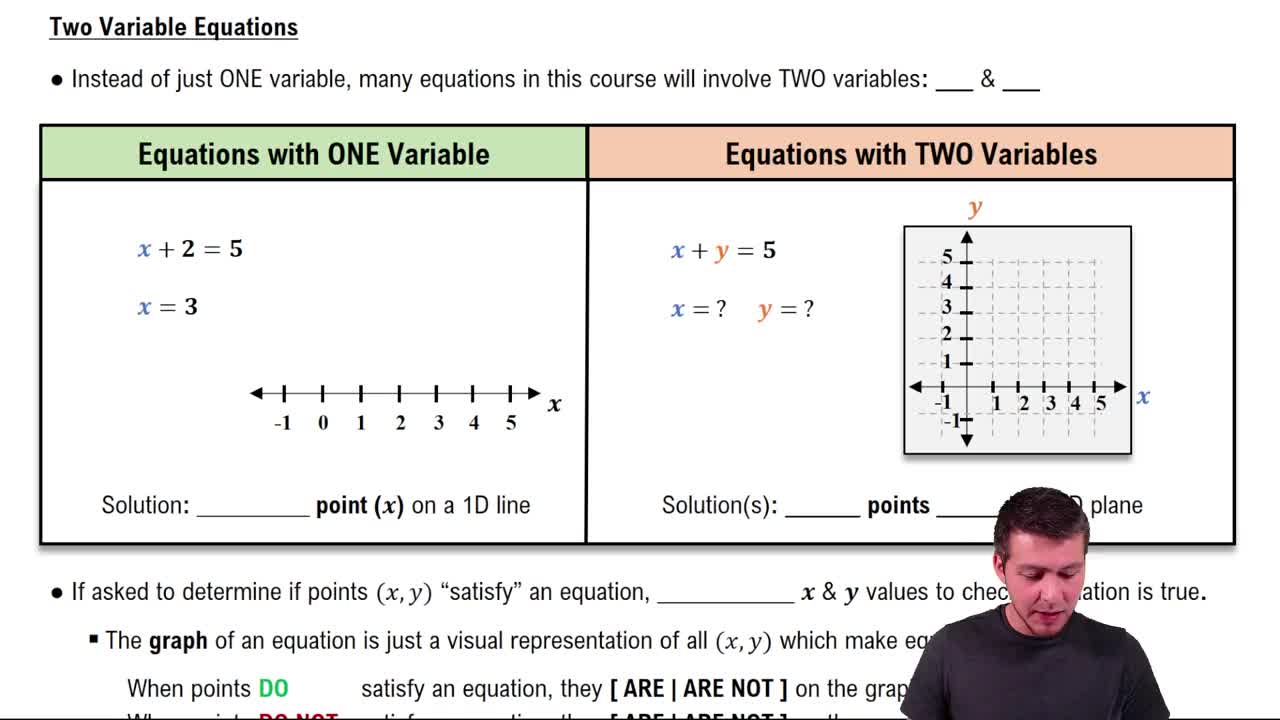
Equations with Two Variables

Properties of Logarithms

Logarithms are the inverses of exponential functions and have specific properties like the product, quotient, and power rules. Understanding these properties helps simplify expressions and solve equations involving logarithms with different bases.
Recommended video:
5:36
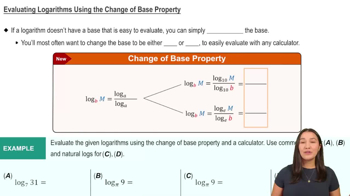
Change of Base Property

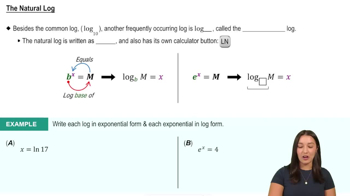
Natural Logarithm and the Constant e

The natural logarithm (ln) is the logarithm with base e, where e ≈ 2.718. It is commonly used in calculus and algebra to solve equations involving growth, decay, or continuous compounding. Recognizing when to apply ln and how to manipulate it is essential for solving equations like p = a + (k/ln x).
Recommended video:
2:51
The Natural Log