In Exercises 11–16, a die is rolled. Find the probability of getting an odd number.
Table of contents
- 0. Review of Algebra4h 18m
- 1. Equations & Inequalities3h 18m
- 2. Graphs of Equations1h 43m
- 3. Functions2h 17m
- 4. Polynomial Functions1h 44m
- 5. Rational Functions1h 23m
- 6. Exponential & Logarithmic Functions2h 28m
- 7. Systems of Equations & Matrices4h 5m
- 8. Conic Sections2h 23m
- 9. Sequences, Series, & Induction1h 22m
- 10. Combinatorics & Probability1h 45m
10. Combinatorics & Probability
Probability
Problem 49
Textbook Question
In Exercises 49–52, a single die is rolled twice. Find the probability of rolling a 2 the first time and a 3 the second time.
Verified step by step guidance1
Understand that the problem involves two independent events: rolling a die twice, where the outcome of the first roll does not affect the second roll.
Recall that the probability of rolling any specific number on a fair six-sided die is \( \frac{1}{6} \).
Calculate the probability of rolling a 2 on the first roll, which is \( \frac{1}{6} \).
Calculate the probability of rolling a 3 on the second roll, which is also \( \frac{1}{6} \).
Since the rolls are independent, multiply the probabilities of the two events: \( \frac{1}{6} \times \frac{1}{6} \) to find the combined probability.
Verified video answer for a similar problem:This video solution was recommended by our tutors as helpful for the problem above
Video duration:
2mPlay a video:
Was this helpful?
Key Concepts
Here are the essential concepts you must grasp in order to answer the question correctly.
Probability of a Single Event
The probability of a single event is the likelihood that the event will occur, calculated as the number of favorable outcomes divided by the total number of possible outcomes. For a fair six-sided die, the probability of rolling any specific number, like a 2, is 1/6.
Recommended video:
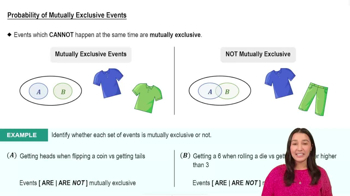
Probability of Mutually Exclusive Events
Independent Events
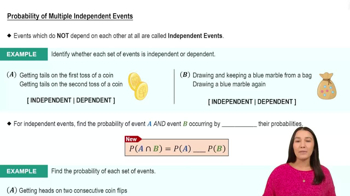
Two events are independent if the outcome of one does not affect the outcome of the other. Rolling a die twice produces independent events because the result of the first roll does not influence the second roll.
Recommended video:
Probability of Multiple Independent Events
Multiplication Rule for Independent Events
When two events are independent, the probability of both occurring is the product of their individual probabilities. For example, the probability of rolling a 2 first and a 3 second is (1/6) × (1/6) = 1/36.
Recommended video:
Probability of Multiple Independent Events
Watch next
Master Introduction to Probability with a bite sized video explanation from Patrick
Start learningRelated Videos
Related Practice
Textbook Question
429
views