Find f(g(x)) and g (f(x)) and determine whether each pair of functions ƒ and g are inverses of each other. f(x) = 4x + 9 and g(x) = (x-9)/4
Table of contents
- 0. Review of Algebra4h 18m
- 1. Equations & Inequalities3h 18m
- 2. Graphs of Equations1h 43m
- 3. Functions2h 17m
- 4. Polynomial Functions1h 44m
- 5. Rational Functions1h 23m
- 6. Exponential & Logarithmic Functions2h 28m
- 7. Systems of Equations & Matrices4h 5m
- 8. Conic Sections2h 23m
- 9. Sequences, Series, & Induction1h 22m
- 10. Combinatorics & Probability1h 45m
3. Functions
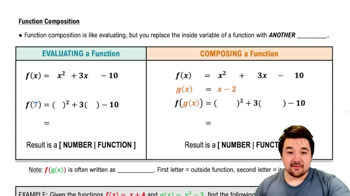
Function Composition
Problem 95
Textbook Question
Determine whether each statement is true or false. If the statement is false, make the necessary change(s) to produce a true statement.
If and , find and .
Verified step by step guidance1
First, understand the notation: (ƒ 0 g)(x) means the composition of functions f and g, which is f(g(x)). Similarly, (ƒ 0 g)^{-1}(x) means the inverse of the composition f(g(x)).
Step 1: Find the composition (ƒ 0 g)(x) by substituting g(x) into f. Since f(x) = 3x and g(x) = x + 5, write the expression for f(g(x)) as \(f(g(x)) = 3(x + 5)\).
Step 2: To find the inverse of the composition, set \(y = 3(x + 5)\) and solve for x in terms of y. This involves isolating x on one side of the equation.
Step 3: Next, find the inverse functions individually: find \(f^{-1}(x)\) by solving \(y = 3x\) for x, and find \(g^{-1}(x)\) by solving \(y = x + 5\) for x.
Step 4: Finally, find the composition \((g^{-1} 0 f^{-1})(x)\) by substituting \(f^{-1}(x)\) into \(g^{-1}\). Write the expression for \(g^{-1}(f^{-1}(x))\).
Verified video answer for a similar problem:This video solution was recommended by our tutors as helpful for the problem above
Video duration:
5mPlay a video:
Was this helpful?
Key Concepts
Here are the essential concepts you must grasp in order to answer the question correctly.
Function Composition
Function composition involves applying one function to the result of another, denoted as (f ∘ g)(x) = f(g(x)). Understanding how to combine functions correctly is essential for evaluating expressions like (f ∘ g)(x) and manipulating them for further operations.
Recommended video:
Function Composition
Inverse Functions
An inverse function reverses the effect of the original function, such that f(f⁻¹(x)) = x. Finding the inverse requires solving for x in terms of y and swapping variables. Recognizing and computing inverses is crucial for expressions involving f⁻¹ or g⁻¹.
Recommended video:
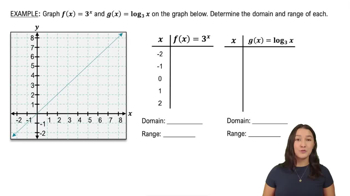
Graphing Logarithmic Functions
Notation and Order of Operations in Compositions and Inverses
Understanding the notation (f ∘ g)⁻¹ and (g⁻¹ ∘ f⁻¹) requires knowing that the inverse of a composition reverses the order: (f ∘ g)⁻¹ = g⁻¹ ∘ f⁻¹. This concept helps correctly interpret and simplify composite inverse functions.
Recommended video:
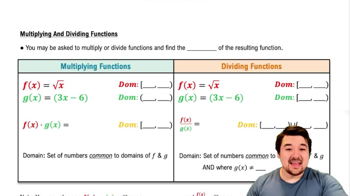
Multiplying & Dividing Functions
Watch next
Master Function Composition with a bite sized video explanation from Patrick
Start learningRelated Videos
Related Practice
Textbook Question
488
views