Ch. P - Fundamental Concepts of Algebra
Blitzer - College Algebra 8th Edition
Blitzer8th EditionCollege AlgebraISBN: 9780136970514Not the one you use?Change textbook
Chapter 1, Problem 15

In Exercises 1–16, evaluate each algebraic expression for the given value or values of the variable(s). (2x+3y)/(x+1), for x=-2 and y=4

Verified step by step guidance
1
Step 1: Begin by substituting the given values of the variables into the algebraic expression. Replace x with -2 and y with 4 in the expression \((2x + 3y) / (x + 1)\).
Step 2: Substitute the values into the numerator \(2x + 3y\). This becomes \(2(-2) + 3(4)\).
Step 3: Substitute the value of x into the denominator \(x + 1\). This becomes \((-2) + 1\).
Step 4: Simplify the numerator \(2(-2) + 3(4)\) by performing the multiplication and addition operations.
Step 5: Simplify the denominator \((-2) + 1\) by performing the addition operation. Combine the simplified numerator and denominator to form the final fraction.

Verified video answer for a similar problem:

This video solution was recommended by our tutors as helpful for the problem above.
Video duration:
2m
Was this helpful?

Key Concepts

Here are the essential concepts you must grasp in order to answer the question correctly.

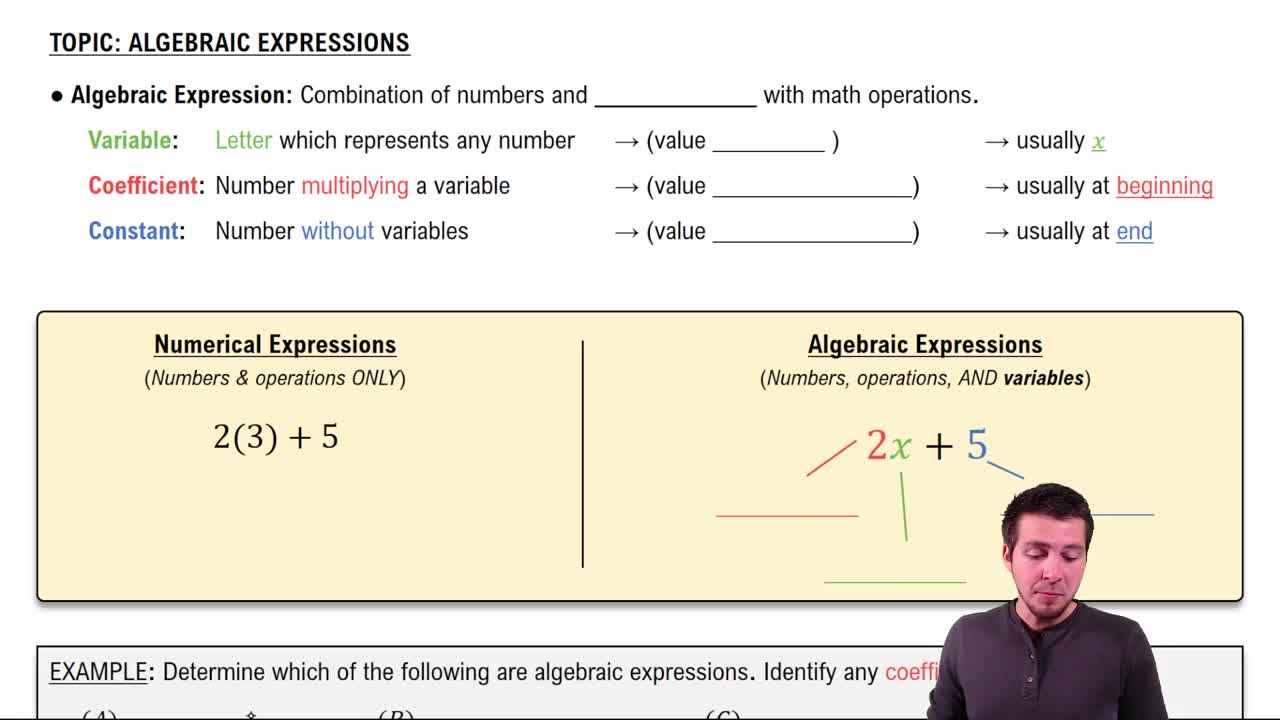
Algebraic Expressions

An algebraic expression is a mathematical phrase that can include numbers, variables, and operation symbols. In this case, the expression (2x + 3y) / (x + 1) combines both variables and constants, and understanding how to manipulate these expressions is crucial for evaluation.
Recommended video:
Guided course
05:09
Introduction to Algebraic Expressions

Substitution

Substitution is the process of replacing variables in an expression with their corresponding numerical values. For the given expression, substituting x = -2 and y = 4 allows us to simplify the expression into a numerical form, which is essential for evaluating the expression correctly.
Recommended video:
Guided course
5:48
Solving Systems of Equations - Substitution

Order of Operations

The order of operations is a set of rules that dictates the sequence in which calculations are performed in an expression. It is commonly remembered by the acronym PEMDAS (Parentheses, Exponents, Multiplication and Division, Addition and Subtraction). Following this order ensures that the evaluation of the expression yields the correct result.
Recommended video:
Guided course
8:38
Performing Row Operations on Matrices