Simplify each radical. Assume all variables represent positive real numbers. ∛(27 + a³)
Verified step by step guidance
1
Recognize that the expression inside the cube root is \(27 + a^3\).
Notice that \(27\) is a perfect cube, since \(27 = 3^3\).
Observe that \(a^3\) is also a perfect cube, as it is \((a)^3\).
Rewrite the expression inside the cube root as \((3 + a)^3\).
Apply the property of cube roots: \(\sqrt[3]{(3 + a)^3} = 3 + a\).
Verified video answer for a similar problem:
This video solution was recommended by our tutors as helpful for the problem above
Video duration:
1m
Play a video:
Was this helpful?
Key Concepts
Here are the essential concepts you must grasp in order to answer the question correctly.
Radical Expressions
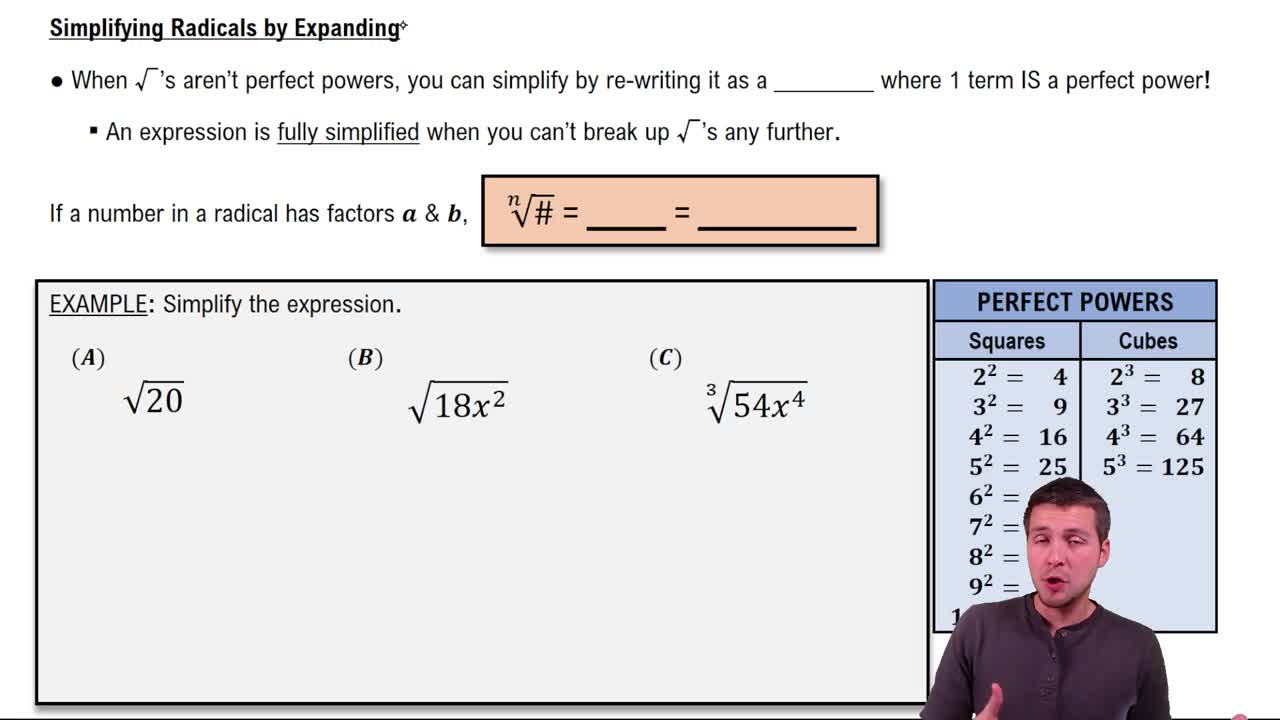
Radical expressions involve roots, such as square roots or cube roots. In this context, the expression ∛(27 + a³) represents the cube root of the sum of 27 and a cubed variable. Understanding how to manipulate and simplify these expressions is crucial for solving problems involving radicals.
Properties of exponents are rules that govern how to handle expressions involving powers and roots. For instance, the cube root can be expressed as raising to the power of one-third. Familiarity with these properties allows for the simplification of expressions like ∛(27 + a³) by recognizing how to combine and simplify terms.
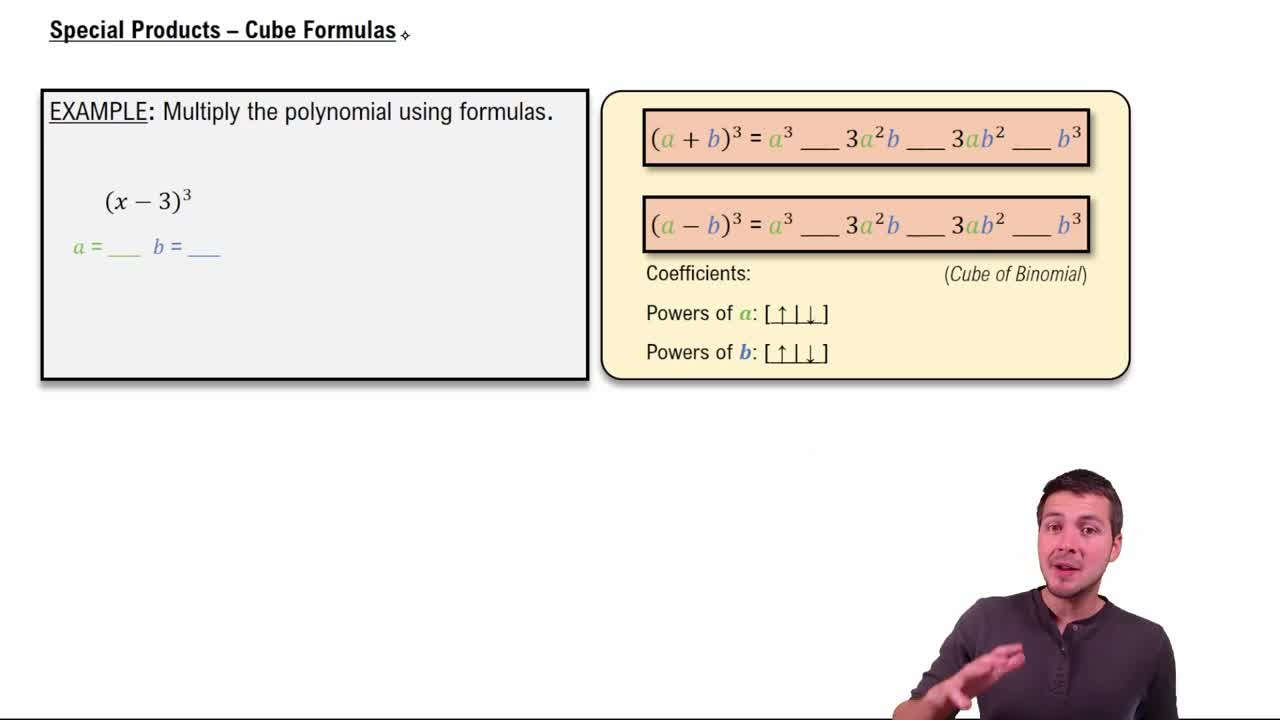
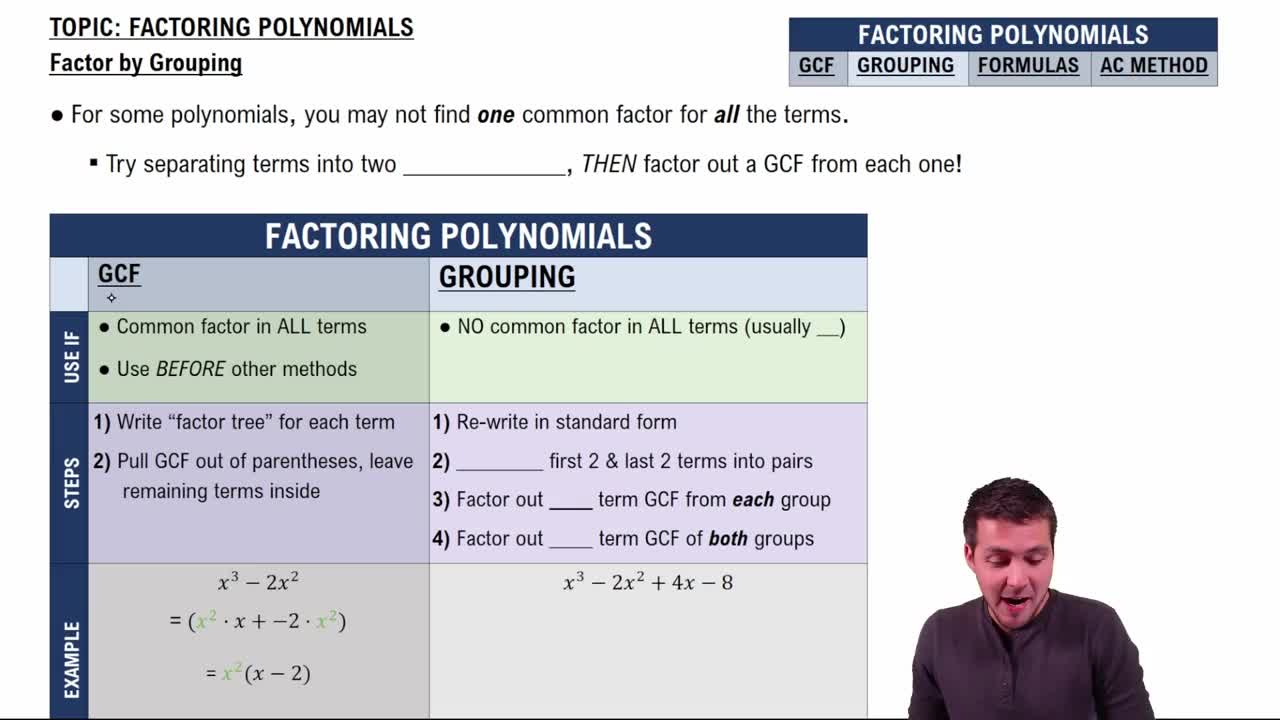
Factoring involves breaking down expressions into simpler components, which can help in simplifying radical expressions. In the case of ∛(27 + a³), recognizing that 27 is a perfect cube (3³) and that a³ is also a perfect cube allows for the application of the sum of cubes formula, facilitating the simplification process.