Write each expression without negative exponents, and evaluate if possible. Assume all variables represent nonzero real numbers. See Example 4. (5t)-3
Verified step by step guidance
1
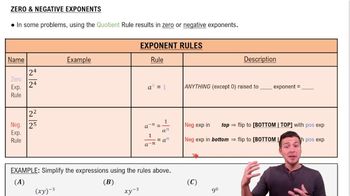
Recall the rule for negative exponents: \(a^{-n} = \frac{1}{a^n}\), where \(a \neq 0\). This means that a negative exponent indicates the reciprocal of the base raised to the positive exponent.
Apply this rule to the expression \((5t)^{-3}\). Rewrite it as the reciprocal of \((5t)^3\), so \((5t)^{-3} = \frac{1}{(5t)^3}\).
Next, expand the denominator by applying the exponent to both factors inside the parentheses: \((5t)^3 = 5^3 \cdot t^3\).
Calculate \$5^3\( as \)5 \times 5 \times 5\(, but since we are not asked for the final numerical value, just write it as \)5^3$ for now.
Write the expression without negative exponents as \(\frac{1}{5^3 t^3}\), which is the simplified form without negative exponents.
Verified video answer for a similar problem:
This video solution was recommended by our tutors as helpful for the problem above
Video duration:
2m
Play a video:
Was this helpful?
Key Concepts
Here are the essential concepts you must grasp in order to answer the question correctly.
Negative Exponents
A negative exponent indicates the reciprocal of the base raised to the corresponding positive exponent. For example, a^-n = 1/a^n, where a ≠ 0. This rule allows rewriting expressions without negative exponents by moving factors between numerator and denominator.
When raising a product to a power, each factor inside the parentheses is raised to that power separately. For instance, (ab)^n = a^n * b^n. This property helps simplify expressions like (5t)^-3 by applying the exponent to both 5 and t.
When variables represent nonzero real numbers, expressions can be simplified using algebraic rules without concern for division by zero. This assumption ensures that operations like taking reciprocals or raising to powers are valid and the expression can be evaluated or simplified accordingly.