Identify the numerator and denominator of the fraction: numerator = 16, denominator = 64.
Find the greatest common divisor (GCD) of 16 and 64. The GCD is the largest number that divides both 16 and 64 without leaving a remainder.
Divide both the numerator and the denominator by the GCD to simplify the fraction.
Write the simplified fraction as \(\frac{\text{numerator} \div \text{GCD}}{\text{denominator} \div \text{GCD}}\).
Verify that the fraction is in lowest terms by checking that the numerator and denominator have no common divisors other than 1.
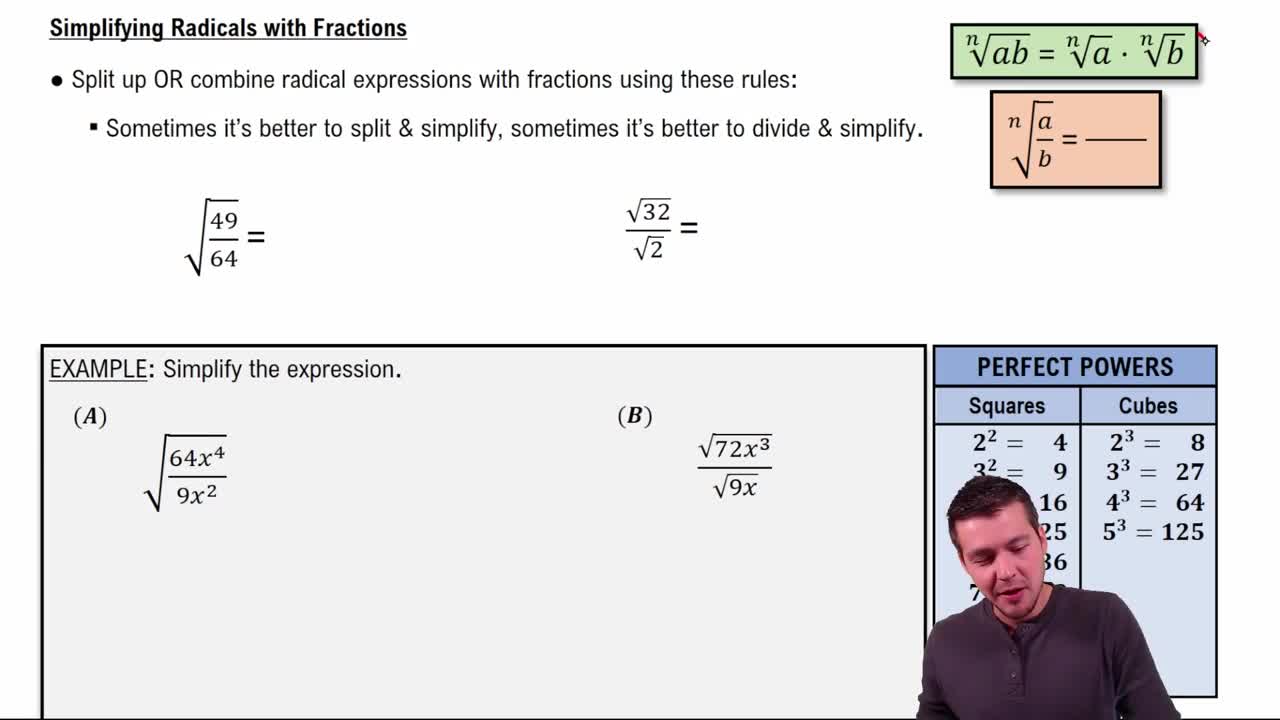
Verified video answer for a similar problem:
This video solution was recommended by our tutors as helpful for the problem above
Video duration:
2m
Play a video:
Was this helpful?
Key Concepts
Here are the essential concepts you must grasp in order to answer the question correctly.
Simplifying Fractions
Simplifying fractions involves reducing the numerator and denominator to their smallest whole numbers while keeping the same value. This is done by dividing both by their greatest common divisor (GCD). For example, simplifying 16/64 requires finding the GCD of 16 and 64.
The GCD of two numbers is the largest number that divides both without leaving a remainder. Finding the GCD is essential for simplifying fractions because it helps identify the factor by which both numerator and denominator can be divided to reduce the fraction.
A fraction represents a part of a whole and consists of a numerator (top number) and a denominator (bottom number). Understanding this notation is crucial for performing operations like simplification, as it clarifies which numbers to manipulate.