For ƒ(x) = 3x and g(x)= (1/4)x find each of the following. Round answers to the nearest thousandth as needed. ƒ(-5/2)
Table of contents
- 0. Review of Algebra4h 18m
- 1. Equations & Inequalities3h 18m
- 2. Graphs of Equations1h 43m
- 3. Functions2h 17m
- 4. Polynomial Functions1h 44m
- 5. Rational Functions1h 23m
- 6. Exponential & Logarithmic Functions2h 28m
- 7. Systems of Equations & Matrices4h 5m
- 8. Conic Sections2h 23m
- 9. Sequences, Series, & Induction1h 22m
- 10. Combinatorics & Probability1h 45m
6. Exponential & Logarithmic Functions
Introduction to Exponential Functions
Problem 27
Textbook Question
Graph each function. ƒ(x) = 3x
Verified step by step guidance1
Identify the type of function given. Here, the function is an exponential function of the form \(f(x) = 3^x\), where the base is 3 and the exponent is the variable \(x\).
Determine key points to plot by substituting values of \(x\) into the function. For example, calculate \(f(-1) = 3^{-1}\), \(f(0) = 3^0\), \(f(1) = 3^1\), and \(f(2) = 3^2\). These points will help you understand the shape of the graph.
Plot the points found on the coordinate plane. Remember that \$3^0 = 1\(, so the graph will pass through the point \)(0,1)$, which is a key characteristic of exponential functions.
Analyze the behavior of the graph as \(x\) approaches positive and negative infinity. For \(f(x) = 3^x\), as \(x \to \infty\), \(f(x) \to \infty\), and as \(x \to -\infty\), \(f(x) \to 0\). This means the graph will rise steeply to the right and approach the x-axis but never touch it on the left.
Draw a smooth curve through the plotted points, ensuring the graph reflects the exponential growth and the horizontal asymptote at \(y=0\). Label the axes and the function for clarity.
Verified video answer for a similar problem:This video solution was recommended by our tutors as helpful for the problem above
Video duration:
5mPlay a video:
Was this helpful?
Key Concepts
Here are the essential concepts you must grasp in order to answer the question correctly.
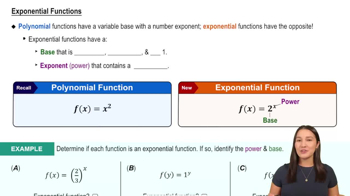
Exponential Functions
An exponential function has the form f(x) = a^x, where the base a is a positive constant not equal to 1. The function grows or decays rapidly depending on whether a is greater than or less than 1. Understanding this form helps in predicting the shape and behavior of the graph.
Recommended video:
Exponential Functions
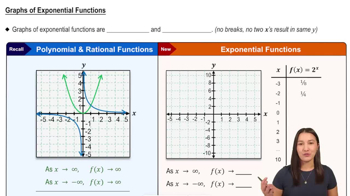
Graphing Exponential Functions
To graph an exponential function like f(x) = 3^x, plot key points such as when x = 0 (f(0) = 1) and other integer values. The graph passes through (0,1) and increases rapidly for positive x, approaching zero but never touching the x-axis for negative x. Recognizing these features aids in sketching the curve accurately.
Recommended video:
Graphs of Exponential Functions
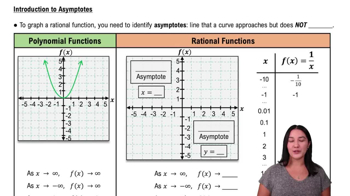
Asymptotes
An asymptote is a line that the graph approaches but never touches. For f(x) = 3^x, the x-axis (y=0) is a horizontal asymptote, meaning the function values get closer to zero as x becomes very negative. Identifying asymptotes helps understand the long-term behavior of the function.
Recommended video:
Introduction to Asymptotes
Watch next
Master Exponential Functions with a bite sized video explanation from Patrick
Start learningRelated Videos
Related Practice
Textbook Question
547
views