Write the partial fraction decomposition of each rational expression. x/(x-2)(x-3)
Table of contents
- 0. Review of Algebra4h 18m
- 1. Equations & Inequalities3h 18m
- 2. Graphs of Equations1h 43m
- 3. Functions2h 17m
- 4. Polynomial Functions1h 44m
- 5. Rational Functions1h 23m
- 6. Exponential & Logarithmic Functions2h 28m
- 7. Systems of Equations & Matrices4h 5m
- 8. Conic Sections2h 23m
- 9. Sequences, Series, & Induction1h 22m
- 10. Combinatorics & Probability1h 45m
7. Systems of Equations & Matrices
Introduction to Matrices
Problem 4
Textbook Question
In Exercises 1–8, write the form of the partial fraction decomposition of the rational expression. It is not necessary to solve for the constants. (3x+16)/(x + 1) (x − 2)²
Verified step by step guidance1
Identify the factors in the denominator: (x + 1) and (x - 2)². Note that (x - 2) is a repeated linear factor with multiplicity 2.
Write a separate term for each factor and each power of the repeated factor. For the linear factor (x + 1), use a term of the form where A is a constant to be determined.
For the repeated linear factor (x - 2)², write terms for each power: one term with denominator (x - 2) and another with denominator (x - 2)². These take the form and respectively, where B and C are constants.
Combine all terms to write the full partial fraction decomposition: .
This expression represents the form of the partial fraction decomposition. Constants A, B, and C would be found by multiplying both sides by the denominator and equating coefficients, but that is not required here.
Verified video answer for a similar problem:This video solution was recommended by our tutors as helpful for the problem above
Video duration:
3mPlay a video:
Was this helpful?
Key Concepts
Here are the essential concepts you must grasp in order to answer the question correctly.
Partial Fraction Decomposition
Partial fraction decomposition is a method used to express a rational function as a sum of simpler fractions, making integration or other operations easier. It involves breaking down a complex fraction into a sum of fractions with simpler denominators, typically linear or quadratic factors.
Recommended video:
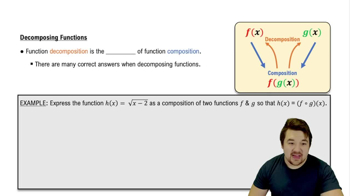
Decomposition of Functions
Factorization of Denominators
Understanding how to factor the denominator into linear and repeated factors is essential. In this problem, the denominator is factored as (x + 1)(x − 2)², indicating one linear factor and one repeated linear factor, which affects the form of the partial fractions.
Recommended video:
Guided course
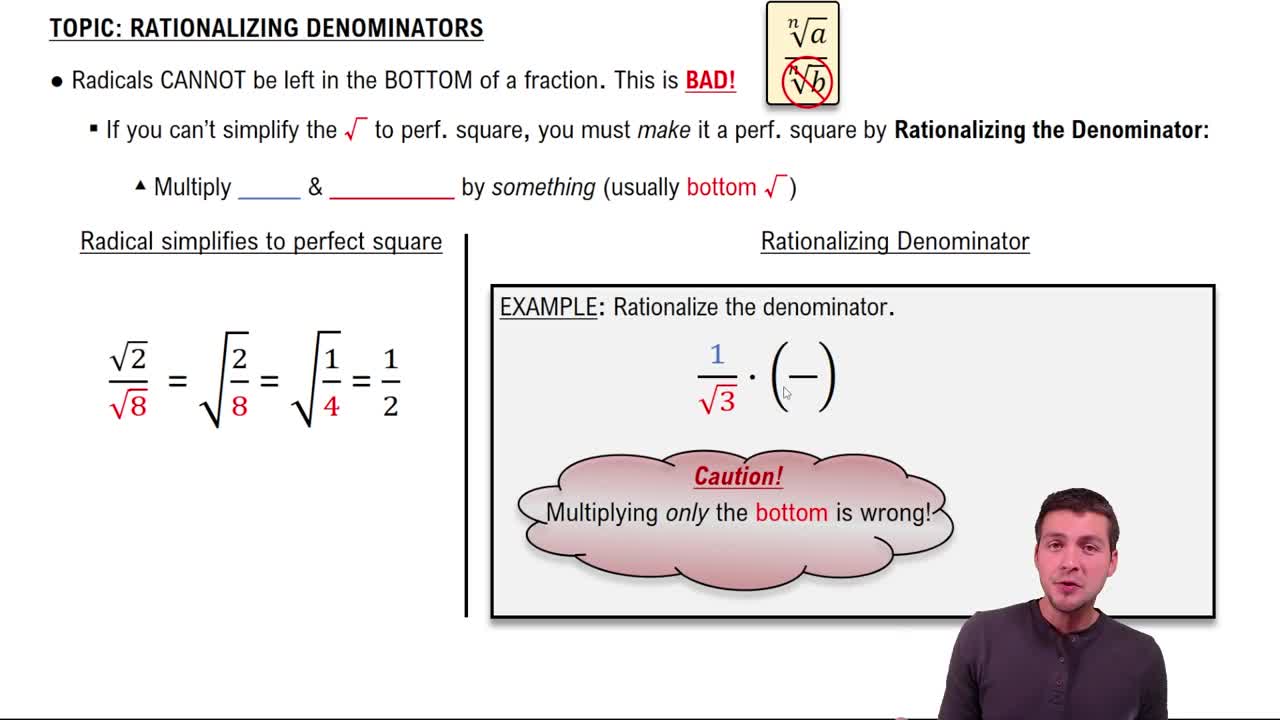
Rationalizing Denominators
Form of Partial Fractions for Repeated Factors
When a denominator has repeated linear factors like (x − 2)², the partial fraction decomposition includes terms for each power of the repeated factor. For (x − 2)², the decomposition includes terms with denominators (x − 2) and (x − 2)², each with its own constant numerator.
Recommended video:
Guided course
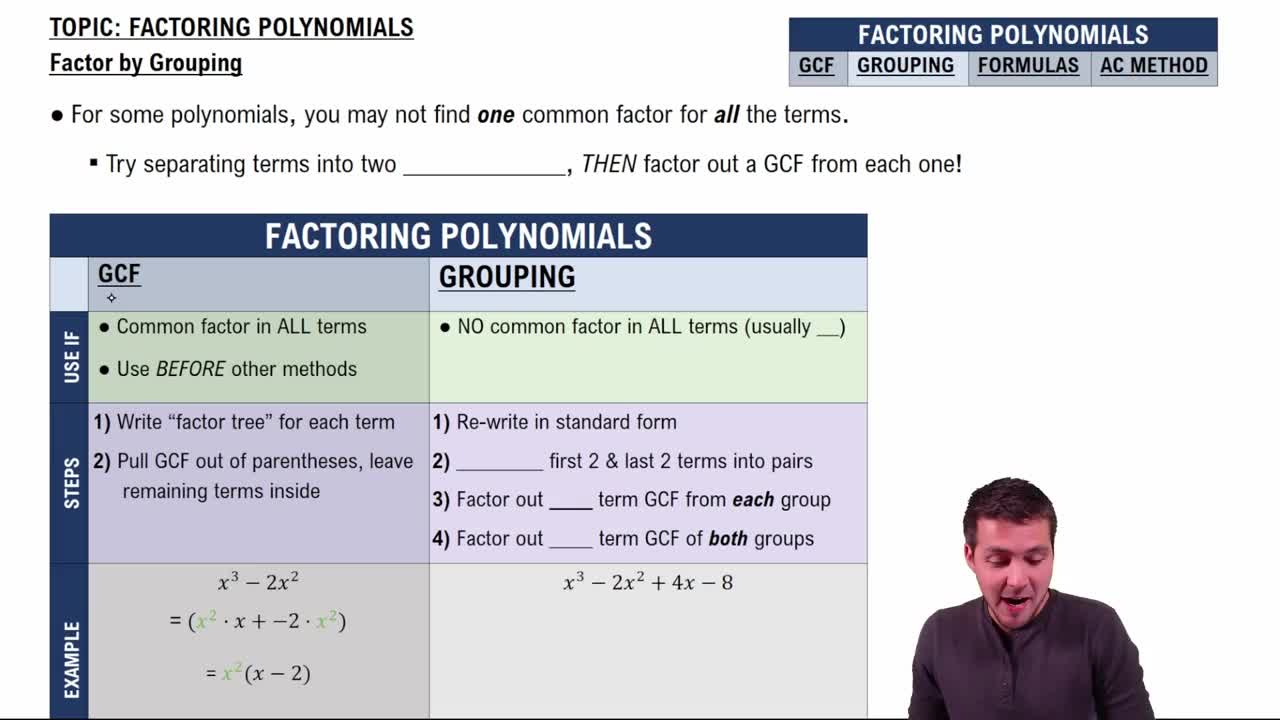
Factor by Grouping
Watch next
Master Introduction to Matrices with a bite sized video explanation from Patrick
Start learningRelated Videos
Related Practice
Textbook Question
455
views