Use the graph of y = f(x) to graph each function g. g(x) = f(x+1)
Table of contents
- 0. Review of Algebra4h 18m
- 1. Equations & Inequalities3h 18m
- 2. Graphs of Equations1h 43m
- 3. Functions2h 17m
- 4. Polynomial Functions1h 44m
- 5. Rational Functions1h 23m
- 6. Exponential & Logarithmic Functions2h 28m
- 7. Systems of Equations & Matrices4h 5m
- 8. Conic Sections2h 23m
- 9. Sequences, Series, & Induction1h 22m
- 10. Combinatorics & Probability1h 45m
3. Functions
Transformations
Problem 107
Textbook Question
Work each problem. Find a function g(x)=ax+b whose graph can be obtained by translating the graph of ƒ(x)=2x+5 up 2 units and to the left 3 units.
Verified step by step guidance1
Start with the original function: \(f(x) = 2x + 5\).
Recall that translating a graph up by 2 units means adding 2 to the entire function, so the function becomes \(f(x) + 2\).
Translating the graph to the left by 3 units means replacing \(x\) with \((x + 3)\) in the function, so the function becomes \(f(x + 3)\).
Apply the horizontal translation first: replace \(x\) with \((x + 3)\) in \(f(x)\) to get \(f(x + 3) = 2(x + 3) + 5\).
Then apply the vertical translation by adding 2: \(g(x) = f(x + 3) + 2 = 2(x + 3) + 5 + 2\). Simplify this expression to write \(g(x)\) in the form \(ax + b\).
Verified video answer for a similar problem:This video solution was recommended by our tutors as helpful for the problem above
Video duration:
1mPlay a video:
Was this helpful?
Key Concepts
Here are the essential concepts you must grasp in order to answer the question correctly.
Function Translation
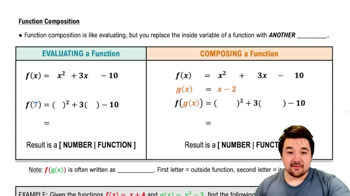
Function translation involves shifting the graph of a function horizontally or vertically without changing its shape. Moving a graph up or down adds or subtracts a constant to the function's output, while moving left or right adjusts the input variable inside the function.
Recommended video:
Function Composition
Horizontal Translation and Input Adjustment
Translating a graph to the left by a certain number of units means replacing the input variable x with (x + h), where h is the number of units moved left. This shifts the graph horizontally and affects the function's formula accordingly.
Recommended video:
Horizontal Parabolas
Linear Function Form and Parameters
A linear function has the form g(x) = ax + b, where a is the slope and b is the y-intercept. Understanding how translations affect these parameters helps in finding the new function after shifting the original graph.
Recommended video:
Linear Inequalities
Watch next
Master Intro to Transformations with a bite sized video explanation from Patrick
Start learningRelated Videos
Related Practice
Textbook Question
615
views