Match each function with its graph without actually entering it into a calculator. Then, after completing the exercises, check the answers with a calculator. Use the standard viewing window. ƒ(x) = (x + 4)2 - 3
Verified step by step guidance
1
Identify the base function: recognize that the given function is a quadratic function in vertex form, which is \(f(x) = (x + 4)^2 - 3\). The base function is \(x^2\), a parabola opening upwards with vertex at the origin.
Determine the vertex of the parabola: since the function is in the form \(f(x) = (x - h)^2 + k\), the vertex is at \((-4, -3)\) because the expression inside the square is \((x + 4)\), which can be rewritten as \((x - (-4))\).
Analyze the transformations: the graph is shifted horizontally 4 units to the left (due to \(x + 4\)) and vertically 3 units down (due to \(-3\)). The parabola still opens upwards because the coefficient of the squared term is positive.
Sketch or visualize the graph based on these transformations: start with the basic parabola \(y = x^2\), move it left 4 units and down 3 units to place the vertex at \((-4, -3)\), and keep the shape the same (opening upwards).
Match the function to the graph that has a vertex at \((-4, -3)\) and opens upwards, without any stretching or reflecting, then verify your choice using a calculator with the standard viewing window.
Verified video answer for a similar problem:
This video solution was recommended by our tutors as helpful for the problem above
Video duration:
3m
Play a video:
0 Comments
Key Concepts
Here are the essential concepts you must grasp in order to answer the question correctly.
Transformations of Quadratic Functions
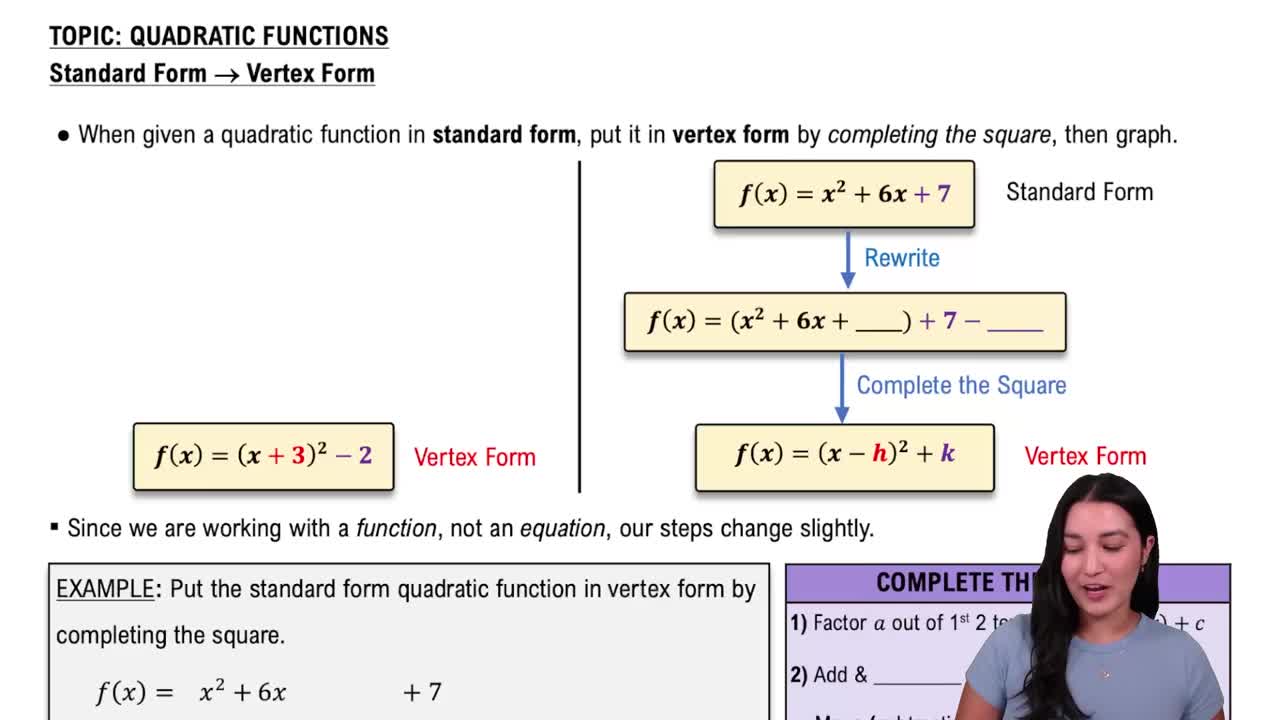
Understanding how changes inside the function's formula affect its graph is essential. For f(x) = (x + 4)^2 - 3, the '+4' inside the parentheses shifts the graph horizontally left by 4 units, and the '-3' shifts it vertically down by 3 units. Recognizing these shifts helps match the function to its graph without graphing technology.
A quadratic function in vertex form, f(x) = a(x - h)^2 + k, reveals the vertex directly as (h, k). Here, rewriting f(x) = (x + 4)^2 - 3 as (x - (-4))^2 - 3 shows the vertex at (-4, -3). Knowing the vertex location is key to identifying the parabola's position on the coordinate plane.
The coefficient of the squared term determines the parabola's opening direction and width. Since the coefficient of (x + 4)^2 is positive 1, the parabola opens upward and has a standard width. This knowledge helps distinguish the graph from others that might open downward or be wider/narrower.

 3:59 minutes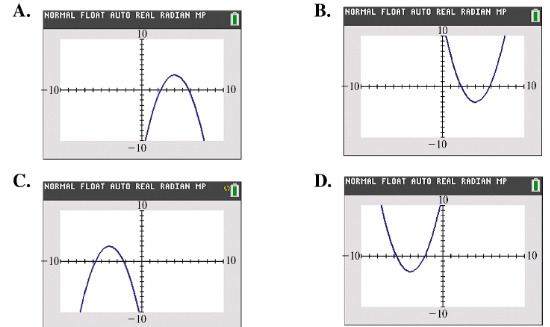
 Verified step by step guidance
 4:22
4:22