Fill in the blank(s) to correctly complete each sentence. If ƒ(x) = 4x, then ƒ(2) = and ƒ(-2) = ________.
Table of contents
- 0. Review of Algebra4h 18m
- 1. Equations & Inequalities3h 18m
- 2. Graphs of Equations1h 43m
- 3. Functions2h 17m
- 4. Polynomial Functions1h 44m
- 5. Rational Functions1h 23m
- 6. Exponential & Logarithmic Functions2h 28m
- 7. Systems of Equations & Matrices4h 5m
- 8. Conic Sections2h 23m
- 9. Sequences, Series, & Induction1h 22m
- 10. Combinatorics & Probability1h 45m
6. Exponential & Logarithmic Functions
Introduction to Exponential Functions
Problem 7
Textbook Question
In Exercises 5–9, graph f and g in the same rectangular coordinate system. Use transformations of the graph of f to obtain the graph of g. Graph and give equations of all asymptotes. Use the graphs to determine each function's domain and range. f(x) = 3x and g(x) = -3x
Verified step by step guidance1
Identify the base function and its transformation: The base function is \(f(x) = 3^x\), which is an exponential function with base 3.
Understand the transformation from \(f(x)\) to \(g(x)\): The function \(g(x) = -3^x\) is obtained by reflecting the graph of \(f(x)\) across the x-axis because of the negative sign in front.
Graph \(f(x) = 3^x\): Plot points for several values of \(x\) (e.g., \(x = -2, -1, 0, 1, 2\)) to see the exponential growth. Note that \(f(x)\) approaches 0 as \(x\) approaches negative infinity but never touches the x-axis.
Graph \(g(x) = -3^x\): Use the reflection transformation on the points of \(f(x)\) by multiplying the \(y\)-values by -1. This flips the graph over the x-axis, so it approaches 0 from below as \(x\) approaches negative infinity.
Determine the asymptotes, domain, and range: Both functions have a horizontal asymptote at \(y=0\). The domain for both is all real numbers, \((-\infty, \infty)\). The range of \(f(x)\) is \((0, \infty)\), and the range of \(g(x)\) is \((-\infty, 0)\).
Verified video answer for a similar problem:This video solution was recommended by our tutors as helpful for the problem above
Video duration:
9mPlay a video:
Key Concepts
Here are the essential concepts you must grasp in order to answer the question correctly.
Exponential Functions and Their Graphs
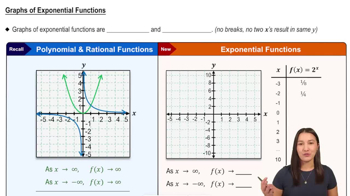
An exponential function has the form f(x) = a^x, where a > 0 and a ≠ 1. Its graph shows rapid growth or decay depending on the base. Understanding the shape and behavior of f(x) = 3^x is essential for graphing and comparing transformations.
Recommended video:
Graphs of Exponential Functions
Transformations of Functions
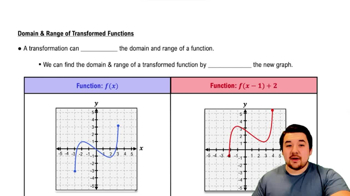
Transformations include shifts, reflections, stretches, and compressions of a graph. For g(x) = -3^x, the negative sign reflects the graph of f(x) = 3^x across the x-axis. Recognizing how these changes affect the graph helps in sketching g from f.
Recommended video:
Domain & Range of Transformed Functions
Asymptotes, Domain, and Range
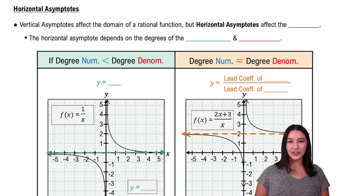
An asymptote is a line that the graph approaches but never touches. For exponential functions like f(x) = 3^x, the horizontal asymptote is y = 0. Identifying asymptotes aids in determining the domain (all real x) and range (values y can take) of the functions.
Recommended video:
Determining Horizontal Asymptotes
Watch next
Master Exponential Functions with a bite sized video explanation from Patrick
Start learningRelated Videos
Related Practice
Textbook Question
680
views