Identify the expression inside the radical: the fourth root of \(7^2\), which can be written as \(\sqrt[4]{7^2}\).
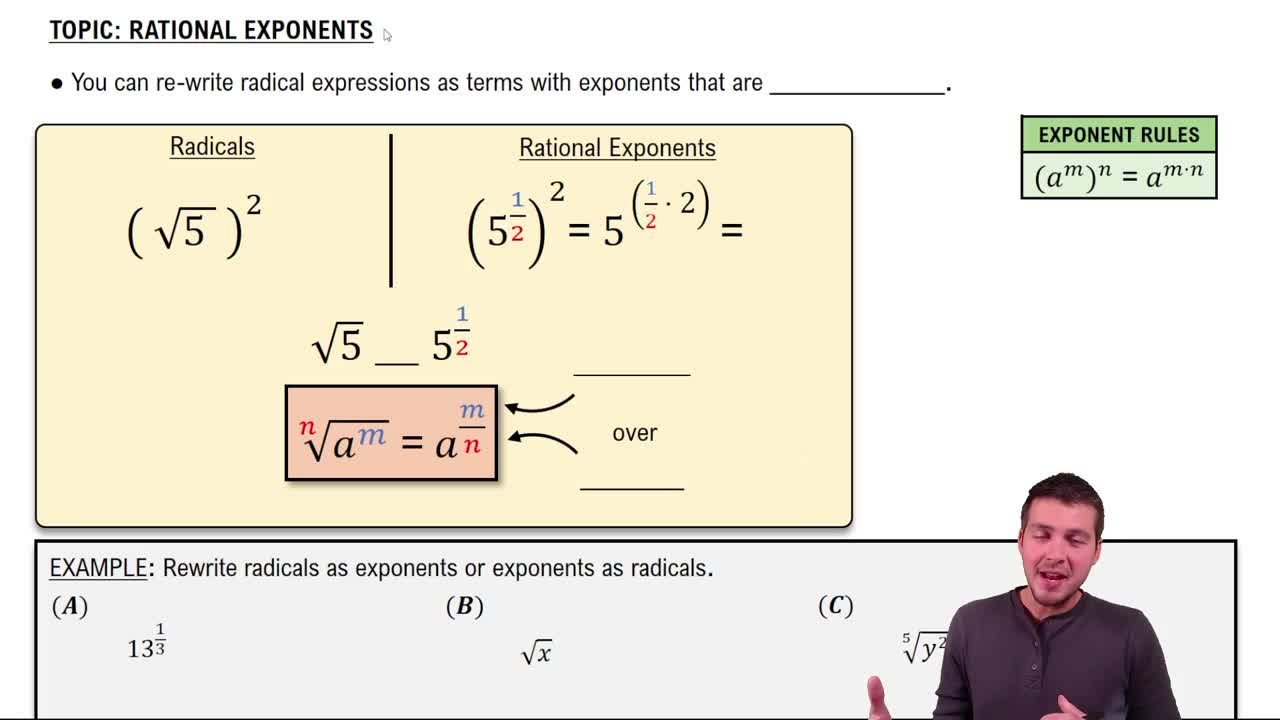
Recall the property of radicals and exponents: \(\sqrt[n]{a^m} = a^{\frac{m}{n}}\). Apply this to rewrite the expression as \(7^{\frac{2}{4}}\).
Simplify the fraction in the exponent: \(\frac{2}{4} = \frac{1}{2}\), so the expression becomes \(7^{\frac{1}{2}}\).
Recognize that \(7^{\frac{1}{2}}\) is equivalent to the square root of 7, or \(\sqrt{7}\).
Thus, the simplified form of \(\sqrt[4]{7^2}\) is \(\sqrt{7}\).
Verified video answer for a similar problem:
This video solution was recommended by our tutors as helpful for the problem above
Video duration:
1m
Play a video:
Was this helpful?
Key Concepts
Here are the essential concepts you must grasp in order to answer the question correctly.
Radical Expressions and Indices
A radical expression involves roots, such as square roots or fourth roots, indicated by an index. The index shows the degree of the root, for example, the fourth root (⁴√) means the number raised to the 1/4 power. Understanding how to interpret and manipulate these indices is essential for simplifying radicals.
Reducing the index means rewriting a radical with a smaller root index or converting it into an equivalent expression with fractional exponents. This often involves expressing the radicand with powers that allow simplification, such as rewriting ⁴√(7²) as 7^(2/4) and then simplifying the fraction.
Fractional exponents represent roots and powers simultaneously, where a^(m/n) equals the nth root of a raised to the mth power. Simplifying expressions with fractional exponents involves reducing the fraction and rewriting the expression in simplest form, which helps in reducing the index of radicals effectively.