
Textbook Question
Solve each of the following problems using one or more conversion factors:
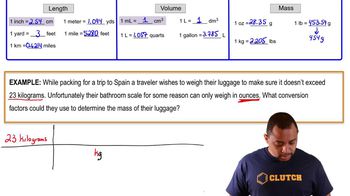
a. A container holds 0.500 qt of liquid. How many milliliters of lemonade will it hold?
2231
views

 Verified step by step guidance
 01:16
01:16
 03:45
03:45 06:11
06:11Solve each of the following problems using one or more conversion factors:
a. A container holds 0.500 qt of liquid. How many milliliters of lemonade will it hold?
Use metric conversion factors to solve each of the following problems:
c. A package of chocolate instant pudding contains 2840 mg of sodium. How many grams of sodium are in the pudding?
Use metric conversion factors to solve each of the following problems:
a. The Daily Value (DV) for phosphorus is 800 mg. How many grams of phosphorus are recommended?
Use metric conversion factors to solve each of the following problems:
d. A jar contains 0.29 kg of olives. How many grams of olives are in the jar?
Use metric conversion factors to solve each of the following problems:
d. A balloon has a volume of 3500 cm3. What is the volume in liters?
Use metric conversion factors to solve each of the following problems:
c. A hummingbird has a mass of 0.0055 kg. What is the mass, in grams, of the hummingbird?