Why can two conversion factors be written for an equality such as 1 m = 100 cm?
Ch.2 Chemistry and Measurements
Timberlake13th EditionChemistry: An Introduction to General, Organic, and Biological ChemistryISBN: 9780134421353Not the one you use?Change textbook
Chapter 2, Problem 52a
Write the equality and two conversion factors, and identify the numbers as exact or give the number of significant figures for each of the following:
a. The label on a bottle reads 10 mg of furosemide per 1 mL.
Verified step by step guidance1
Step 1: Write the equality based on the given information. The label states that there are 10 mg of furosemide per 1 mL. Therefore, the equality is: .
Step 2: Create the first conversion factor using the equality. To convert from milligrams to milliliters, the conversion factor is: .
Step 3: Create the second conversion factor using the equality. To convert from milliliters to milligrams, the conversion factor is: .
Step 4: Identify the numbers in the equality and conversion factors as exact or approximate. The number '1' in '1 mL' is exact because it is defined, while '10 mg' is approximate and has 2 significant figures.
Step 5: Summarize the equality and conversion factors. The equality is , and the conversion factors are and . The significant figures and exactness of the numbers have been identified.

Verified video answer for a similar problem:
This video solution was recommended by our tutors as helpful for the problem above.
Video duration:
3mWas this helpful?
Key Concepts
Here are the essential concepts you must grasp in order to answer the question correctly.
Significant Figures
Significant figures are the digits in a number that contribute to its precision. This includes all non-zero digits, any zeros between significant digits, and trailing zeros in the decimal portion. Understanding significant figures is crucial for accurately reporting measurements and ensuring that calculations reflect the precision of the data.
Recommended video:
Guided course
Significant Figures (Simplified) Example 2
Conversion Factors
Conversion factors are ratios that express how many of one unit are equal to another unit. They are used to convert measurements from one unit to another while maintaining the same quantity. For example, in the case of the furosemide solution, the conversion factor could relate milligrams to grams or milliliters to liters, facilitating accurate calculations in different units.
Recommended video:
Guided course
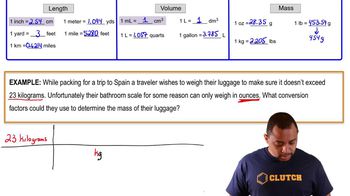
Conversion Factors (Simplified) Example 2
Exact Numbers
Exact numbers are values that are counted or defined and have no uncertainty, such as the number of items in a dozen (12) or defined quantities like 1 inch = 2.54 cm. In contrast, measured numbers have a degree of uncertainty. Identifying whether a number is exact or measured is essential for determining how many significant figures to report in calculations.
Recommended video:
Guided course
Calculate Oxidation Numbers
Related Practice
Textbook Question
1555
views
Textbook Question
Write the equality and two conversion factors for each of the following pairs of units:
b. nanograms and grams
1516
views
Textbook Question
Write the equality and two conversion factors for each of the following pairs of units:
a. centimeters and inches
1457
views
Textbook Question
Write the equality and two conversion factors, and identify the numbers as exact or give the number of significant figures for each of the following:
b. The Daily Value (DV) for selenium is 70. mcg.
1324
views
Textbook Question
Write an equality and two conversion factors for each of the following medications:
a. 10 mg of Atarax per 5 mL of Atarax syrup
1729
views
Textbook Question
Write an equality and two conversion factors for each of the following medications:
b. 0.25 g of Lanoxin per 1 tablet of Lanoxin
1379
views