Pearson+ LogoPearson+ Logo
Ch.9 Solutions
Timberlake - Chemistry: An Introduction to General, Organic, and Biological Chemistry 13th Edition
Timberlake13th EditionChemistry: An Introduction to General, Organic, and Biological ChemistryISBN: 9780134421353Not the one you use?Change textbook
Chapter 9, Problem 83

A semipermeable membrane separates two compartments, A and B. If the levels in A and B are equal initially, select the diagram that illustrates the final levels in a to d:
<IMAGE>

Verified step by step guidance
1
Step 1: Understand the concept of osmosis. Osmosis is the movement of water across a semipermeable membrane from a region of lower solute concentration to a region of higher solute concentration to equalize the concentrations on both sides.
Step 2: Analyze the given data. Compartment I contains 0.15% (m/v) KCl, and Compartment II contains 0.45% (m/v) KCl. The semipermeable membrane allows water to pass but not the solute (KCl).
Step 3: Predict the direction of water movement. Since Compartment II has a higher solute concentration (0.45% KCl) compared to Compartment I (0.15% KCl), water will move from Compartment I to Compartment II.
Step 4: Determine the effect on liquid levels. As water moves from Compartment I to Compartment II, the liquid level in Compartment I will decrease, and the liquid level in Compartment II will increase.
Step 5: Select the diagram that matches the final levels. The correct diagram will show a lower liquid level in Compartment I and a higher liquid level in Compartment II, reflecting the movement of water due to osmosis.

Verified video answer for a similar problem:

This video solution was recommended by our tutors as helpful for the problem above.
Video duration:
1m
Was this helpful?

Key Concepts

Here are the essential concepts you must grasp in order to answer the question correctly.

Semipermeable Membrane

A semipermeable membrane is a barrier that allows certain molecules or ions to pass through while blocking others. In biological systems, this property is crucial for maintaining homeostasis, as it regulates the movement of substances between compartments, such as cells and their environment.
Recommended video:
Guided course
1:00
Cell Membranes Example 1

Osmosis

Osmosis is the movement of water across a semipermeable membrane from an area of lower solute concentration to an area of higher solute concentration. This process continues until equilibrium is reached, which is essential for maintaining proper cell function and volume.
Recommended video:
Guided course
00:38
Osmosis Example 1

Concentration Gradient

A concentration gradient refers to the difference in the concentration of a substance between two areas. In this scenario, the gradient exists between compartments A and B due to the differing KCl concentrations, driving the movement of water and ions until the concentrations equalize.
Recommended video:
Guided course
00:52
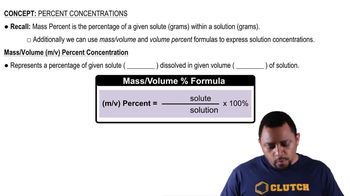
Percent Concentrations Concept 1