Pearson+ LogoPearson+ Logo
Ch.10 Acids and Bases and Equilibrium
Timberlake - Chemistry: An Introduction to General, Organic, and Biological Chemistry 13th Edition
Timberlake13th EditionChemistry: An Introduction to General, Organic, and Biological ChemistryISBN: 9780134421353Not the one you use?Change textbook
Chapter 10, Problem 81e

Identify each of the following as an acid, base, or salt, and give its name:
e. H2CO3

Verified step by step guidance
1
Step 1: Recognize the chemical formula H₂CO₃. This is a molecular compound composed of hydrogen (H), carbon (C), and oxygen (O).
Step 2: Recall that acids typically have hydrogen atoms that can dissociate in water to produce H⁺ ions. H₂CO₃ contains hydrogen atoms that can ionize, which is a characteristic of acids.
Step 3: Identify the polyatomic ion present in the compound. The CO₃ portion represents the carbonate ion (CO₃²⁻). When combined with hydrogen, it forms carbonic acid.
Step 4: Name the compound. The systematic name for H₂CO₃ is carbonic acid. It is classified as an acid because it can donate H⁺ ions in aqueous solutions.
Step 5: Conclude that H₂CO₃ is an acid and its name is carbonic acid.

Verified video answer for a similar problem:

This video solution was recommended by our tutors as helpful for the problem above.
Video duration:
6m
Was this helpful?

Key Concepts

Here are the essential concepts you must grasp in order to answer the question correctly.

Acids and Bases

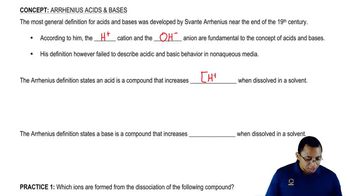
Acids are substances that can donate protons (H⁺ ions) in a solution, while bases are substances that can accept protons. This concept is fundamental in understanding the behavior of various compounds in chemical reactions, particularly in aqueous solutions.
Recommended video:
Guided course
03:11
Arrhenius Acids & Bases Concept 1

Carbonic Acid

H₂CO₃, known as carbonic acid, is a weak acid formed when carbon dioxide dissolves in water. It plays a crucial role in the bicarbonate buffer system, which helps maintain pH balance in biological systems and is important in processes like respiration and digestion.
Recommended video:
Guided course
2:41
Amino Acid Catabolism: Carbon Atoms Concept 1

Acid-Base Classification

The classification of substances as acids, bases, or salts is based on their chemical properties and behavior in water. Understanding this classification helps in predicting how substances will interact in chemical reactions, which is essential for solving problems in chemistry.
Recommended video:
Guided course
1:33
Amino Acid Classifications Example 3