Pearson+ LogoPearson+ Logo
Ch.4 Atoms and Elements
Timberlake - Chemistry: An Introduction to General, Organic, and Biological Chemistry 13th Edition
Timberlake13th EditionChemistry: An Introduction to General, Organic, and Biological ChemistryISBN: 9780134421353Not the one you use?Change textbook
Chapter 4, Problem 22c

Is each of the following statements true or false?
c. Neutrons repel each other.

Verified step by step guidance
1
Understand the nature of neutrons: Neutrons are subatomic particles found in the nucleus of an atom. They are electrically neutral, meaning they have no charge.
Recall the concept of electromagnetic forces: Charged particles interact through electromagnetic forces, which can cause attraction or repulsion. Since neutrons have no charge, they do not experience electromagnetic repulsion or attraction with other neutrons.
Consider the strong nuclear force: Neutrons interact with other neutrons and protons in the nucleus through the strong nuclear force, which is responsible for holding the nucleus together. This force is attractive and acts over very short distances.
Evaluate the statement: Since neutrons do not repel each other (they lack charge and are bound by the attractive strong nuclear force), the statement 'Neutrons repel each other' is false.
Conclude the reasoning: The absence of repulsion between neutrons is due to their neutral charge and the dominance of the strong nuclear force within the nucleus.

Verified video answer for a similar problem:

This video solution was recommended by our tutors as helpful for the problem above.
Video duration:
1m
Was this helpful?

Key Concepts

Here are the essential concepts you must grasp in order to answer the question correctly.

Neutrons

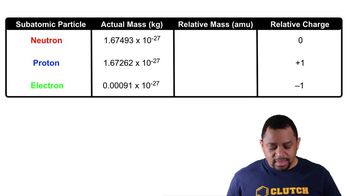
Neutrons are subatomic particles found in the nucleus of an atom, alongside protons. They have no electric charge, which distinguishes them from protons, which are positively charged. This lack of charge means that neutrons do not experience electromagnetic forces, allowing them to coexist in the nucleus without repelling each other.
Recommended video:
Guided course
02:36
Subatomic Particles (Simplified) Concept 2

Nuclear Forces

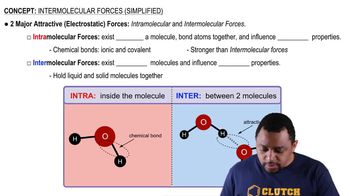
Nuclear forces, specifically the strong nuclear force, are the interactions that hold protons and neutrons together in the atomic nucleus. This force is much stronger than the electromagnetic force but acts over very short distances. It is responsible for overcoming the repulsion between positively charged protons, allowing neutrons to stabilize the nucleus.
Recommended video:
Guided course
01:59
Intermolecular Forces (Simplified) Concept 1

Electromagnetic Repulsion

Electromagnetic repulsion occurs between charged particles, such as protons, which repel each other due to their like charges. Neutrons, being neutral, do not engage in this type of interaction. Therefore, the statement that neutrons repel each other is false, as they do not exert electromagnetic forces on one another.
Recommended video:
Guided course
05:11
Electromagnetic Spectrum (Simplified) Concept 1