Degrees of Vertices: Videos & Practice Problems
Degrees of Vertices focuses on how many edges are connected to each vertex in a graph. The degree of a vertex is found by counting all edges attached to it. If a graph is given by a list of edges instead of a picture, the degree can still be found by locating every edge that includes the vertex. Vertices are also described by parity: a vertex is even if its degree is even and odd if its degree is odd.
This topic also includes recognizing special cases. An isolated vertex has degree 0 because no edges are connected to it. A loop is counted as one edge in the graph, but it adds 2 to the degree of its vertex. These ideas help when labeling vertices, identifying odd and even vertices, and deciding whether a graph has a required number of vertices or a required number of odd vertices.
Degrees of Vertices


Label the degree and parity (even/odd) of each vertex on each graph.
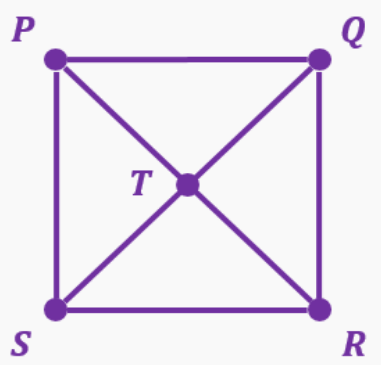
P = 3-odd; Q = 6-even; R = 9-odd; S = 12-even; T = 4-even
P = 3-odd; Q = 6-even; R = 9-odd; S = 12-even; T = 16-even
P = 3-odd; Q = 3-odd; R = 3-odd; S = 3-odd; T = 4-even
P = 2-odd; Q = 3-odd; R = 3-odd; S = 3-odd; T = 4-even
Label the degree and parity (even/odd) of each vertex on each graph.
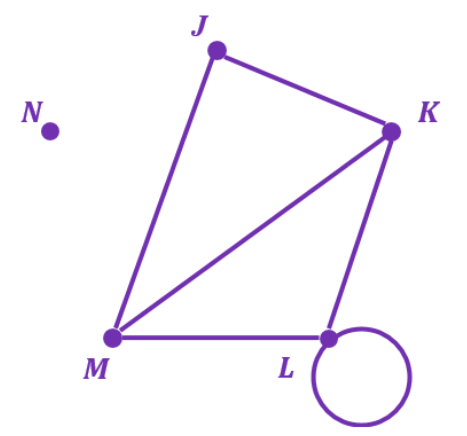
J = 2-even; K = 3-odd; L = 4-even; M = 3-odd; N = 4-even
J = 2-even; K = 3-odd; L = 4-even; M = 3-odd; N = 0-even
J = 2-even; K = 5-odd; L = 9-odd; M = 12-even; N = 0-even
J = 2-even; K = 5-odd; L = 9-odd; M = 12-even; N = 16-even
Label the degree and parity (even/odd) of each vertex on each graph.
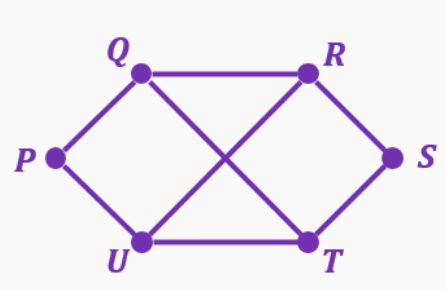
P = 2-even; Q = 3-odd; R = 3-odd; S = 2-even; T = 3-odd; U = 3-odd
P = 2-even; Q = 3-odd; R = 3-odd; S = 2-even; T = 3-odd; U = 4-even
P = 2-even; Q = 5-odd; R = 8-even; S = 10-even; T = 13-odd; U = 16-even
P = 2-even; Q = 5-odd; R = 8-even; S = 10-even; T = 13-odd; U = 17-odd
Determine which graph fits the criteria: exactly five vertices and four odd vertices.
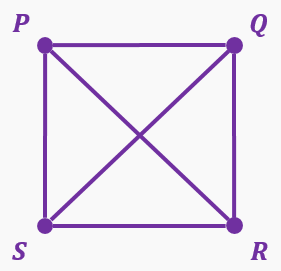
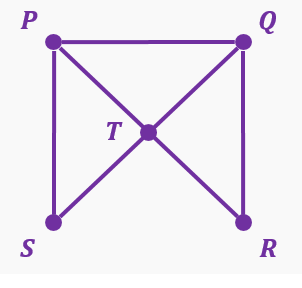
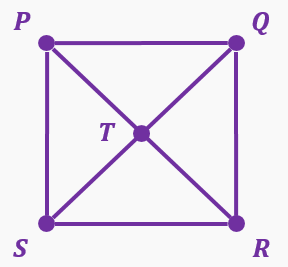
Graph is composed of vertices , and edges .
Which vertices are adjacent to vertex ?
Graph is composed of vertices , and edges .
Find the degree of vertex .
4
1
3
11
Degrees of Vertices Example 1
Degrees of Vertices Example 2
Here's what students ask on this topic:
The degree of a vertex in a graph is the number of edges connected to that vertex. To find the degree, you count all edges that have the vertex as an endpoint. This includes edges that connect the vertex to other vertices as well as loops, which are edges that start and end at the same vertex. Each loop contributes 2 to the degree because it touches the vertex twice. Understanding the degree of vertices is important in graph theory because it helps describe the structure and properties of the graph.
Loops are special edges that connect a vertex to itself. In terms of degree, a loop counts as one edge in the graph, but it adds 2 to the degree of the vertex it is attached to. This is because the loop touches the vertex twice, once at each end of the edge, even though both ends are the same vertex. So, when calculating the degree of a vertex, each loop increases the degree by 2, which is different from regular edges that increase the degree by 1.
An isolated vertex is a vertex in a graph that has no edges connected to it. Because there are no edges attached, the degree of an isolated vertex is 0. Isolated vertices are important to recognize because they do not contribute to the connectivity of the graph. They stand alone without any connections, which can affect properties like the number of odd or even vertices in the graph.
A vertex is classified as even or odd based on the parity of its degree. If the degree of the vertex is an even number, then the vertex is called an even vertex. Conversely, if the degree is an odd number, the vertex is called an odd vertex. This classification is useful in many graph theory problems, such as those involving Eulerian paths or circuits, where the number of odd vertices plays a key role.
When you have a list of edges instead of a graph diagram, you can find the degree of a vertex by counting how many edges include that vertex. Each edge that has the vertex as one of its endpoints contributes 1 to the degree. If the list includes loops (edges where both endpoints are the same vertex), count each loop as 2 towards the degree. This method allows you to determine the degree of any vertex even without a visual representation of the graph.