Euler's Theorems: Videos & Practice Problems
Euler's Theorems are used to decide whether a graph has an Euler path, an Euler circuit, or neither by checking the number of odd vertices. A vertex is odd if it has an odd number of edges connected to it, and even if it has an even number. The key idea is to find the degree of each vertex and count how many odd vertices the graph contains.
If a graph has 0 odd vertices, it has an Euler circuit; if it has exactly 2 odd vertices, it has an Euler path; and if it has more than 2 odd vertices, it has neither. In symbol form: \(0\) odd vertices \(\rightarrow\) Euler circuit, \(2\) odd vertices \(\rightarrow\) Euler path, more than \(2\) odd vertices \(\rightarrow\) neither.
When using Fleury’s algorithm to trace the path or circuit, each edge must be used exactly once. If there are 2 odd vertices, start at one of the odd vertices; if there are 0 odd vertices, start at any vertex. While tracing, avoid a bridge unless it is the last available choice.
Euler's Theorems


Determine if the graph has an Euler path (E.P.), an Euler circuit (E.C.), or neither.
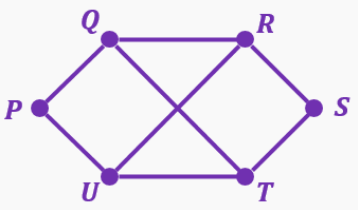
E.P.
E.C.
NEITHER
Determine if the graph has an Euler path (E.P.), an Euler circuit (E.C.), or neither.
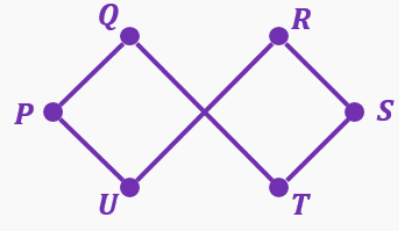
E.P.
E.C.
NEITHER
Determine if the graph has an Euler path (E.P.), an Euler circuit (E.C.), or neither.
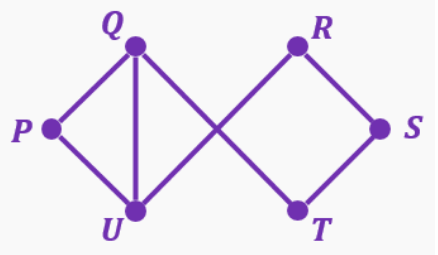
E.P.
E.C.
NEITHER
Euler's Theorems Example 1
Fleury's Algorithm
Use Fleury’s alg. to find an Euler path or circuit.
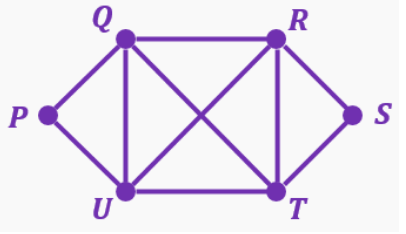
Use Fleury’s alg. to find an Euler path or circuit.
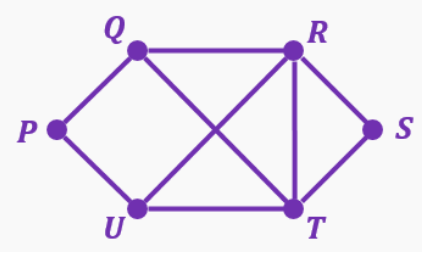
Fleury's Algorithm Example 2
Here's what students ask on this topic:
Euler's Theorem in graph theory helps us determine whether a graph contains an Euler path, an Euler circuit, or neither by analyzing the degrees of its vertices. A vertex's degree is the number of edges connected to it. The theorem states: if a graph has zero vertices with an odd degree, it contains an Euler circuit, meaning a path that starts and ends at the same vertex and uses every edge exactly once. If there are exactly two vertices with an odd degree, the graph has an Euler path, which uses every edge once but starts and ends at different vertices. If there are more than two odd vertices, the graph has neither an Euler path nor an Euler circuit. This classification is crucial for solving problems involving traversing all edges without repetition.
To identify odd and even vertices in a graph for Euler's Theorem, you first calculate the degree of each vertex, which is the count of edges connected to it. A vertex is considered odd if it has an odd number of edges, and even if it has an even number. For example, if a vertex connects to 3 edges, it is odd; if it connects to 4 edges, it is even. After determining the degree of every vertex, count how many vertices have odd degrees. This count directly informs whether the graph has an Euler path, Euler circuit, or neither, according to Euler's Theorem.
Fleury's algorithm is a method used to find Euler paths or circuits in a graph by tracing edges without repetition. The algorithm starts at a vertex: if the graph has two odd vertices, start at one of them; if none are odd, start anywhere. At each step, choose an edge to traverse, but avoid crossing a bridge (an edge whose removal would disconnect the graph) unless it is the only option left. This ensures the path or circuit uses every edge exactly once. Fleury's algorithm is practical for visualizing Euler paths and circuits and verifying their existence in a graph.
To determine if a graph has an Euler circuit using Euler's Theorem, examine the degrees of all vertices. If every vertex has an even degree (meaning the number of edges connected to each vertex is even), then the graph contains an Euler circuit. This means you can start at any vertex and traverse every edge exactly once, returning to the starting point. If even one vertex has an odd degree, the graph does not have an Euler circuit. This simple check is a quick way to identify Euler circuits without tracing the entire graph.
If a graph has exactly two odd vertices according to Euler's Theorem, it means the graph contains an Euler path but not an Euler circuit. An Euler path is a trail that uses every edge exactly once but starts and ends at different vertices. The two odd vertices are the start and end points of this path. This condition is important because it tells us that while a closed loop (Euler circuit) is not possible, a path covering all edges without repetition still exists.