Ch. 8 - Microbial Metabolism
Norman-McKay- Microbiology: Basic and Clinical Principles 2nd Edition
Norman-McKay2nd EditionMicrobiology: Basic and Clinical PrinciplesISBN: 9780137661619Not the one you use?Change textbook
Chapter 8, Problem 5

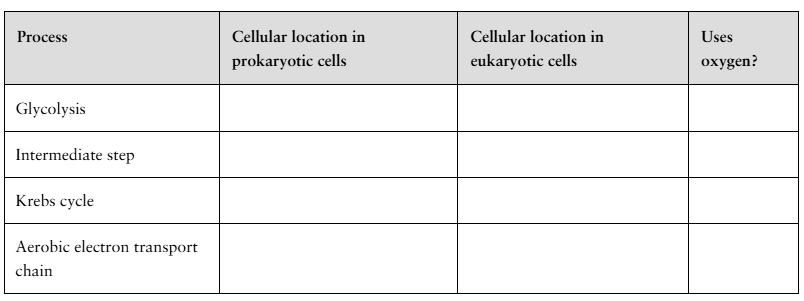
Complete the table.
Blank table with columns for process, cellular location in prokaryotic and eukaryotic cells, and oxygen use to be completed.

Verified step by step guidance
1
Identify the parameters or variables that the table requires you to complete. These might include microbial growth phases, generation time, cell counts, or other microbiological data.
Recall the relevant formulas or concepts related to microbial growth, such as the generation time formula: \(\text{Generation time} = \frac{t}{n}\), where \(t\) is the total time and \(n\) is the number of generations.
If the table involves calculating the number of cells after a certain time, use the formula for exponential growth: \(N_t = N_0 \times 2^n\), where \(N_t\) is the final number of cells, \(N_0\) is the initial number of cells, and \(n\) is the number of generations.
Calculate the number of generations \(n\) using the formula \(n = \frac{\log N_t - \log N_0}{\log 2}\) if you have initial and final cell counts.
Fill in the table by applying these formulas step-by-step for each row or column, ensuring units are consistent and calculations are accurate.

Verified video answer for a similar problem:

This video solution was recommended by our tutors as helpful for the problem above.
Video duration:
7m
Was this helpful?

Key Concepts

Here are the essential concepts you must grasp in order to answer the question correctly.

Microbial Classification and Taxonomy

Understanding how microorganisms are classified based on characteristics such as morphology, genetic makeup, and metabolic properties is essential. This helps in organizing microbes into groups like bacteria, archaea, fungi, and viruses, which is often required to complete tables summarizing their features.
Recommended video:
Guided course
02:19
Introduction to Taxonomy

Microbial Physiology and Metabolism

Knowledge of microbial metabolic pathways, energy sources, and growth requirements is crucial. This includes understanding how microbes obtain energy (e.g., aerobic vs anaerobic respiration) and nutrients, which often forms the basis for comparing different microorganisms in tables.
Recommended video:
Guided course
02:17
Introduction to Metabolism

Microscopy and Staining Techniques

Familiarity with methods used to visualize and differentiate microbes, such as Gram staining or acid-fast staining, is important. These techniques reveal structural and chemical differences that are commonly summarized in tables to distinguish microbial types.
Recommended video:
Guided course
03:46
Light Microscopy: Bright-Field Microscopes
Related Practice
Textbook Question

Why do human cells require oxygen? Select all relevant statements.

a. To carry out glycolysis

b. To carry out fermentation

c. To carry out cellular respiration

d. To oxidize fats

e. To carry out substrate-level phosphorylation

f. To carry out oxidative phosphorylation

g. To carry out photophosphorylation

1125
views
Textbook Question

The graph shows an enzyme-catalyzed reaction.

a. Draw a line that would correspond to a noncatalyzed reaction.

b. Is this an endergonic or exergonic reaction? How can you tell?

c. Label the point on your graph that corresponds with the activation energy.

1530
views
Textbook Question

Match the term to the statement (some statements may be used more than once; others may not be used at all).

1024
views
Textbook Question

Draw and then fill out a Venn diagram (see sample version here) that compares and contrasts anaerobic respiration to aerobic respiration. The middle section of the diagram is where you should list the features these processes have in common. Include as many details as possible in this diagram to make this a useful exercise.

1226
views
Textbook Question

Indicate which statements about fermentation are true, and then correct the false statements.

a. Fermentation is an anaerobic process that can be used by prokaryotic or eukaryotic cells.

b. Sugars are the only nutrients that can be fermented.

c. Fermentation is a low ATP yielding process.

d. There are only five types of fermentation: homolactic, heterolactic, alcohol, mixed acid, and butanediol fermentation.

e. Fermentation is the same as anaerobic respiration.

1142
views
Textbook Question

Indicate the true statements about ATP, and then reword the false statements so that they are true.

a. ATP is made using anabolic reactions.

b. Substrate-level phosphorylation converts ATP to ADP.

c. ATP is commonly used by cells to store energy.

d. ATP is used to jump-start cellular respiration.

e. Catabolic reactions are used to make ATP.

f. In cellular respiration, the most ATP is made by glycolysis.

g. ATP can be made by phosphorylating ADP.

1584
views