Ch 13: Newton's Theory of Gravity
Knight Calc - Physics for Scientists and Engineers 5th Edition
Knight Calc5th EditionPhysics for Scientists and EngineersISBN: 9780137344796Not the one you use?Change textbook
Chapter 13, Problem 52b

In 2000, NASA placed a satellite in orbit around an asteroid. Consider a spherical asteroid with a mass of 1.0 x 10¹⁶ kg and a radius of 8.8 km. What is the escape speed from the asteroid?

Verified step by step guidance
1
Step 1: Recall the formula for escape speed, which is derived from the conservation of energy principle. The escape speed \( v_{\text{esc}} \) is given by \( v_{\text{esc}} = \sqrt{\frac{2GM}{R}} \), where \( G \) is the gravitational constant \( 6.674 \times 10^{-11} \, \text{m}^3 \text{kg}^{-1} \text{s}^{-2} \), \( M \) is the mass of the asteroid, and \( R \) is the radius of the asteroid.
Step 2: Convert the radius of the asteroid from kilometers to meters. Since \( 1 \, \text{km} = 1000 \, \text{m} \), the radius \( R \) becomes \( 8.8 \times 10^3 \, \text{m} \).
Step 3: Substitute the given values into the escape speed formula. Use \( M = 1.0 \times 10^{16} \, \text{kg} \), \( R = 8.8 \times 10^3 \, \text{m} \), and \( G = 6.674 \times 10^{-11} \, \text{m}^3 \text{kg}^{-1} \text{s}^{-2} \). The formula becomes \( v_{\text{esc}} = \sqrt{\frac{2 \cdot (6.674 \times 10^{-11}) \cdot (1.0 \times 10^{16})}{8.8 \times 10^3}} \).
Step 4: Simplify the numerator \( 2 \cdot G \cdot M \) and the denominator \( R \) separately. This will help in organizing the calculation process.
Step 5: Take the square root of the resulting value from the division \( \frac{2GM}{R} \) to find the escape speed \( v_{\text{esc}} \). Ensure units are consistent throughout the calculation, and the final speed will be in meters per second (\( \text{m/s} \)).

Verified video answer for a similar problem:

This video solution was recommended by our tutors as helpful for the problem above.
Video duration:
3m
Was this helpful?

Key Concepts

Here are the essential concepts you must grasp in order to answer the question correctly.

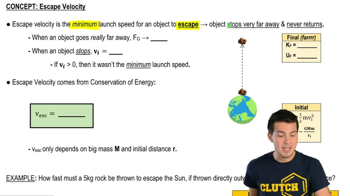
Escape Velocity

Escape velocity is the minimum speed an object must reach to break free from the gravitational pull of a celestial body without any additional propulsion. It depends on the mass of the body and the distance from its center to the point of escape, typically calculated using the formula v = √(2GM/r), where G is the gravitational constant, M is the mass of the body, and r is its radius.
Recommended video:
Guided course
7:27
Escape Velocity

Gravitational Constant

The gravitational constant (G) is a fundamental physical constant used in the calculation of gravitational forces and escape velocity. Its value is approximately 6.674 × 10⁻¹¹ N(m/kg)². This constant plays a crucial role in determining the strength of the gravitational attraction between two masses, influencing how quickly an object can escape a celestial body's gravity.
Recommended video:
Guided course
08:59
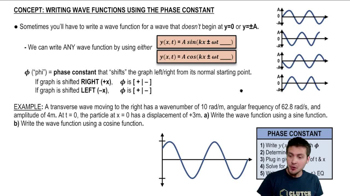
Phase Constant of a Wave Function

Mass and Radius of Celestial Bodies

The mass and radius of a celestial body, such as an asteroid, are critical parameters in calculating escape velocity. The mass determines the strength of the gravitational field, while the radius affects the distance from the center of mass to the surface. In this case, the asteroid's mass is 1.0 x 10¹⁶ kg and its radius is 8.8 km, both of which are essential for applying the escape velocity formula.
Recommended video:
Guided course
08:42
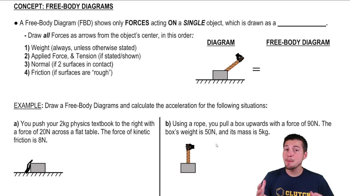
Free-Body Diagrams
Related Practice
Textbook Question

In 2014, the European Space Agency placed a satellite in orbit around comet 67P/Churyumov-Gerasimenko and then landed a probe on the surface. The actual orbit was elliptical, but we’ll approximate it as a 50-km-diameter circular orbit with a period of 11 days. What is the mass of the comet?

1056
views
Textbook Question

A 4000 kg lunar lander is in orbit 50 km above the surface of the moon. It needs to move out to a 300-km-high orbit in order to link up with the mother ship that will take the astronauts home. How much work must the thrusters do?

1128
views
Textbook Question

Large stars can explode as they finish burning their nuclear fuel, causing a supernova. The explosion blows away the outer layers of the star. According to Newton’s third law, the forces that push the outer layers away have reaction forces that are inwardly directed on the core of the star. These forces compress the core and can cause the core to undergo a gravitational collapse. The gravitational forces keep pulling all the matter together tighter and tighter, crushing atoms out of existence. Under these extreme conditions, a proton and an electron can be squeezed together to form a neutron. If the collapse is halted when the neutrons all come into contact with each other, the result is an object called a neutron star, an entire star consisting of solid nuclear matter. Many neutron stars rotate about their axis with a period of ≈ 1 s and, as they do so, send out a pulse of electromagnetic waves once a second. These stars were discovered in the 1960s and are called pulsars. How many revolutions per minute are made by a satellite orbiting 1.0 km above the surface?

968
views
Textbook Question

FIGURE P13.57 shows two planets of mass m orbiting a star of mass M. The planets are in the same orbit, with radius r, but are always at opposite ends of a diameter. Find an exact expression for the orbital period T. Hint: Each planet feels two forces.

1166
views
Textbook Question

A starship is circling a distant planet of radius R. The astronauts find that the free-fall acceleration at their altitude is half the value at the planet's surface. How far above the surface are they orbiting? Your answer will be a multiple of R.

1275
views
Textbook Question

The 75,000 kg space shuttle used to fly in a 250-km-high circular orbit. It needed to reach a 610-km-high circular orbit to service the Hubble Space Telescope. How much energy was required to boost it to the new orbit?

1362
views