A capacitor has a peak current of 330 μA when the peak voltage at 250 kHz is 2.2 V. What is the capacitance?
Ch 32: AC Circuits
Knight Calc5th EditionPhysics for Scientists and EngineersISBN: 9780137344796Not the one you use?Change textbook
Chapter 32, Problem 15
A high-pass RC filter with a crossover frequency of 1000 Hz uses a 100 Ω resistor. What is the value of the capacitor?
Verified step by step guidance1
Understand the problem: A high-pass RC filter is a circuit that allows signals with frequencies higher than the crossover frequency to pass through while attenuating lower frequencies. The crossover frequency (f_c) is given as 1000 Hz, and the resistor (R) has a value of 100 Ω. We need to find the capacitance (C).
Recall the formula for the crossover frequency of an RC circuit: . Rearrange this formula to solve for the capacitance (C): .
Substitute the given values into the formula: . Ensure that the units are consistent (resistance in ohms, frequency in hertz).
Simplify the denominator: Calculate the product of . This will give the value of the denominator in the capacitance formula.
Finally, compute the capacitance (C) by dividing 1 by the result of the denominator. The unit of capacitance will be in farads (F). If needed, convert the result to microfarads (μF) for practical use by multiplying by .

Verified video answer for a similar problem:
This video solution was recommended by our tutors as helpful for the problem above.
Was this helpful?
Key Concepts
Here are the essential concepts you must grasp in order to answer the question correctly.
High-Pass RC Filter
A high-pass RC filter is an electronic circuit that allows signals with a frequency higher than a certain cutoff frequency to pass through while attenuating signals with lower frequencies. It consists of a resistor (R) and a capacitor (C) arranged in a specific configuration. The cutoff frequency is determined by the values of R and C, and it is the frequency at which the output signal is reduced to 70.7% of the input signal.
Recommended video:
Guided course
Example 1
Crossover Frequency
The crossover frequency, also known as the cutoff frequency, is the frequency at which the output voltage of the filter is equal to 70.7% of the input voltage. For a high-pass filter, frequencies above this point are allowed to pass, while those below are attenuated. It is calculated using the formula f_c = 1/(2πRC), where f_c is the crossover frequency, R is the resistance, and C is the capacitance.
Recommended video:
Guided course
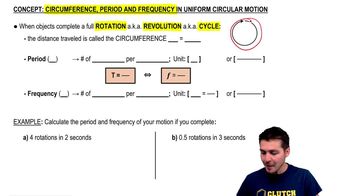
Circumference, Period, and Frequency in UCM
Capacitance Calculation
To find the value of the capacitor in an RC circuit, you can rearrange the formula for the crossover frequency. Given the crossover frequency (f_c) and the resistance (R), the capacitance (C) can be calculated using C = 1/(2πf_cR). This relationship shows how the capacitor's value directly influences the filter's behavior and its ability to pass or block certain frequencies.
Recommended video:
Guided course
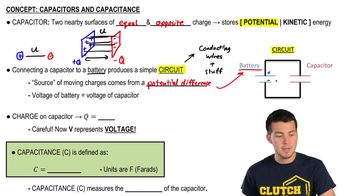
Capacitors & Capacitance (Intro)
Related Practice
Textbook Question
153
views
Textbook Question
A high-pass RC filter is connected to an AC source with a peak voltage of 10.0 V. The peak capacitor voltage is 6.0 V. What is the peak resistor voltage?
137
views
Textbook Question
A low-pass filter consists of a 100 μF capacitor in series with a 159 Ω resistor. The circuit is driven by an AC source with a peak voltage of 5.00 V. What is the crossover frequency fc?
138
views
Textbook Question
A 20 nF capacitor is connected across an AC generator that produces a peak voltage of 5.0 V. What is the instantaneous value of the emf at the instant when iC = IC?
161
views
Textbook Question
A capacitor has a peak current of 330 μA when the peak voltage at 250 kHz is 2.2 V. If the peak voltage is held constant, what is the peak current at 500 kHz?
169
views
Textbook Question
What are VR and VC if the emf frequency in FIGURE EX32.19 is 2.5 kHz?
127
views