
What is the difference between temporal summation and spatial summation?
Verified step by step guidance
1
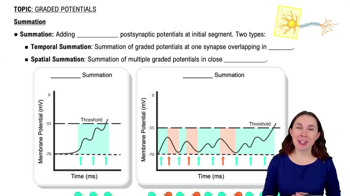
Step 1: Understand that both temporal summation and spatial summation are mechanisms by which neurons integrate incoming signals to generate an action potential.
Step 2: Temporal summation occurs when a single presynaptic neuron fires multiple action potentials in rapid succession, causing the postsynaptic potentials to add up over time at the same synapse.
Step 3: Spatial summation happens when multiple presynaptic neurons fire simultaneously at different synapses on the same postsynaptic neuron, and their postsynaptic potentials combine to influence the membrane potential.
Step 4: Recognize that temporal summation depends on the timing of signals from one neuron, while spatial summation depends on the number and location of inputs from multiple neurons.
Step 5: Summarize that temporal summation is about rapid repeated stimulation from one source, whereas spatial summation is about simultaneous stimulation from multiple sources.
Verified video answer for a similar problem:
This video solution was recommended by our tutors as helpful for the problem above
Play a video:
0 Comments
Key Concepts
Here are the essential concepts you must grasp in order to answer the question correctly.
Temporal Summation
Temporal summation refers to the process where multiple action potentials arrive at a single synapse in rapid succession, causing the postsynaptic potentials to add up over time. This can increase the likelihood of reaching the threshold for an action potential in the postsynaptic neuron.
Spatial summation occurs when multiple presynaptic neurons release neurotransmitters simultaneously at different locations on the postsynaptic neuron. The combined effect of these inputs can depolarize the postsynaptic membrane enough to trigger an action potential.
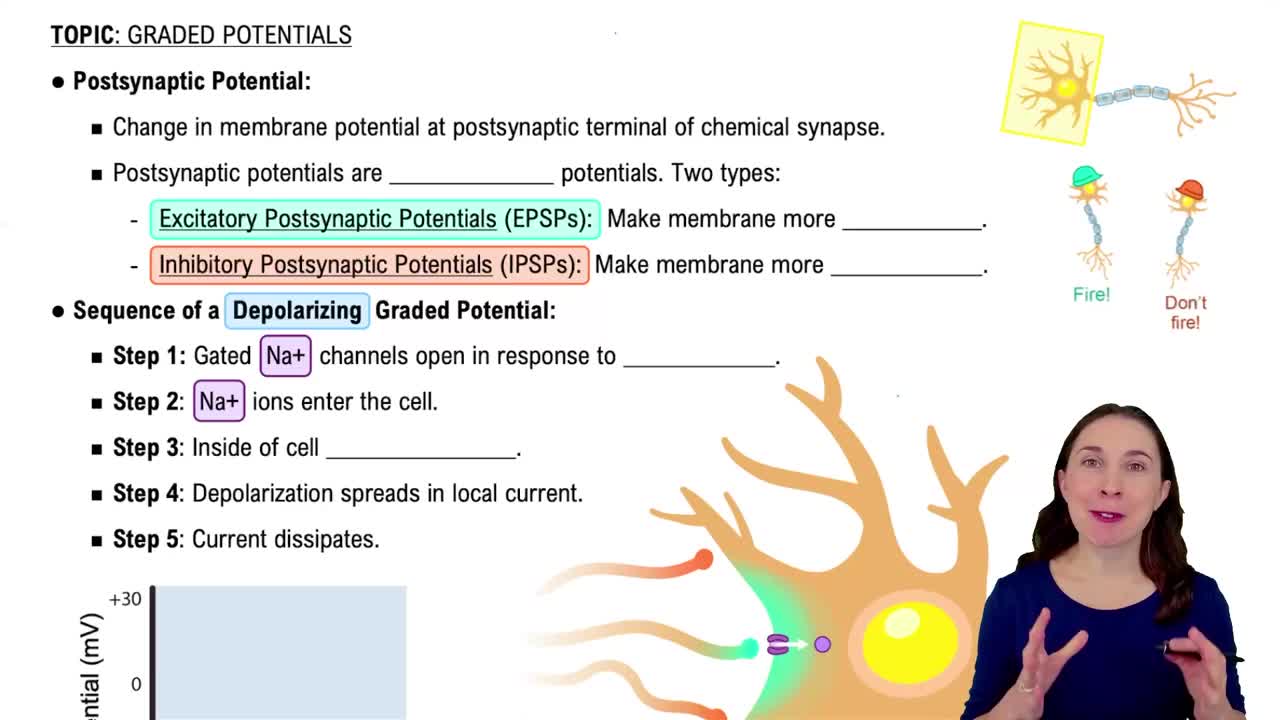
Postsynaptic potential integration is the process by which a neuron combines excitatory and inhibitory inputs over time and space. Understanding how temporal and spatial summation contribute to this integration is essential for grasping how neurons decide to fire or not.