Ch. 21 Blood Vessels and Circulation
Martini - Fundamentals of Anatomy & Physiology 11th Edition
Martini, Nath, Bartholomew11th EditionFundamentals of Anatomy & PhysiologyISBN: 9780136874089Not the one you use?Change textbook
Chapter 21, Problem 23

Why do capillaries permit the diffusion of materials, whereas arteries and veins do not?

Verified step by step guidance
1
Understand the structural differences between capillaries, arteries, and veins. Capillaries have very thin walls composed of a single layer of endothelial cells, while arteries and veins have thicker walls with multiple layers including smooth muscle and connective tissue.
Recognize that the thin walls of capillaries reduce the diffusion distance for substances such as oxygen, nutrients, and waste products, facilitating efficient exchange between blood and surrounding tissues.
Consider the presence of pores or fenestrations in some capillaries, which further enhance permeability and allow certain molecules to pass through more easily.
Note that arteries and veins have thicker walls designed to withstand higher pressure and maintain blood flow, which limits their permeability and prevents easy diffusion of materials.
Summarize that the unique structure of capillaries—thin walls and sometimes fenestrations—enables diffusion, whereas the thicker, more robust walls of arteries and veins restrict this process.

Verified video answer for a similar problem:

This video solution was recommended by our tutors as helpful for the problem above.
Was this helpful?

Key Concepts

Here are the essential concepts you must grasp in order to answer the question correctly.

Structure of Capillaries

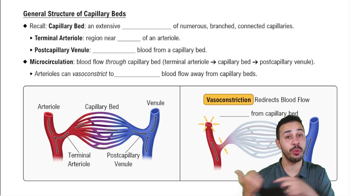
Capillaries are the smallest blood vessels with very thin walls composed of a single layer of endothelial cells. This thin structure allows substances like oxygen, nutrients, and waste products to easily diffuse through their walls into surrounding tissues.
Recommended video:
5:59
General Structure of Capillary Beds

Differences Between Arteries, Veins, and Capillaries

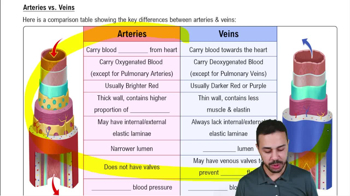
Arteries and veins have thicker walls made of multiple layers including smooth muscle and connective tissue, which provide strength and elasticity but limit permeability. In contrast, capillaries lack these thick layers, making them more permeable to small molecules.
Recommended video:
7:42
Arteries vs. Veins

Diffusion and Permeability in Blood Vessels

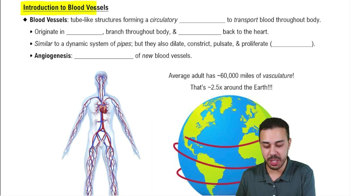
Diffusion is the passive movement of molecules from high to low concentration. Capillaries' thin walls and small diameter facilitate efficient diffusion of gases and nutrients, whereas the thicker walls of arteries and veins restrict this process, preventing direct exchange with tissues.
Recommended video:
4:59
Blood Vessels