Ch. 6 Bones and Bone Structure
Martini - Fundamentals of Anatomy & Physiology 11th Edition
Martini, Nath, Bartholomew11th EditionFundamentals of Anatomy & PhysiologyISBN: 9780136874089Not the one you use?Change textbook
Chapter 6, Problem 16b

What hormonal factors are necessary for normal bone growth and maintenance?

Verified step by step guidance
1
Understand that bone growth and maintenance are regulated by a combination of hormones that influence osteoblast and osteoclast activity, calcium homeostasis, and overall bone remodeling.
Identify the key hormones involved: Growth hormone (GH), which stimulates bone growth by promoting the activity of osteoblasts; Thyroid hormones, which regulate the metabolic rate and influence bone development; and Sex hormones (estrogen and testosterone), which are critical for the growth spurt during puberty and maintenance of bone density.
Recognize the role of parathyroid hormone (PTH) and calcitonin in calcium homeostasis. PTH increases blood calcium levels by stimulating osteoclast activity, while calcitonin lowers blood calcium levels by inhibiting osteoclasts and promoting calcium deposition in bones.
Include the importance of vitamin D, which is converted into its active form (calcitriol) and facilitates calcium absorption in the intestines, ensuring adequate calcium availability for bone mineralization.
Summarize how these hormones work together to maintain a balance between bone formation and resorption, ensuring healthy bone growth and structural integrity throughout life.

Verified video answer for a similar problem:

This video solution was recommended by our tutors as helpful for the problem above.
Video duration:
2m
Was this helpful?

Key Concepts

Here are the essential concepts you must grasp in order to answer the question correctly.

Growth Hormone

Growth hormone (GH), produced by the pituitary gland, plays a crucial role in bone growth by stimulating the proliferation of chondrocytes in the growth plates of bones. It promotes the synthesis of insulin-like growth factor 1 (IGF-1), which further enhances bone formation and mineralization, contributing to overall skeletal development.
Recommended video:
Guided course
4:31
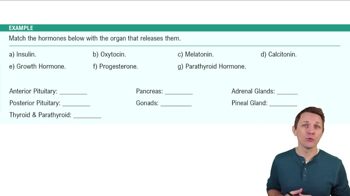
Hormone Review Table Example 1

Calcitonin and Parathyroid Hormone

Calcitonin, secreted by the thyroid gland, helps lower blood calcium levels by inhibiting osteoclast activity, which reduces bone resorption. In contrast, parathyroid hormone (PTH) increases blood calcium levels by stimulating osteoclasts and promoting calcium reabsorption in the kidneys, thus maintaining calcium homeostasis essential for bone health.
Recommended video:
Guided course
4:31
Hormone Review Table Example 1

Vitamin D

Vitamin D is vital for bone health as it enhances the intestinal absorption of calcium and phosphate, which are critical for bone mineralization. It also influences the activity of osteoblasts and osteoclasts, ensuring a balanced remodeling process that supports both bone growth and maintenance throughout life.