
Pearson+ LogoPearson+ Logo
Ch. 52 - Community Ecology
Freeman - Biological Science 8th Edition
Freeman8th EditionBiological ScienceISBN: 9780138276263Not the one you use?Change textbook
Chapter 52, Problem 6

Evaluate this statement: Species want to increase their fitness by helping friendly species and hurting enemy species.

Verified step by step guidance
1
Identify the key terms: 'fitness' refers to an organism's ability to survive and reproduce, passing on its genes to the next generation. 'Friendly species' and 'enemy species' imply interactions between different species, which can be mutualistic, competitive, or antagonistic.
Clarify misconceptions: The statement anthropomorphizes species by suggesting they have desires ('want') and can categorize other species as 'friendly' or 'enemy'. In reality, species do not have intentions or emotions; they behave in ways that have evolved to maximize their survival and reproductive success.
Examine interspecies interactions: Mutualism (where both species benefit) can indeed increase a species' fitness. However, the relationship is not based on 'friendliness' but on reciprocal benefits that enhance survival and reproduction for both species involved.
Consider the impact of harming other species: While competition or antagonism (where one species benefits at the expense of another) can sometimes increase a species' fitness, it is not a matter of 'wanting' to hurt 'enemy' species. These interactions are driven by resource competition, not malice or intent.
Conclude with evolutionary perspective: Species evolve traits and behaviors that maximize their fitness in a given environment. Interactions with other species, whether beneficial or harmful, are outcomes of evolutionary pressures and ecological dynamics, not deliberate strategies or emotional decisions.

Verified video answer for a similar problem:

This video solution was recommended by our tutors as helpful for the problem above.
Video duration:
48s
Was this helpful?

Key Concepts

Here are the essential concepts you must grasp in order to answer the question correctly.

Fitness in Evolutionary Biology

Fitness refers to an organism's ability to survive and reproduce in its environment. It encompasses not just the number of offspring produced, but also how well those offspring can survive and reproduce themselves. In evolutionary terms, higher fitness means a greater contribution to the gene pool of future generations.
Recommended video:
02:45
History of Evolutionary Theory Example 1

Mutualism and Competition

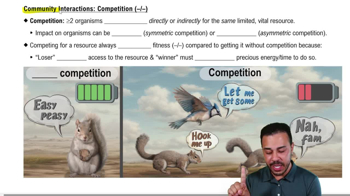
Mutualism is a type of symbiotic relationship where two species benefit from each other, enhancing their fitness. In contrast, competition occurs when species vie for the same resources, which can lead to one species harming another. Understanding these interactions is crucial for evaluating how species may help or hurt each other in their quest for increased fitness.
Recommended video:
Guided course
02:13
Community Interactions: Competition (-/-)

Altruism and Kin Selection

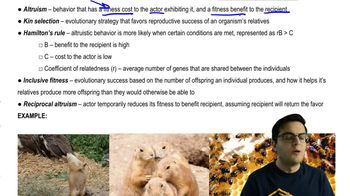
Altruism in biology refers to behaviors that benefit other individuals at a cost to oneself. Kin selection is a form of altruism where individuals help relatives, thereby increasing the survival of shared genes. This concept is essential for understanding how helping friendly species can be a strategy for enhancing overall fitness in a social context.
Recommended video:
Guided course
07:15
Migration and Altruism