Pearson+ LogoPearson+ Logo
Ch. 52 - Community Ecology
Freeman - Biological Science 8th Edition
Freeman8th EditionBiological ScienceISBN: 9780138276263Not the one you use?Change textbook
Chapter 52, Problem 4

Pioneer species tend to have high ________ and lower survivorship.

Verified step by step guidance
1
Understand the concept of pioneer species: Pioneer species are the first organisms to colonize a barren or disturbed ecosystem. They play a crucial role in ecological succession by preparing the environment for subsequent species.
Identify the characteristics of pioneer species: These species often have traits such as rapid growth, high reproductive rates, and the ability to thrive in harsh conditions. They are typically opportunistic and can quickly establish themselves in new areas.
Explore the concept of high reproductive rates: Pioneer species tend to produce a large number of offspring to increase the chances of survival in unpredictable environments. This is often referred to as having high fecundity.
Examine the concept of lower survivorship: Despite their high reproductive rates, individual pioneer species may have lower survivorship due to the challenging conditions they face. This means that while many offspring are produced, fewer survive to adulthood.
Connect these concepts to ecological succession: Pioneer species initiate the process of ecological succession, gradually altering the environment to make it more suitable for other species, which often have higher survivorship and lower reproductive rates.

Verified video answer for a similar problem:

This video solution was recommended by our tutors as helpful for the problem above.
Video duration:
2m
Was this helpful?

Key Concepts

Here are the essential concepts you must grasp in order to answer the question correctly.

Pioneer Species

Pioneer species are the first organisms to colonize barren or disturbed environments, initiating ecological succession. They are typically hardy and adaptable, capable of surviving in harsh conditions with minimal resources. Their presence helps modify the environment, making it more suitable for subsequent species.
Recommended video:
03:24
Biological Species Concept

Ecological Succession

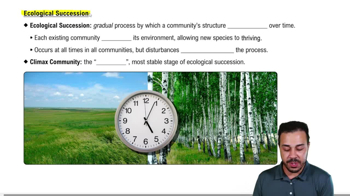
Ecological succession is the process by which the structure of a biological community evolves over time. It begins with pioneer species and progresses through various stages until a stable climax community is established. This process involves changes in species composition, diversity, and ecosystem structure.
Recommended video:
Guided course
02:59
Ecological Succession

Survivorship

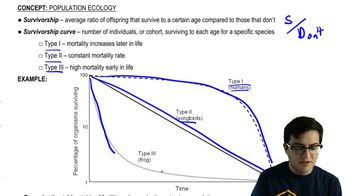
Survivorship refers to the proportion of individuals in a population that survive to a particular age. In the context of pioneer species, they often exhibit lower survivorship due to their strategy of producing many offspring with the expectation that only a few will survive in the harsh initial conditions of a new environment.
Recommended video: